Self-host Plausible Analytics
Cookie-free Google Analytics alternative, with the stats on your own VM.
Shelley handles the setup. About 15 minutes.
Prefer a terminal?
curl -fsSL https://exe.dev/deploy/plausible/prompt.txt | ssh exe.dev new --prompt=/dev/stdinPlausible shows the numbers most sites need on one page: visitors, pageviews, where people came from, what they read, and the goals you care about, without cookies or personal data. Community Edition is the same code as Plausible's cloud service, minus a few paid features, and its analytics repository has nearly 30,000 stars on GitHub. Self-hosted, it is Plausible, PostgreSQL and ClickHouse in Docker Compose, so it wants a real machine with memory and disk to spare. An exe.dev VM is that, with HTTPS already done.
Visitors' browsers need to reach the tracker, so that part is public. The dashboard isn't: it sits on port 3000, which only you and the people you share the VM with can open, and Plausible asks for its own password too. Shelley can set it up, back it up, mail you a weekly summary, and answer "how did last week go?" from your numbers.
What you get#
- Plausible CE 3.2.1 with ClickHouse and PostgreSQL, restarted after a reboot.
- A private dashboard on port 3000, where you create the first account.
- A public address that serves only the tracker script and event endpoint.
- Nightly backups of both databases and the secrets, kept two weeks.
What's running, and where
https://my-plausible.exe.xyz:3000/
The Plausible dashboard, behind exe.dev login and Plausible's own
https://my-plausible.exe.xyz/js/
The tracker script and its event endpoint, once you make the VM public
Deploy with Shelley#
Click Deploy and Shelley will set up Plausible on a new VM, then check that it works. No config-file wrangling required.
Prefer a terminal?
curl -fsSL \
  https://exe.dev/deploy/plausible/prompt.txt \
  | ssh exe.dev new --prompt=/dev/stdin
When it's done, run this on your computer (only you can):
ssh exe.dev share set-public my-plausible # lets visitors' browsers reach the trackerWhat Shelley is told
Set up Plausible on this VM by following the exe.dev recipe at https://exe.dev/deploy/plausible.md?via=deploy from top to bottom.

The recipe's example VM name is my-plausible. This VM's name is the output of `hostname`: use it wherever the recipe writes my-plausible. Skip the step that creates the VM; you are on it.

You are done when all of these are true. Check each one yourself:
- Plausible CE 3.2.1 with ClickHouse and PostgreSQL, restarted after a reboot.
- A private dashboard on port 3000, where you create the first account.
- A public address that serves only the tracker script and event endpoint.
- Nightly backups of both databases and the secrets, kept two weeks.

Read the whole recipe, including closed details, and follow "Install by
hand" first, skipping VM creation and SSH. The opening walkthrough is
for the owner afterwards. Do not run Restore or Update.
Work as exedev in ~/plausible. Never overwrite an existing
~/plausible/.env. Do not register a Plausible account, add sites, or set
up email: the owner creates the first account in the browser, and the
first account to register becomes the owner. Leave public sharing off;
only the owner can turn it on. Verify docker.service is enabled, all
four containers are running, localhost:3000/api/system/health/ready
reports every check "ok", localhost:8000/js/script.js returns 200,
localhost:8000/login returns a 302 to port 3000, and the backup timer is
enabled with a .dump and a .zip in ~/plausible/backups. Finish with the
sign-up URL, https://<vm>.exe.xyz:3000/register, and the command the
owner runs on their own computer to make the tracker public:
ssh exe.dev share set-public <vm>

Finish with the URLs I should open and these commands, which only I can run, from my own computer (with this VM's name in them):
  ssh exe.dev share set-public my-plausible   # lets visitors' browsers reach the tracker
Also at /deploy/plausible/prompt.txt. The recipe it follows is /deploy/plausible.md.
Make your account and add your site#
Open https://my-plausible.exe.xyz:3000/register, the address Shelley
gives you. After exe.dev login you'll see Plausible's sign-up form.
- Register with your name, email and a strong password. The first account becomes the instance's owner. Plausible doesn't email you to confirm it.
- Enter your site's domain (
example.com, nohttps://) and time zone, then Install Plausible. - On the installation page, choose what else to count under Optional measurements (outbound links and file downloads are on; form submissions, 404 pages and more are a tick away), then copy the snippet.
The snippet already points at the VM's public address, not port 3000:
<!-- Privacy-friendly analytics by Plausible -->
<script async src="https://my-plausible.exe.xyz/js/pa-AbCdEf123.js"></script>
<script>
  window.plausible=window.plausible||function(){(plausible.q=plausible.q||[]).push(arguments)},plausible.init=plausible.init||function(i){plausible.o=i||{}};
  plausible.init()
</script>
The pa-… name is your site's own script; it carries the options you
ticked, so come back for a new copy if you change them.
Tip
Turn on two-factor authentication under Settings → Security.
Make the tracker public#
Until now everything on the VM has been private. On your computer:
ssh exe.dev share set-public my-plausible
That opens https://my-plausible.exe.xyz/, and only the tracker behind
it. The HTTPS proxy keeps port 3000 private, and the
tracker proxy on port 8000 answers just the tracker scripts and the
endpoint they report to. Everything else redirects to port 3000, so links
in Plausible's emails still work for you. Check from your computer:
curl -sI https://my-plausible.exe.xyz/js/script.js | head -1   # HTTP/2 200
curl -sI https://my-plausible.exe.xyz/login | grep -i location  # ...exe.xyz:3000/login
That matters: in May 2026 Plausible fixed a remote code execution hole in an endpoint CE 3.0 to 3.2.0 exposed. Behind this proxy, the internet never reached it.
Add the script to your site#
Put the snippet in the <head> of every page and load one. Click
Verify Script installation: Plausible waits for that first pageview,
then opens your dashboard.
- Plain HTML or a static site generator: paste it into the shared head template.
- Next.js, React and other single-page apps: paste it into the root
layout's
<head>. Plausible follows client-side navigation itself. - WordPress: use the installation page's WordPress tab, or a header-scripts plugin.
To count a signup, call plausible('Signup') from your code, or give
the button the class plausible-event-name=Signup. Then add Signup
under Site settings → Goals so it gets its own report. To leave
your own visits out, run localStorage.plausible_ignore = 'true' in the
browser console on your site, or add your address under Site settings
→ Shields → IP addresses.
Nothing showing up? Open the browser's developer tools on your site: the
Network tab should show the pa-…js script and a 202 from
/api/event. A blocked request usually means an ad blocker. Plausible
also ignores localhost, and automated browsers.
Proxy it through your site#
Ad blockers know the addresses of analytics services. Serving the
script and endpoint from your own site, as
Plausible recommends,
counts those visitors too. If your site runs on nginx (on exe.dev or
anywhere), add two locations, with your own pa-… name:
location = /js/script.js {
    proxy_pass https://my-plausible.exe.xyz/js/pa-AbCdEf123.js;
    proxy_ssl_server_name on;
    proxy_set_header Host my-plausible.exe.xyz;
}
location = /api/event {
    proxy_pass https://my-plausible.exe.xyz/api/event;
    proxy_ssl_server_name on;
    proxy_set_header Host my-plausible.exe.xyz;
    proxy_set_header X-Forwarded-For $proxy_add_x_forwarded_for;
}
Then load the script from your own site and tell it where to report:
<script async src="/js/script.js"></script>
<script>
  window.plausible=window.plausible||function(){(plausible.q=plausible.q||[]).push(arguments)},plausible.init=plausible.init||function(i){plausible.o=i||{}};
  plausible.init({endpoint: "/api/event"})
</script>
The X-Forwarded-For line passes on the visitor's address. Without it,
Plausible sees every visit come from your server and quietly drops
them as bots. Plausible's docs have the same for
Caddy, Cloudflare, Netlify, Vercel and more.
Or give the tracker a hostname of your own: add
stats.example.com CNAME my-plausible.exe.xyz at your DNS provider, run
ssh exe.dev domain add my-plausible stats.example.com on your computer,
load the script from https://stats.example.com/js/pa-AbCdEf123.js, and
call plausible.init({endpoint: "https://stats.example.com/api/event"}).
Keep BASE_URL as it is: the dashboard stays on
my-plausible.exe.xyz:3000. More in custom domains.
Bring your team#
The dashboard is private to you until you share the VM. On your computer:
ssh exe.dev share add my-plausible alice@example.com   # one person
ssh exe.dev share add my-plausible team                # your exe.dev team
They sign in to exe.dev and make their own account at
https://my-plausible.exe.xyz:3000/register. Only people you've shared
the VM with can reach that page. Then invite their email under Site
settings → People as a guest viewer or editor. No email is needed: the
invitation waits on their Sites page, marked Pending invitation,
until they click it and Accept and continue.
For a read-only view without an account, add a link under Site settings → Visibility → Shared links. It opens on port 3000 too, so it still needs exe.dev login. See sharing.
Weekly email from the VM#
Plausible's own weekly reports need an email provider (next section). Without one, a small script can send you the numbers through exe.dev's email gateway, which mails you and people you share the VM with. From our test VM:
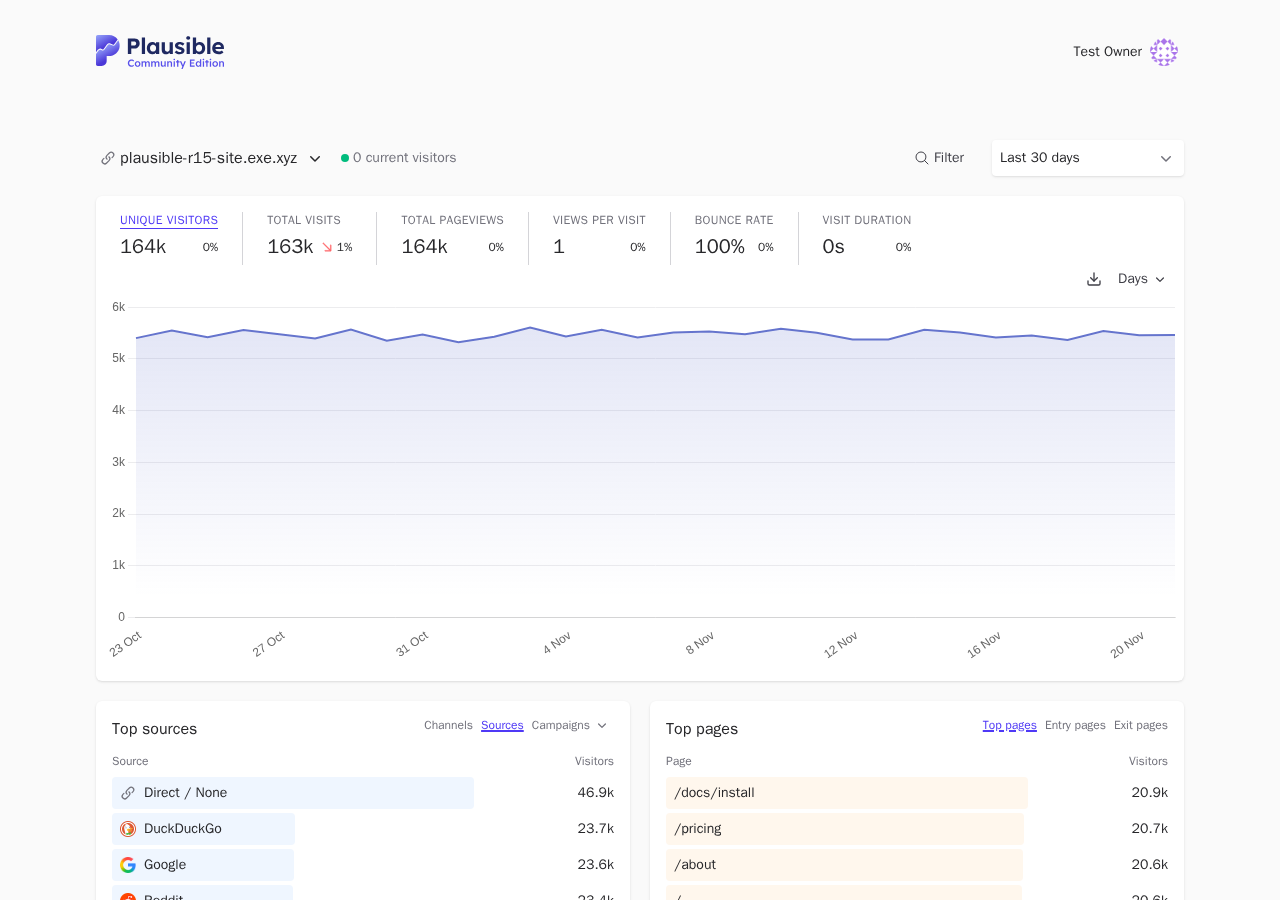
example.com, 2026-11-15 to 2026-11-21
  visitors: 38202 (-1%)
  pageviews: 38205 (-1%)
  bounce rate: ...
  Top pages:
       4885  /
       4879  /docs/install
       ...
  Top sources:
      11084  Direct / None
       5598  Google
       ...
In Plausible, open Settings → API keys, create a key, and ask Shelley: "Set up the weekly Plausible email from the recipe, with this API key, to me, for example.com."
Set it up by hand
On the VM, put your key, address and sites in a private file:
cd ~/plausible
(umask 077; cat > report.env <<'EOF'
PLAUSIBLE_API_KEY=paste-your-key-here
REPORT_TO=you@example.com
SITES=example.com
EOF
)
The script asks the Stats API on port 3000 for last week and the week before, and mails the result:
cat > ~/plausible/weekly-email.py <<'EOF'
#!/usr/bin/env python3
"""Email last week's Plausible numbers through exe.dev's email gateway."""
import datetime, json, os, urllib.request

env = {}
for line in open(os.path.expanduser("~/plausible/report.env")):
    if "=" in line and not line.startswith("#"):
        k, v = line.strip().split("=", 1)
        env[k] = v

def post(url, body, headers={}):
    req = urllib.request.Request(url, data=json.dumps(body).encode(),
        headers={"Content-Type": "application/json", **headers})
    with urllib.request.urlopen(req, timeout=60) as r:
        return json.load(r)

def query(site, dates, metrics, dimensions=[], limit=5):
    return post("http://localhost:3000/api/v2/query",
        {"site_id": site, "metrics": metrics, "date_range": dates,
         "dimensions": dimensions, "pagination": {"limit": limit}},
        {"Authorization": "Bearer " + env["PLAUSIBLE_API_KEY"]})["results"]

end = datetime.date.today() - datetime.timedelta(days=1)
week = [str(end - datetime.timedelta(days=6)), str(end)]
before = [str(end - datetime.timedelta(days=13)), str(end - datetime.timedelta(days=7))]
names = ["visitors", "pageviews", "bounce_rate", "visit_duration"]
units = {"bounce_rate": "%", "visit_duration": " s"}
out = []
for site in env["SITES"].split(","):
    now = query(site, week, names)[0]["metrics"]
    prev = query(site, before, names)[0]["metrics"]
    out.append(f"{site}, {week[0]} to {week[1]}")
    for name, a, b in zip(names, now, prev):
        change = f" ({(a - b) / b:+.0%})" if b else ""
        out.append(f"  {name.replace('_', ' ')}: {a}{units.get(name, '')}{change}")
    for dim, title in [("event:page", "Top pages"), ("visit:source", "Top sources")]:
        out.append(f"  {title}:")
        for row in query(site, week, ["visitors"], [dim]):
            out.append(f"    {row['metrics'][0]:>7}  {row['dimensions'][0]}")
    out.append("")
out.append(f"Dashboard: https://{os.uname().nodename}.exe.xyz:3000/")

post("http://169.254.169.254/gateway/email/send",
     {"to": env["REPORT_TO"], "subject": f"Plausible: week ending {week[1]}",
      "body": "\n".join(out)})
print("sent to", env["REPORT_TO"])
EOF
chmod +x ~/plausible/weekly-email.py
~/plausible/weekly-email.py
It prints sent to you@example.com. Send it every Monday morning:
sudo tee /etc/systemd/system/plausible-weekly.service >/dev/null <<'EOF'
[Unit]
Description=Email the weekly Plausible summary

[Service]
Type=oneshot
User=exedev
ExecStart=/home/exedev/plausible/weekly-email.py
EOF
sudo tee /etc/systemd/system/plausible-weekly.timer >/dev/null <<'EOF'
[Unit]
Description=Weekly Plausible summary

[Timer]
OnCalendar=Mon 08:00
Persistent=true

[Install]
WantedBy=timers.target
EOF
sudo systemctl daemon-reload
sudo systemctl enable --now plausible-weekly.timer
systemctl list-timers plausible-weekly.timer
Ask Shelley about your traffic#
Shelley on the VM can query the same Stats API with that key, so your numbers never leave the machine. Ask "Which pages got the most visitors last month?" or "Where did Tuesday's spike come from?"
Scripts on your own computer can reach it too, with an exe.dev API token for the VM in front of the Plausible key. On your computer:
ssh exe.dev ssh-key generate-api-key --vm=my-plausible --label=stats
It prints a token starting with exe1.; keep it in a file only you can
read, such as ~/.plausible-vm-token with chmod 600, and the Plausible
key in ~/.plausible-key:
curl https://my-plausible.exe.xyz:3000/api/v2/query \
  -H "X-Exedev-Authorization: Bearer $(cat ~/.plausible-vm-token)" \
  -H "Authorization: Bearer $(cat ~/.plausible-key)" \
  -H 'Content-Type: application/json' \
  -d '{"site_id":"example.com","metrics":["visitors","pageviews"],"date_range":"7d"}'
Email (optional)#
Out of the box this setup sends no email. Plausible uses it for password
resets, invitations, weekly and monthly reports, and traffic spike
alerts. Give it an SMTP account from your provider (Postmark, Mailgun,
Amazon SES, Fastmail, Gmail with an app password): ask Shelley to replace
the MAILER_ADAPTER line in ~/plausible/.env with these and restart:
MAILER_ADAPTER=Bamboo.Mua
MAILER_EMAIL=plausible@example.com
MAILER_NAME=Plausible
SMTP_HOST_ADDR=smtp.example.com
SMTP_HOST_PORT=587
SMTP_USER_NAME=...
SMTP_USER_PWD=...
Then docker compose up -d in ~/plausible, and try Forgot
password? on the login page. Links in the emails use the public address
and redirect to port 3000. Use port 465 if your provider wants SSL from
the start. The configuration page
lists Postmark, Mailgun and other API adapters.
Privacy#
Plausible is built to need no personal data, but the details matter:
- No cookies. The tracker stores nothing in the browser.
- No IP addresses kept. Plausible counts a visitor with a hash of the IP address, browser, site and a salt that it replaces every day, so the same person tomorrow is a new visitor. The address is used to look up the country, with a database bundled in the image, and thrown away.
- No access logs on the public side. The tracker proxy runs with
access_log off. - Your data stays on your VM, until you delete it under Site settings → Danger zone.
Whether you need consent for analytics is a legal question about your whole site, not just Plausible. Plausible's data policy explains what it collects.
Umami or Plausible#
Both are good, cookie-free choices. Pick Plausible for its one-page dashboard, its Google Search Console and Google Analytics import, and ClickHouse, which keeps reports quick when you count millions of pageviews. Pick Umami when you want one PostgreSQL database instead of two, an MIT license, session replay, or a dashboard that answers Shelley over MCP. Both recipes put the dashboard behind exe.dev login and leave only the tracker public.
Keep your history#
Every night a backup of both databases goes to ~/plausible/backups,
with a copy of .env. Keep a copy off the VM too. On your computer:
scp -r my-plausible.exe.xyz:plausible/backups .
.env holds the key that signs logins and encrypts two-factor secrets,
so treat the backups as private. For updates or problems, ask Shelley,
or open the instructions below.
The nuts and bolts#
These are Shelley's setup steps and your maintenance reference. Tested with Plausible CE 3.2.1, ClickHouse 24.12, PostgreSQL 16 and nginx 1.30 on November 22, 2026.
Install by hand
Create a VM#
On your computer (pick another name if my-plausible is taken):
ssh exe.dev new --name=my-plausible
ssh my-plausible.exe.xyz
The remaining commands run on the VM, as exedev.
Get Plausible#
Plausible's Compose repository
holds its compose.yml and ClickHouse's low-memory settings, one
branch per release:
sudo systemctl enable --now docker.service
git clone -b v3.2.1 --single-branch \
  https://github.com/plausible/community-edition ~/plausible
cd ~/plausible && git log --oneline -1
The last line shows Update v3.2.1. Enabling docker.service brings
the containers back after a reboot; Plausible's Compose file restarts
them always.
Write the settings#
BASE_URL is the public address, which the tracker snippet and email
links use. SECRET_KEY_BASE signs logins and TOTP_VAULT_KEY encrypts
two-factor secrets. Registration stays open, because the sign-up page is
on port 3000, behind exe.dev login. Email stays off until you give
Plausible an SMTP account: without one it tries to deliver straight to
recipients' mail servers, which times out from a VM and stalls the page
that sent it. The file is created only once, so running this again keeps
your keys:
cd ~/plausible
if [ ! -f .env ]; then
  (umask 077; cat > .env <<EOF
BASE_URL=https://$(hostname).exe.xyz
SECRET_KEY_BASE=$(openssl rand -base64 48 | tr -d '\n')
TOTP_VAULT_KEY=$(openssl rand -base64 32)
DISABLE_REGISTRATION=false
MAILER_ADAPTER=Bamboo.LocalAdapter
EOF
  )
fi
ls -l .env
ls shows -rw-------.
Add the tracker proxy#
Plausible's compose.yml stays as it is; compose.override.yml adds
to it. It publishes Plausible on port 3000, adds the nginx tracker proxy
on 8000, and lets ClickHouse write backups:
cd ~/plausible
cat > compose.override.yml <<'EOF'
services:
  plausible:
    ports: ["3000:8000"]
  plausible_events_db:
    volumes:
      - ./clickhouse/backups.xml:/etc/clickhouse-server/config.d/backups.xml:ro
  tracker:
    image: nginx:1.30-alpine
    restart: always
    ports: ["8000:8000"]
    volumes: ["./tracker.conf:/etc/nginx/conf.d/default.conf:ro"]
    depends_on: [plausible]
EOF

cat > clickhouse/backups.xml <<'EOF'
<clickhouse>
    <storage_configuration>
        <disks>
            <backups>
                <type>local</type>
                <path>/var/lib/clickhouse/backups/</path>
            </backups>
        </disks>
    </storage_configuration>
    <backups>
        <allowed_disk>backups</allowed_disk>
    </backups>
</clickhouse>
EOF

cat > tracker.conf <<EOF
server {
    listen 8000;
    access_log off;
    resolver 127.0.0.11 valid=30s;
    set \$plausible http://plausible:8000;

    # The tracker scripts and the endpoint they report to; nothing else is public.
    location ~ ^/js/(pa-[A-Za-z0-9_-]+|p|(plausible|script|analytics)(\.[a-z-]+)*)\.js\$ {
        limit_except GET { deny all; }
        proxy_pass \$plausible;
    }
    location = /api/event {
        limit_except POST OPTIONS { deny all; }
        proxy_pass \$plausible;
    }
    # Everything else (the dashboard, links in emails) goes to the private port.
    location / {
        return 302 https://$(hostname).exe.xyz:3000\$request_uri;
    }
}
EOF
grep 'return 302' tracker.conf
The last line shows your VM's name in the redirect.
Start Plausible#
cd ~/plausible
docker compose up -d --wait --wait-timeout 300
timeout 300 sh -c 'until curl -fs localhost:3000/api/system/health/ready; do sleep 3; done'; echo
docker compose ps --format '{{.Service}}: {{.Status}}'
curl -s -o /dev/null -w 'tracker %{http_code}\n' localhost:8000/js/script.js
curl -s -o /dev/null -w 'login on the public port %{http_code} %{redirect_url}\n' localhost:8000/login
printf 'Sign up: https://%s.exe.xyz:3000/register\n' "$(hostname)"
The first start pulls about 1.5 GB of images, and Plausible creates its
tables before it answers. The health check prints "ok" four times,
all four services are up, the databases healthy, then you see
tracker 200 and a 302 to port 3000.
What the pieces do:
- The HTTPS proxy sends
https://my-plausible.exe.xyz/to port 8000 and:3000to Plausible. Port 3000 always needs exe.dev login. - The tracker proxy on 8000 forwards only the tracker scripts (the
per-site
pa-…jsand the olderscript.jsvariants) and the event endpoint. Everything else, the login page and APIs included, is a redirect to port 3000. - exe.dev's proxy adds the visitor's address to
X-Forwarded-For, and nginx passes it on. Plausible takes the first address there, which is the visitor's even when the request came through your own site's proxy. clickhouse/backups.xmlis yours: the repository ignores it, and the other files inclickhouse/are Plausible's.
Set up nightly backups#
pg_dump copies PostgreSQL and ClickHouse's own BACKUP copies the
stats, both while Plausible keeps counting. The script checks the dump is
readable and keeps two weeks:
cd ~/plausible
cat > backup.sh <<'EOF'
#!/bin/sh
# Back up Plausible: PostgreSQL (accounts, sites, goals) and ClickHouse (the stats).
set -eu
umask 077
cd "$(dirname "$0")"
mkdir -p backups
stamp=$(date +%Y%m%d-%H%M%S)
pg="backups/postgres-$stamp.dump"
ch="backups/clickhouse-$stamp.zip"
docker compose exec -T plausible_db pg_dump -U postgres -d plausible_db -Fc > "$pg.tmp"
docker compose exec -T plausible_db pg_restore --list < "$pg.tmp" > /dev/null
mv "$pg.tmp" "$pg"
docker compose exec -T plausible_events_db clickhouse-client -q \
  "BACKUP DATABASE plausible_events_db TO Disk('backups', 'latest.zip')" > /dev/null
docker compose exec -T plausible_events_db cat /var/lib/clickhouse/backups/latest.zip > "$ch.tmp"
docker compose exec -T plausible_events_db rm /var/lib/clickhouse/backups/latest.zip
mv "$ch.tmp" "$ch"
cp .env backups/plausible.env
find backups -name 'postgres-*.dump' -mtime +14 -delete
find backups -name 'clickhouse-*.zip' -mtime +14 -delete
EOF
chmod +x backup.sh

sudo tee /etc/systemd/system/plausible-backup.service >/dev/null <<'EOF'
[Unit]
Description=Back up Plausible
After=docker.service

[Service]
Type=oneshot
User=exedev
ExecStart=/home/exedev/plausible/backup.sh
EOF
sudo tee /etc/systemd/system/plausible-backup.timer >/dev/null <<'EOF'
[Unit]
Description=Back up Plausible nightly

[Timer]
OnCalendar=daily
Persistent=true

[Install]
WantedBy=timers.target
EOF
sudo systemctl daemon-reload
sudo systemctl enable --now plausible-backup.timer
sudo systemctl start plausible-backup.service
systemctl list-timers plausible-backup.timer
ls -l backups
The timer lists its next run, and backups holds a .dump, a .zip
and plausible.env. In our test, a year of 2 million pageviews backed
up in under 4 seconds to a 98 MB zip. Now open the sign-up page and
follow the walkthrough at the top.
Back up and restore
For an extra backup, on the VM: ~/plausible/backup.sh.
Restore#
On a new VM, run Install by hand up to Write the settings, then
replace ~/plausible/.env with the old plausible.env and copy a
.dump and its .zip into ~/plausible/backups/ (with scp). If the
new VM has a different name, change BASE_URL in .env to match. With
the same keys, two-factor settings and Stats API keys carry over. Finish
Install by hand.
On the VM, substitute your backup's timestamp:
cd ~/plausible
stamp=YYYYMMDD-HHMMSS
sudo systemctl stop plausible-backup.timer
docker compose stop plausible tracker
docker compose exec -T plausible_db pg_restore -U postgres -d plausible_db \
  --clean --if-exists --no-owner < backups/postgres-$stamp.dump
docker compose exec -T plausible_events_db sh -c \
  'cat > /var/lib/clickhouse/backups/restore.zip' < backups/clickhouse-$stamp.zip
docker compose exec -T plausible_events_db clickhouse-client -q \
  "DROP DATABASE plausible_events_db SYNC"
docker compose exec -T plausible_events_db clickhouse-client -q \
  "RESTORE DATABASE plausible_events_db FROM Disk('backups', 'restore.zip')"
docker compose exec -T plausible_events_db rm /var/lib/clickhouse/backups/restore.zip
docker compose up -d --wait
sudo systemctl start plausible-backup.timer
timeout 300 sh -c 'until curl -fs localhost:3000/api/system/health/ready; do sleep 3; done'; echo
RESTORE prints RESTORED, and the health check "ok" four times.
Restoring a year of 2 million pageviews took under 30 seconds in our
test. Sign in with the password you had when the
backup was taken; your sites and their history are back.
Update
Each Plausible release has a branch in the Compose repository; read its
release notes first.
On the VM, back up, then switch to the new branch (here v3.2.2) and
restart:
cd ~/plausible
new=v3.2.2
./backup.sh
git fetch origin $new:$new && git checkout $new
docker compose up -d --wait
timeout 300 sh -c 'until curl -fs localhost:3000/api/system/health/ready; do sleep 3; done'; echo
docker compose images plausible
The last line shows the new tag; we tested this going from 3.2.0 to
3.2.1. Plausible runs its database migrations
as it starts. Your .env, compose.override.yml, tracker.conf and
clickhouse/backups.xml aren't part of the repository, so they carry
over. If a release changes ClickHouse or PostgreSQL major versions, its
notes say what to do; ask Shelley when the time comes.
Troubleshooting
Start with the logs, on the VM:
cd ~/plausible
docker compose ps
docker compose logs plausible --tail=50
curl -s localhost:3000/api/system/health/ready; echo
- No visits recorded? Check the VM is public
(
ssh exe.dev share show my-plausibleon your computer), the script address has no:3000, and the browser's Network tab shows/api/eventreturning202. Plausible answers202even when it drops a request as a bot, so test with a real browser, notcurl. - Every visit through your own proxy missing? It isn't passing
X-Forwarded-For; see Proxy it through your site. - Fewer visits than you expected? Ad blockers block some visitors; proxy the tracker through your site.
- Dashboard won't load on a custom domain? Use
https://my-plausible.exe.xyz:3000/. Custom domains reach the tracker proxy only, andBASE_URLstays on theexe.xyzname. - Down after a reboot? Run
sudo systemctl enable --now docker.service. - A page hangs for a while, and the log says
Mua.TransportErrortimeout? Plausible is trying to send email with no SMTP account. Set one up, or putMAILER_ADAPTER=Bamboo.LocalAdapterback in.env. - Forgot the password? Set up email and use Forgot password?, or ask Shelley to reset it.
Frequently asked questions#
Is Plausible Community Edition free?
Yes. Plausible CE is open source under the AGPL-3.0, with no limits on sites or pageviews when you host it. You pay for the VM; see exe.dev plans. Plausible's paid cloud adds features CE doesn't have, such as funnels.
Does Plausible use cookies? Do I need a cookie banner?
The tracker sets no cookies and Plausible doesn't store IP addresses; visitors are counted with a hash that changes every day. Whether your site needs a banner depends on everything else on it and the law where you and your visitors are. See Privacy.
How much memory and disk does it need?
Plausible asks for at least 2 GB of RAM and a CPU with SSE 4.2, which every exe.dev VM has. In our tests the stack used 750 to 900 MB of memory, on a 2 GB VM too, and a year of 2 million pageviews took 160 MB of ClickHouse disk, with reports over all of it under half a second. Grow the disk later with ssh exe.dev resize my-plausible --disk=50GB.
Umami or Plausible?
Both count visits without cookies. Plausible has the more polished single-page dashboard, Search Console and Google Analytics import, and ClickHouse underneath, which stays quick with millions of pageviews. Umami is lighter (one PostgreSQL), MIT-licensed, and has session replay. See Umami or Plausible.
Can I import my Google Analytics history?
Yes, from GA4 once you connect a Google Cloud OAuth client, as the CE wiki's Google integration page explains; the redirect URL is https://my-plausible.exe.xyz/auth/google/callback. CSV exports from another Plausible import without Google.
Can my teammates see the stats?
Yes. Share the VM with them; they make a Plausible account on port 3000 and you invite them to your sites. See Bring your team.
Published Nov 23, 2026 · Updated Nov 22, 2026 · tested end to end Nov 22, 2026 · Markdown · manifest.json · Something wrong? Tell us