
Self-host Metabase
Charts for the whole team. Questions answered before the meeting.
Shelley handles the setup. About 15 minutes.
Prefer a terminal?
curl -fsSL https://exe.dev/deploy/metabase/prompt.txt | ssh exe.dev new --prompt=/dev/stdinMetabase turns "can someone pull the numbers?" into a dashboard anyone can open. Point it at your database, click together a question (or write SQL), and pin the answer to a dashboard that stays up to date.
On exe.dev it's private from the first minute: exe.dev login sits in front of it, HTTPS comes with the VM, and you share it by email address. Metabot answers questions in plain English through exe.dev's LLM gateway, and dashboards arrive by email, without an API key or a mail service in sight.
What you get#
- Metabase with its sample dashboards, behind exe.dev login.
- PostgreSQL as Metabase's database, with its keys in a private file.
- Metabot, Metabase's AI helper, through exe.dev's LLM gateway.
- Invites and dashboard subscriptions by email, with no mail service.
- Nightly backups; everything restarts after a reboot.
What's running, and where
https://my-metabase.exe.xyz/
Metabase, after exe.dev login, for you and anyone you share it with
Deploy with Shelley#
Click Deploy and Shelley will set up Metabase on a new VM, then check that it works. No config-file wrangling required.
Prefer a terminal?
curl -fsSL \
  https://exe.dev/deploy/metabase/prompt.txt \
  | ssh exe.dev new --prompt=/dev/stdin
What Shelley is told
Set up Metabase on this VM by following the exe.dev recipe at https://exe.dev/deploy/metabase.md from top to bottom.

The recipe's example VM name is my-metabase. This VM's name is the output of `hostname`: use it wherever the recipe writes my-metabase. Skip the step that creates the VM; you are on it.

You are done when all of these are true. Check each one yourself:
- Metabase with its sample dashboards, behind exe.dev login.
- PostgreSQL as Metabase's database, with its keys in a private file.
- Metabot, Metabase's AI helper, through exe.dev's LLM gateway.
- Invites and dashboard subscriptions by email, with no mail service.
- Nightly backups; everything restarts after a reboot.

Read the whole recipe, including closed details, and follow "Install by
hand" first. The opening walkthrough is for the owner afterwards.
Do not create the Metabase admin account: whoever finishes setup first
becomes the admin, so leave it to the owner and don't share the VM before
they have. Don't connect databases, invite people, or send email. Do not
run the later Restore or Update instructions.
Work as exedev in ~/metabase. Verify docker.service is enabled, all three
containers are up with metabase and postgres healthy, and
curl -fs localhost:8000/api/health returns {"status":"ok"}. Check that the
backup timer is enabled and the first archive lists metabase.dump.
Finish with https://<vm>.exe.xyz/ and invite the owner to create their
admin account, then open Examples → E-commerce Insights.

Finish with the URLs I should open.
Also at /deploy/metabase/prompt.txt. The recipe it follows is /deploy/metabase.md.
Create your admin account#
Open the URL Shelley gives you, like https://my-metabase.exe.xyz/, and
sign in to exe.dev. Metabase's setup asks for your name, email, and a
password: you're its first admin. At Add your data, choose Continue
with sample data; your own comes later. The
last step lets you turn off Metabase's anonymous usage statistics.
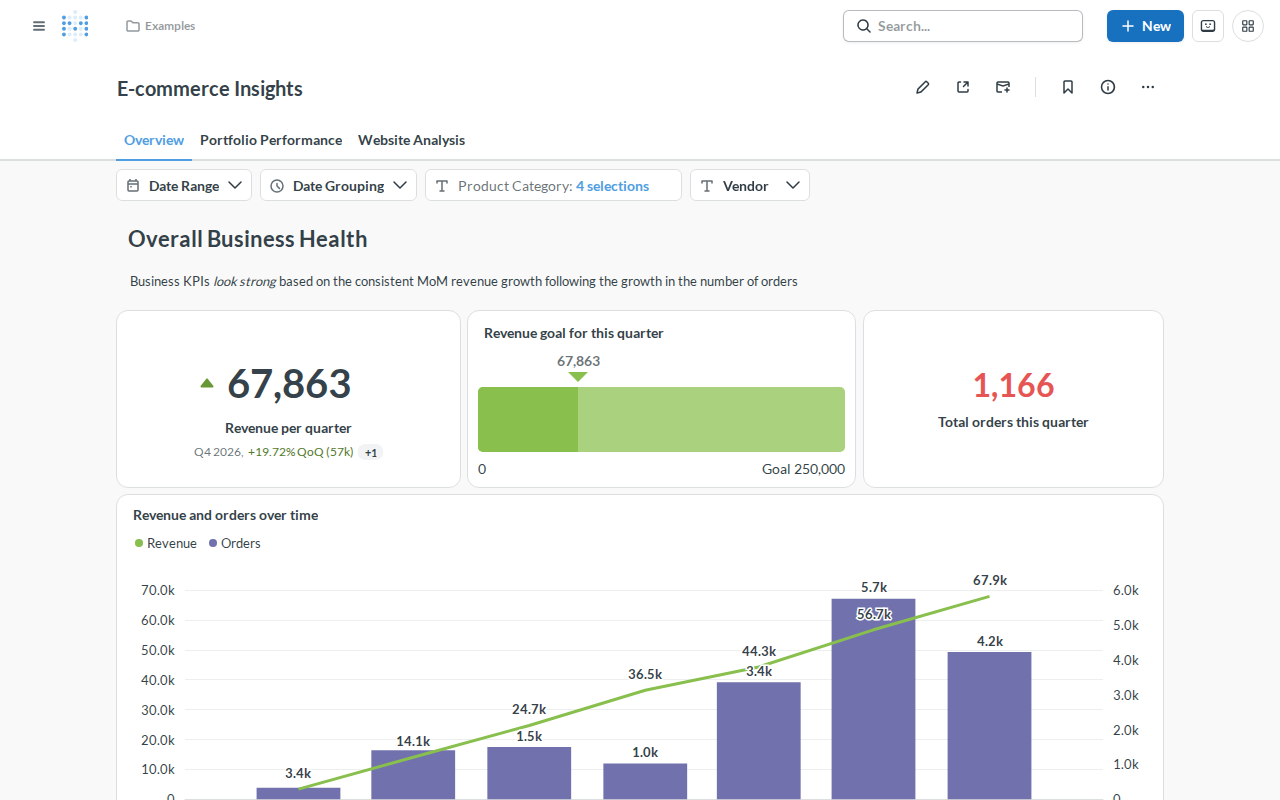
Then open Examples → E-commerce Insights from the sidebar. It's a finished dashboard on Metabase's sample database. Click any chart to see the question behind it, change a filter, or press New → Question to make your own.
Ask Metabot#
Press Ctrl+E (or the chat button at the top right) and ask a question about your data, like Which product category had the most revenue last quarter? Metabot writes the query, runs it, and links the chart it made, which you can save or tweak like any other question.
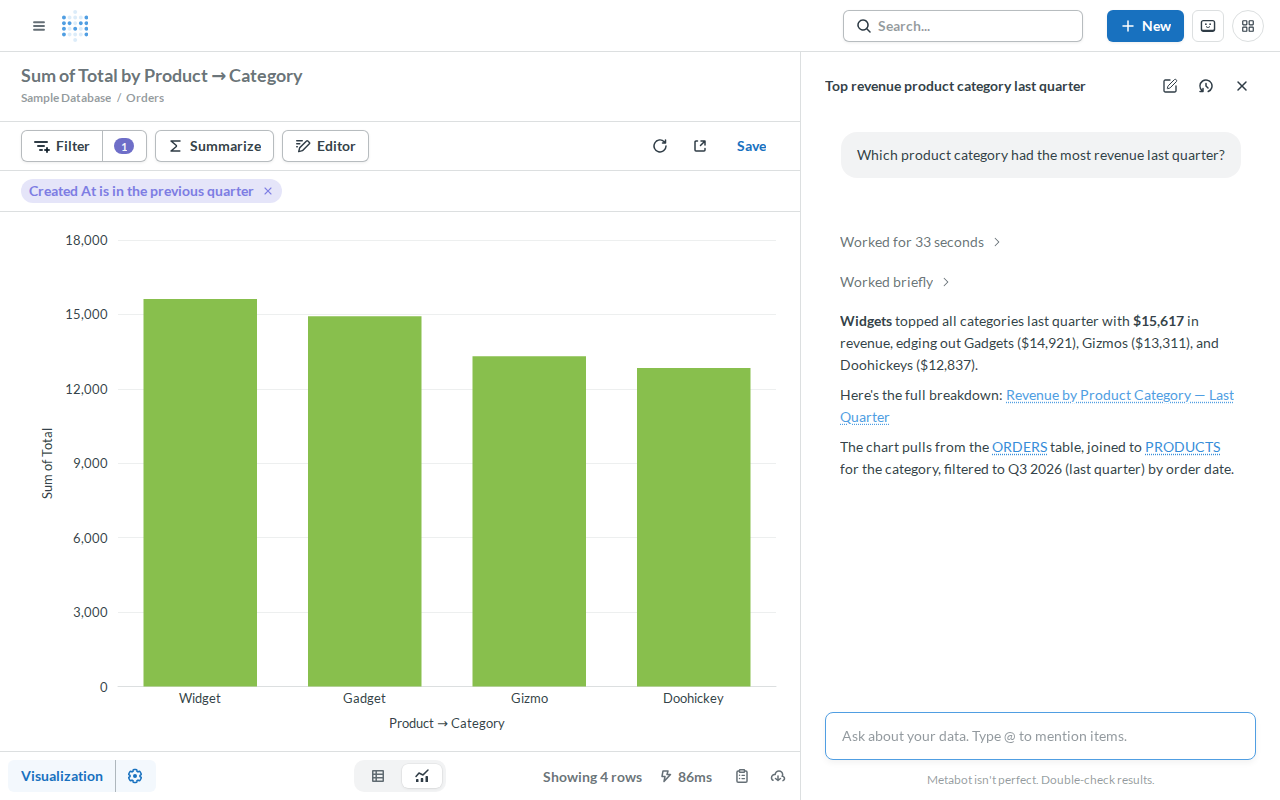
Metabot runs on Claude Sonnet 4.6 through exe.dev's LLM gateway, so there's no API key to paste. Under Admin → AI the default model reads Select a model, but Claude is what answers; pick a GPT model there to switch.
Note
Metabot sends your question, table and column names, and query results to the model provider. Turn off Allow Metabot to read query results, or Disable all AI features, under Admin → AI if that's not OK. A question uses around 50,000 input tokens, mostly cached.
Connect your database#
Give Metabase a login that can only read. For a database from the PostgreSQL recipe, on that VM:
pw=$(openssl rand -hex 24); echo "metabase_ro password: $pw"
psql -d app -v ON_ERROR_STOP=1 -v pw="$pw" <<'EOF'
CREATE ROLE metabase_ro LOGIN PASSWORD :'pw';
GRANT CONNECT ON DATABASE app TO metabase_ro;
GRANT USAGE ON SCHEMA public TO metabase_ro;
GRANT SELECT ON ALL TABLES IN SCHEMA public TO metabase_ro;
ALTER DEFAULT PRIVILEGES FOR ROLE app IN SCHEMA public GRANT SELECT ON TABLES TO metabase_ro;
EOF
The open-source edition can't limit what someone sees within a database, so this login is the line Metabase can't cross.
exe.dev VMs don't share a private network or expose database ports, so Metabase reaches another VM one of two ways:
-
Tailscale. Put both VMs on your tailnet as in Connect from another VM (MySQL too). Metabase runs in Docker, which doesn't use Tailscale's DNS, so in the Host field use the database VM's address from
tailscale ip -4 my-postgres. -
SSH tunnel, built into Metabase. On the Metabase VM, make a key:
ssh-keygen -t ed25519 -N '' -C metabase-tunnel -f ~/metabase/tunnel-key
cat ~/metabase/tunnel-key.pub
On your computer, let that key into the database VM, and only that VM (a VM-scoped key), pasting the line it printed:
echo 'ssh-ed25519 AAAA... metabase-tunnel' | ssh exe.dev ssh-key add --vm=my-postgresIn Metabase, use Host
localhost, turn on Use an SSH tunnel, and entermy-postgres.exe.xyz, port22, usernameexedev, and the private key fromcat ~/metabase/tunnel-key.
Then go to Admin → Databases → Add a database, enter the database name,
metabase_ro, and its password, and Save. Metabase scans the tables;
your data appears under Browse → Databases a minute later.
Bring in your team#
People need two things: access to the VM, then a Metabase account. On your computer, share the VM with a person or your whole team:
ssh exe.dev share add my-metabase alice@example.com
ssh exe.dev share add my-metabase team
Alice gets an email from exe.dev. Once she has opened the link and signed in, add her under Admin → People → Invite someone; Metabase emails her an invitation. Teammates can be invited straight away.
The open-source edition has no way to trust exe.dev's login, so each person also has a Metabase password. Use Groups and Collections to decide who sees which dashboards.
Tip
Removing someone? Deactivate them in Admin → People, then on your computer run
ssh exe.dev share remove my-metabase alice@example.com.
Get dashboards by email#
On any dashboard, click the Subscriptions button at the top, choose
Email it, add people, and set a schedule. Metabase's mail goes through
smtp-relay, a small program next to it, out of exe.dev's
email gateway. There's no SMTP server to configure;
Admin → Settings → Email shows it's set up.
exe.dev only delivers to you, your team, and people you've shared the VM with who have signed in, and it limits how much and how often. Emails are plain text with the charts attached as images, ten at most and 1 MB in all; a bigger dashboard arrives with a note listing what was left out. CSV and Excel attachments come first.
Keep your data#
Your questions, dashboards, and people live in Metabase's PostgreSQL
database in ~/metabase/postgres, and nightly backups go to
~/metabase/backups. Your business data stays in your own database.
Keep a copy off the VM. On your computer:
scp -r my-metabase.exe.xyz:metabase/backups .
Backups hold the key that unlocks the database passwords Metabase saved, so keep them private. For updates or trouble, ask Shelley, or open the instructions below.
The nuts and bolts#
Happy clicking Deploy? You can stop here. These are Shelley's setup steps and your maintenance reference.
Install by hand
Create a VM#
On your computer (pick another name if my-metabase is taken):
ssh exe.dev new --name=my-metabase
ssh my-metabase.exe.xyz
The default VM (8 GB) suits a team. All remaining installation commands
run on the VM, as exedev.
Write the secrets#
Metabase uses an encryption key for the database passwords it saves and a session key for logins. This writes them, and PostgreSQL's password, to a file only you can read, once:
mkdir -p ~/metabase && cd ~/metabase
if [ ! -e .env ]; then
  touch .env && chmod 600 .env
  cat >> .env <<EOF
# Metabase's secrets. Back this file up: without MB_ENCRYPTION_SECRET_KEY,
# Metabase can't read the database passwords it has saved.
MB_DB_PASS=$(openssl rand -hex 24)
MB_ENCRYPTION_SECRET_KEY=$(openssl rand -base64 32)
MB_SESSION_SECRET_KEY=$(openssl rand -base64 32)
MB_SITE_URL=https://$(hostname).exe.xyz
MB_EMAIL_FROM_ADDRESS=metabase@$(hostname).exe.xyz
EOF
fi
ls -l .env
ls should show -rw-------. MB_SITE_URL is the address used in emailed
links; change it if you add a custom domain.
Start Metabase#
smtp-relay.py is a short Python program, standard library only, that accepts Metabase's email and sends it through exe.dev's email gateway. It listens only inside Docker's network. Fetch it, then write the Compose file:
cd ~/metabase
curl -fsSLo smtp-relay.py https://exe.dev/deploy/metabase/smtp-relay.py
cat > compose.yaml <<'EOF'
# Metabase behind exe.dev's HTTPS proxy, with PostgreSQL as its
# application database. Secrets come from .env in this directory.
name: metabase

services:
  metabase:
    # v0.65.x follows the newest 0.65 release.
    image: metabase/metabase:v0.65.x
    restart: unless-stopped
    ports:
      - "8000:3000"
    env_file: .env
    environment:
      MB_DB_TYPE: postgres
      MB_DB_HOST: postgres
      MB_DB_PORT: 5432
      MB_DB_DBNAME: metabase
      MB_DB_USER: metabase
      MB_DISABLE_LEGACY_STARTUP_ENCRYPTION: "true"
      # Half the VM's memory for Java's heap; it follows a resize.
      JAVA_OPTS: -XX:MaxRAMPercentage=50
      # Email through exe.dev's email gateway, by way of smtp-relay.
      MB_EMAIL_SMTP_HOST: smtp-relay
      MB_EMAIL_SMTP_PORT: 2525
      MB_EMAIL_SMTP_SECURITY: none
      MB_EMAIL_FROM_NAME: Metabase
      # Metabot through exe.dev's LLM gateway: no real key needed.
      # The gateway's address is link-local, hence allow-all.
      MB_LLM_ANTHROPIC_API_KEY: exe-llm-gateway
      MB_LLM_ANTHROPIC_API_BASE_URL: https://llm.int.exe.xyz
      MB_LLM_OPENAI_API_KEY: exe-llm-gateway
      MB_LLM_OPENAI_API_BASE_URL: https://llm.int.exe.xyz
      MB_LLM_ALLOWED_NETWORKS: allow-all
    depends_on:
      postgres:
        condition: service_healthy
    healthcheck:
      test: ["CMD", "curl", "-fs", "http://localhost:3000/api/health"]
      interval: 15s
      timeout: 5s
      retries: 5
      start_period: 3m

  postgres:
    image: postgres:18
    restart: unless-stopped
    environment:
      POSTGRES_USER: metabase
      POSTGRES_DB: metabase
      POSTGRES_PASSWORD: ${MB_DB_PASS:?set in .env}
    volumes:
      - ./postgres:/var/lib/postgresql
    healthcheck:
      test: ["CMD", "pg_isready", "-U", "metabase", "-d", "metabase"]
      interval: 10s
      timeout: 5s
      retries: 5

  smtp-relay:
    image: python:3.13-alpine
    restart: unless-stopped
    command: ["python3", "-u", "/smtp-relay.py"]
    environment:
      SMTP_RELAY_LISTEN: 0.0.0.0
    volumes:
      - ./smtp-relay.py:/smtp-relay.py:ro
EOF
docker compose config --quiet && echo compose ok
Enable Docker at boot, download the images (about 2.7 GB), and start. Metabase's first start takes a minute or two while it sets up its database:
sudo systemctl enable --now docker.service
docker compose pull -q
docker compose up -d --wait --wait-timeout 300
curl -fs localhost:8000/api/health; echo
printf 'Metabase: https://%s.exe.xyz/\n' "$(hostname)"
curl should print {"status":"ok"}. The
HTTPS proxy adds HTTPS and exe.dev login in front of
port 8000.
Warning
Until someone finishes Metabase's setup, whoever opens the URL first becomes its admin. The VM is private, so that's you; create your account before you share it.
Set up nightly backups#
This dumps Metabase's database while it runs, checks the dump, saves it
with .env and compose.yaml, and keeps two weeks of backups:
cd ~/metabase
cat > backup.sh <<'EOF'
#!/bin/sh
# Back up Metabase: its application database and the .env with its keys.
set -eu
umask 077
cd "$(dirname "$0")"
mkdir -p -m 700 backups
out="backups/metabase-$(date +%Y%m%d-%H%M%S).tar.gz"
work=$(mktemp -d)
trap 'rm -rf "$work"' EXIT
docker compose exec -T postgres pg_dump -U metabase -d metabase -Fc > "$work/metabase.dump"
docker compose exec -T postgres pg_restore --list < "$work/metabase.dump" > /dev/null
cp .env compose.yaml "$work/"
tar -C "$work" -czf "$out.tmp" .
mv "$out.tmp" "$out"
find backups -name 'metabase-*.tar.gz' -mtime +14 -delete
EOF
chmod +x backup.sh

sudo tee /etc/systemd/system/metabase-backup.service >/dev/null <<'EOF'
[Unit]
Description=Back up Metabase
After=docker.service

[Service]
Type=oneshot
User=exedev
ExecStart=/home/exedev/metabase/backup.sh
EOF
sudo tee /etc/systemd/system/metabase-backup.timer >/dev/null <<'EOF'
[Unit]
Description=Back up Metabase nightly

[Timer]
OnCalendar=daily
Persistent=true

[Install]
WantedBy=timers.target
EOF
sudo systemctl daemon-reload
sudo systemctl enable --now metabase-backup.timer
sudo systemctl start metabase-backup.service
systemctl list-timers metabase-backup.timer
tar -tzf backups/metabase-*.tar.gz
The timer should list its next run, and the archive should hold
metabase.dump, .env, and compose.yaml. You're ready: create your
admin account and try the walkthrough above.
Back up and restore
To take an extra backup, on the VM:
cd ~/metabase
./backup.sh
Restore#
Pick an archive in backups/ and substitute its filename below. On a new
VM, run Install by hand first and copy your archive into that folder.
These commands run on the VM. They take Metabase's keys from the
backup, keep this VM's PostgreSQL password, and set the current database
aside rather than delete it:
cd ~/metabase
backup=backups/metabase-YYYYMMDD-HHMMSS.tar.gz
work=$(mktemp -d)
tar -C "$work" -xzf "$backup" &&
docker compose exec -T postgres pg_restore --list < "$work/metabase.dump" >/dev/null &&
sudo systemctl stop metabase-backup.timer metabase-backup.service &&
docker compose stop metabase &&
cp -p .env ".env.before-restore-$(date +%s)" &&
for key in MB_ENCRYPTION_SECRET_KEY MB_SESSION_SECRET_KEY; do
  line=$(grep "^$key=" "$work/.env") && sed -i "s|^$key=.*|$line|" .env
done &&
docker compose exec -T postgres psql -U metabase -d postgres \
  -c "ALTER DATABASE metabase RENAME TO metabase_before_restore_$(date +%s)" \
  -c "CREATE DATABASE metabase" &&
docker compose exec -T postgres pg_restore -U metabase -d metabase --exit-on-error < "$work/metabase.dump" &&
docker compose up -d --wait &&
sudo systemctl start metabase-backup.timer &&
rm -rf "$work"
Sign in and check your dashboards and Admin → Databases. Once you're
happy, drop the set-aside database; list it with
docker compose exec postgres psql -U metabase -d postgres -c '\l', then
docker compose exec postgres dropdb -U metabase metabase_before_restore_....
Update
The v0.65.x tag gets each 0.65 bug-fix release. On the VM, back up
first, then pull and restart; Metabase updates its database on start:
cd ~/metabase
./backup.sh && docker compose pull && docker compose up -d --wait --wait-timeout 300
For a new major version, read the
release notes, change the
tag in compose.yaml (to v0.66.x, say), and run the same command. Going
up several versions? Step through each one's latest release. Metabase
can't go back to an older version on an upgraded database: to undo an
update, put the old tag back and restore the backup
you took first.
Something's not happy?
Start with the logs. On the VM:
cd ~/metabase
docker compose ps
docker compose logs --tail=50 metabase
- 502 right after a start? Metabase takes about a minute to boot.
- Down after a reboot? Run
sudo systemctl enable --now docker.service. - Slow, or
OutOfMemoryErrorin the logs? Give the VM more memory on your computer withssh exe.dev resize my-metabase --memory=16GB; Metabase's heap grows with it. - No email? Check
docker compose logs smtp-relay. A recipient outside your team must accept the VM share and sign in first. - Metabot says it can't connect? Check that
curl -s https://llm.int.exe.xyz/v1/modelsworks on the VM; your LLM integration must be attached to it. - Can't reach a database? From the VM, try it outside Docker first,
e.g.
nc -zv 100.x.y.z 5432over Tailscale. - Locked out? Another admin can reset your password in Admin → People, or Metabase can email you a reset link.
Frequently asked questions#
Is Metabase free?
The open-source edition is, under the AGPL. You pay for your VM plan, and Metabot uses your exe.dev LLM allocation. Metabase's paid plans add SSO, row-level permissions, and white-labelling.
Can people sign in with their exe.dev login alone?
Not in the open-source edition. exe.dev decides who can reach the VM; Metabase still asks for its own account. Metabase's single sign-on (JWT, SAML, OIDC) is a paid feature. Google Sign-In and LDAP are free.
Why PostgreSQL instead of the built-in H2 database?
Metabase says not to run H2 in production. It's a single file that Metabase keeps open, so a crash can corrupt it, it can't be backed up while Metabase runs, and upgrades are riskier. PostgreSQL costs about 100 MB of memory and backs up live with pg_dump.
How big a VM do I need?
The default 8 GB VM gives Metabase a 4 GB Java heap, plenty for a team. Metabase takes half the VM's memory, so ssh exe.dev resize is all it takes to give it more. Below 4 GB, expect it to slow down.
Does my data leave the VM?
Queries go straight from the VM to your database. Metabot sends your question, table and column names, and (unless you turn it off) query results to the model provider through exe.dev's gateway. Emailed dashboards go out through exe.dev's email gateway.
Can Metabase reach a database on another exe.dev VM?
Yes, over Tailscale or Metabase's built-in SSH tunnel. VMs don't share a private network and have no public database ports. See Connect your database.
Updated Nov 16, 2026 · tested end to end Nov 16, 2026 · Markdown · manifest.json · Something wrong? Tell us


