Self-host MoneyPrinterTurbo
AI short videos from a topic, with scripts by exe.dev's LLM gateway.
Shelley handles the setup. About 10 minutes.
Prefer a terminal?
curl -fsSL https://exe.dev/deploy/moneyprinterturbo/prompt.txt | ssh exe.dev new --prompt=/dev/stdinMoneyPrinterTurbo turns a topic into a finished short video: an AI model writes the script and the search terms, it finds matching stock footage, records a voiceover, adds subtitles and music, and renders a 9:16, 16:9 or 1:1 MP4 with ffmpeg. You drive it from a WebUI, an HTTP API, or a command line.
On an exe.dev VM it runs all the time on its own disk, so a render keeps going after you close the tab and every video stays where you can find it. The WebUI and the API are private behind exe.dev's login, which matters here because MoneyPrinterTurbo has no login of its own. Scripts come from exe.dev's LLM gateway, so there's no OpenAI or Kimi key to paste, and the voices are free. The only key you add is a free stock-footage one. A timer on the VM can make a video every morning from a list of topics and email you the link.
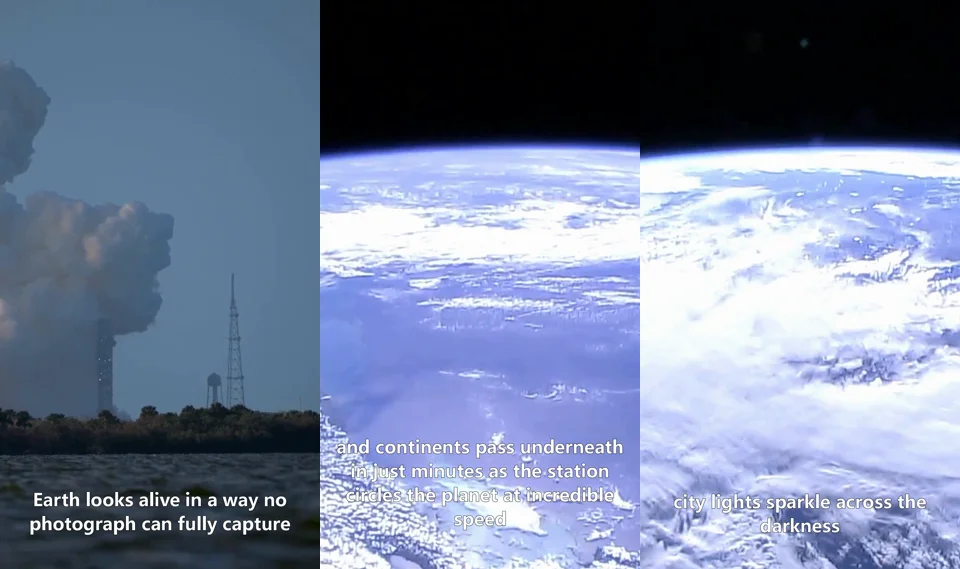
What you get#
- MoneyPrinterTurbo 1.3.10's WebUI at the VM's private URL and its API on port 8080, back after a reboot
- Scripts and keywords written by exe.dev's LLM gateway, with no LLM API key on the VM
- Free Edge TTS voiceover and subtitles, rendered with ffmpeg on the VM
- Every video kept on the VM's disk in
~/moneyprinterturbo/storage/tasks - A test script from the gateway through MoneyPrinterTurbo's API, proving the WebUI's script button will work
What's running, and where
https://my-moneyprinterturbo.exe.xyz/
the WebUI, for you and people you share the VM with
https://my-moneyprinterturbo.exe.xyz:8080/docs
the API, from a browser or with a VM token from scripts
Deploy with Shelley#
Click Deploy and Shelley will set up MoneyPrinterTurbo on a new VM, then check that it works. No config-file wrangling required.
Have these ready; Shelley asks for them:
PEXELS_API_KEY: optional; a free key from https://www.pexels.com/api/ for stock footage. Leave it as is to add it later in the WebUI
Prefer a terminal?
curl -fsSL \
  https://exe.dev/deploy/moneyprinterturbo/prompt.txt \
  | ssh exe.dev new --prompt=/dev/stdin
What Shelley is told
PEXELS_API_KEY=<fill-this-in>

Set up MoneyPrinterTurbo on this VM by following the exe.dev recipe at https://exe.dev/deploy/moneyprinterturbo.md?via=deploy from top to bottom.

The values at the top of this message are mine:
- PEXELS_API_KEY: optional; a free key from https://www.pexels.com/api/ for stock footage. Leave it as is to add it later in the WebUI
Ask me for any that still say <fill-this-in> before you need them.

The recipe's example VM name is my-moneyprinterturbo. This VM's name is the output of `hostname`: use it wherever the recipe writes my-moneyprinterturbo. Skip the step that creates the VM; you are on it.

You are done when all of these are true. Check each one yourself:
- MoneyPrinterTurbo 1.3.10's WebUI at the VM's private URL and its API on port 8080, back after a reboot
- Scripts and keywords written by exe.dev's LLM gateway, with no LLM API key on the VM
- Free Edge TTS voiceover and subtitles, rendered with ffmpeg on the VM
- Every video kept on the VM's disk in `~/moneyprinterturbo/storage/tasks`
- A test script from the gateway through MoneyPrinterTurbo's API, proving the WebUI's script button will work

Run "Install by hand" first, skipping VM creation: Docker, the Compose
file, config.toml, the LLM settings, starting it, and the checks at the
end. Never overwrite an existing config.toml. If the owner gave a
PEXELS_API_KEY, add it as that section says; otherwise leave Pexels
unset and say so. Don't make a test video (it takes minutes of CPU) or
set up the daily timer; those are the owner's choice. Don't share the
VM or make it public: the WebUI has no login of its own. Finish with
the WebUI's URL and what to do first from "Make your first video".

Finish with the URLs I should open.
Also at /deploy/moneyprinterturbo/prompt.txt. The recipe it follows is /deploy/moneyprinterturbo.md.
Make your first video#
Open https://my-moneyprinterturbo.exe.xyz/ and sign in to exe.dev if
asked. A short tour points at Settings; the AI model is already set up
there (OpenAI, through exe.dev's gateway).
- Footage. Click Settings → Material Source Settings and paste a free Pexels API key (or a Pixabay one). Skip this if Shelley already added yours. No key? Choose Local as the video source and upload your own clips instead.
- Script. Type a subject, such as "Why octopuses are so smart", and click Generate Script & Keywords with AI. In a few seconds you get a script and English search terms for the footage. Edit either one.
- Voice. In the audio settings, keep the Azure TTS V1 server, which
is Edge TTS: free, with no key. Pick a voice in your script's language,
such as
en-US-AvaNeuraloren-US-AndrewNeural, and play the sample. - Music. Pick one of the bundled background tracks, upload your own under Background Music, or turn it off.
- Click Generate Video at the bottom. The log shows each stage. Rendering takes minutes: about 8½ for a 41-second portrait video on the default VM.
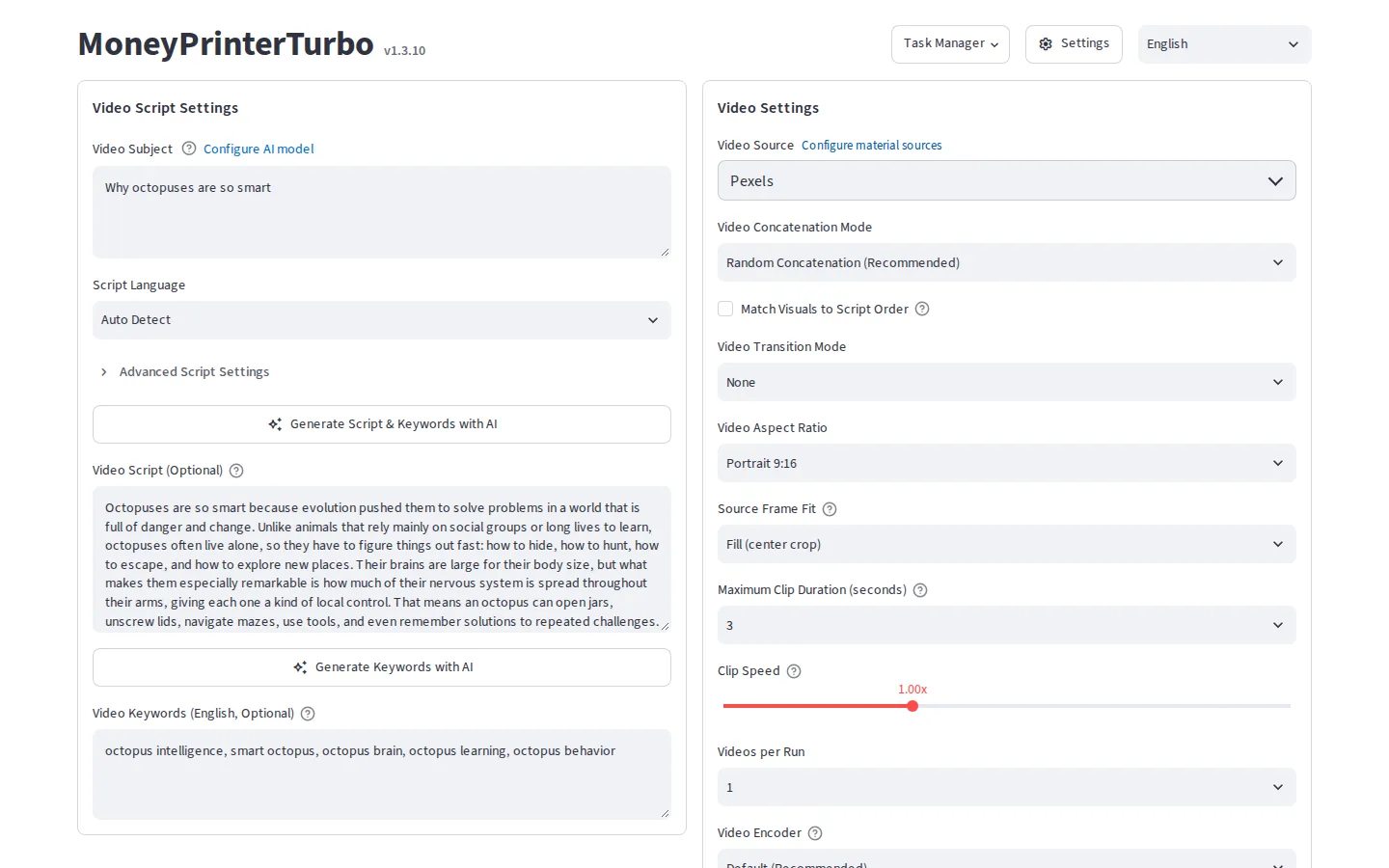
The finished video plays in the page, and every run is listed under Task
Manager, including ones started from the API. The files are on the VM in
~/moneyprinterturbo/storage/tasks/<task id>/: final-1.mp4 is the video,
next to its script, voiceover and subtitles. To copy one to your computer:
scp my-moneyprinterturbo.exe.xyz:moneyprinterturbo/storage/tasks/<task-id>/final-1.mp4 .
The render runs on the VM, so you can close the tab and come back later.
Footage and voices#
Footage is the one thing you need a key for. MoneyPrinterTurbo searches
Pexels, Pixabay or Coverr with the AI's search terms and downloads matching
clips. Pexels and Pixabay keys are free with an account; add several and it
rotates through them. The keys live in ~/moneyprinterturbo/config.toml
(mode 600), not in an exe.dev integration, because MoneyPrinterTurbo calls
api.pexels.com directly and has no setting for another address. A Pexels
key can only search Pexels, so this is a small risk, but anyone you share
the VM with can read it in Settings. Your own clips work with no key at
all: choose Local and upload them. AI-generated footage (Seedance,
MiniMax and others) is there too, with those providers' paid keys.
Voices: Edge TTS (Azure TTS V1 in the WebUI) is free and needs no key; it is the voice Microsoft Edge reads pages aloud with, and MoneyPrinterTurbo uses it unofficially. Azure Speech (Azure TTS V2), ElevenLabs, Gemini, MiniMax and others need their own keys. Kokoro and Chatterbox are open models you can run yourself. Subtitles come from the voice's timestamps by default, which needs no GPU.
Rights. The software's MIT license doesn't cover what goes into your video:
- Pexels and Pixabay footage is free to use, commercially too, under their licenses: don't resell clips unaltered, and take care with recognizable people, logos and trademarks.
- Edge TTS has no license for this use. For commercial work, use a voice service whose terms you've accepted.
- Platforms ask you to label realistic AI-generated content, and they demote mass-produced, repetitive videos. Review what you post.
Use the API#
The API is the same engine with no browser: everything the WebUI does,
as JSON. Its interactive docs are at
https://my-moneyprinterturbo.exe.xyz:8080/docs behind your exe.dev login,
and tasks started there show up in the WebUI's Task Manager.
From a script on your computer (or n8n, or CI), exe.dev's proxy needs a VM token instead of a browser login. On your computer:
TOKEN=$(ssh exe.dev ssh-key generate-api-key --vm=my-moneyprinterturbo --label=mpt --exp=90d --json | jq -r .token)
Keep the token (it starts with exe1.) like a password: until it expires,
it reaches every web port of this VM as you, and only this VM.
Then start a video and check on it:
API=https://my-moneyprinterturbo.exe.xyz:8080/api/v1
curl -fsS "$API/videos" -H "X-Exedev-Authorization: Bearer $TOKEN" \
  -H 'Content-Type: application/json' -d '{
    "video_subject": "Three facts about honeybees",
    "video_language": "en-US",
    "video_aspect": "9:16",
    "video_source": "pexels",
    "voice_name": "en-US-AvaNeural-Female",
    "bgm_type": ""
  }'
# {"status":200,"message":"success","data":{"task_id":"1053fd5f-..."}}
curl -fsS "$API/tasks/<task-id>" -H "X-Exedev-Authorization: Bearer $TOKEN"
state is 4 while it runs, 1 when it's done and -1 if it failed.
When it's done, videos lists the file, which you download with the same
header: https://my-moneyprinterturbo.exe.xyz:8080/tasks/<task-id>/final-1.mp4.
The API keeps task status in memory, so after a restart it answers 404
for older tasks; their files are still there, and a render that was
running is lost.
Set voice_name (the API's own examples use Chinese voices) and
bgm_type ("" for no music, "random" for the bundled songs). The
full list of fields is in /docs under POST /api/v1/videos.
Tools that only do Basic auth can send the token as the password, with any
user name. MoneyPrinterTurbo also has its own x-api-key check (api_key
under [app] in config.toml). You don't need it here: the proxy already
turns away anyone without access to the VM.
A video every morning#
next-video is a
short script for the VM: it takes the first line of
~/moneyprinterturbo/topics.txt, starts a video through the local API with
the settings in ~/moneyprinterturbo/video.json, removes the topic from the
list, waits for the render, and emails you the link with exe.dev's
email. On the VM, install it with a list of topics and
your settings:
mkdir -p ~/.local/bin
curl -fsSL https://exe.dev/deploy/moneyprinterturbo/next-video -o ~/.local/bin/next-video
chmod +x ~/.local/bin/next-video
cd ~/moneyprinterturbo
printf '%s\n' "How a rocket reaches orbit" "Why the sky is blue" >> topics.txt
cat > video.json <<'EOF'
{
  "video_language": "en-US",
  "video_aspect": "9:16",
  "video_source": "pexels",
  "voice_name": "en-US-AndrewNeural-Male",
  "bgm_type": "",
  "paragraph_number": 1
}
EOF
Then a systemd timer runs it every day at 06:00 UTC, and catches up after the VM was off:
sudo tee /etc/systemd/system/next-video.service >/dev/null <<'EOF'
[Unit]
Description=MoneyPrinterTurbo: make the next video in topics.txt
After=docker.service

[Service]
Type=oneshot
User=exedev
ExecStart=/home/exedev/.local/bin/next-video
EOF
sudo tee /etc/systemd/system/next-video.timer >/dev/null <<'EOF'
[Unit]
Description=Make a MoneyPrinterTurbo video every morning

[Timer]
OnCalendar=*-*-* 06:00:00 UTC
Persistent=true

[Install]
WantedBy=timers.target
EOF
sudo systemctl daemon-reload
sudo systemctl enable --now next-video.timer
Run one now to check it, and follow along:
sudo systemctl start --no-block next-video.service
journalctl -fu next-video
It prints the task ID, then next-video: New video: <topic> when the render
is done, and the email arrives. For more than one a day, add OnCalendar=
lines; the API queues what it can't start yet. For a one-off batch without
the API, the command line takes a JSON list of up to 100 videos:
docker compose exec api python3 cli.py --batch-file storage/tasks.json
(see python3 cli.py --help).
Share it#
On your computer, share the VM with someone:
ssh exe.dev share add my-moneyprinterturbo teammate@example.com
They sign in to exe.dev and get the same WebUI, the same task list and the
same settings, keys included; there are no separate accounts. Their scripts
use your LLM allocation. share remove takes access away again.
Warning
Don't run
share set-publicon this VM. The WebUI has no password, so anyone could make videos on your CPU and LLM allocation, read your keys, and delete your videos. To publish a video, download it and post it.
Size the VM#
Rendering is CPU work. On the default VM (2 CPUs, 8 GB), a 41-second 1080×1920 video from eight source clips took about 8½ minutes: 15 seconds for the script and voice, 4½ minutes to cut and scale the clips, a minute to join them, and 3 minutes for the final pass with subtitles and audio. Footage downloads add a little with Pexels.
More CPUs barely speed up one video: the same video took about 7¾ minutes
on 4 CPUs, because MoneyPrinterTurbo prepares the clips one at a time. They
help when you render several videos at once, such as a batch or a team
sharing the VM:
ssh exe.dev resize my-moneyprinterturbo --cpu=4 --memory=16GB.
The image takes 3 GB of disk, and each finished video about 10-20 MB plus its intermediate files. Local Whisper subtitles download a 1.6-3 GB model and are much slower on a CPU; the default subtitles need neither.
Install by hand
Create the VM#
On your computer, create a VM (pick any free name; this page uses
my-moneyprinterturbo):
ssh exe.dev new --name=my-moneyprinterturbo
ssh my-moneyprinterturbo.exe.xyz
Install MoneyPrinterTurbo#
On the VM, turn Docker on at boot, then fetch the example configuration for the release this page was tested with:
sudo systemctl enable --now docker.service
mkdir -p ~/moneyprinterturbo/storage && cd ~/moneyprinterturbo
[ -f config.toml ] || curl -fsSL https://raw.githubusercontent.com/harry0703/MoneyPrinterTurbo/v1.3.10/config.example.toml -o config.toml
chmod 600 config.toml
The Compose file is upstream's docker-compose.release.yml, with the image
pinned (upstream's latest follows the main branch, not the latest
release) and the WebUI on port 8000, so it's the VM's main address. Both
ports listen only on 127.0.0.1, where exe.dev's proxy
reaches them:
cat > compose.yaml <<'EOF'
x-moneyprinterturbo: &mpt
  image: ghcr.io/harry0703/moneyprinterturbo:1.3.10
  restart: unless-stopped
  volumes:
    - ./config.toml:/MoneyPrinterTurbo/config.toml
    - ./storage:/MoneyPrinterTurbo/storage

services:
  webui:
    <<: *mpt
    container_name: moneyprinterturbo-webui
    ports:
      - "127.0.0.1:8000:8501"
    command: ["streamlit", "run", "./webui/Main.py", "--server.address=0.0.0.0", "--server.port=8501", "--server.headless=true", "--browser.gatherUsageStats=false", "--client.toolbarMode=minimal", "--server.showEmailPrompt=false"]
  api:
    <<: *mpt
    container_name: moneyprinterturbo-api
    ports:
      - "127.0.0.1:8080:8080"
    command: ["python3", "main.py"]
EOF
Use exe.dev's LLM gateway#
The example configuration picks Moonshot's Kimi API, which needs a key. Switch it to the OpenAI provider pointed at the gateway. The gateway ignores the key, but MoneyPrinterTurbo wants one, so it gets a placeholder:
sed -i \
  -e 's|^llm_provider = "moonshot"|llm_provider = "openai"|' \
  -e 's|^openai_api_key = ""|openai_api_key = "exe-dev-gateway"|' \
  -e 's|^openai_base_url = ""|openai_base_url = "https://llm.int.exe.xyz/v1"|' \
  -e 's|^openai_model_name = ""|openai_model_name = "gpt-5.4-mini"|' \
  config.toml
grep -E '^(llm_provider|openai_(api_key|base_url|model_name)) ' config.toml
The last command prints the four lines with their new values.
curl -s https://llm.int.exe.xyz/v1/models | jq -r '.data[].id' lists the
other models you can use, such as fireworks/kimi-k3 or
fireworks/glm-5p3-flash.
If you have a Pexels key, add it now (or later in the WebUI):
PEXELS_API_KEY=paste-your-key-here
sed -i "s|^pexels_api_keys = \[\]|pexels_api_keys = [\"$PEXELS_API_KEY\"]|" config.toml
grep '^pexels_api_keys' config.toml
Start it#
docker compose up -d
sleep 15
docker compose ps
curl -s -o /dev/null -w 'WebUI %{http_code}\n' http://127.0.0.1:8000/_stcore/health
curl -s -o /dev/null -w 'API %{http_code}\n' http://127.0.0.1:8080/docs
The first up pulls the 3 GB image. Both containers should be Up, and
both checks print 200. Check that the gateway writes a script, through
the API:
curl -fsS http://127.0.0.1:8080/api/v1/scripts -H 'Content-Type: application/json' \
  -d '{"video_subject": "Why octopuses are so smart", "paragraph_number": 1}' | jq -r .data.video_script
A paragraph about octopuses means it works. Then open
https://my-moneyprinterturbo.exe.xyz/.
Back up and restore
Everything is in ~/moneyprinterturbo: config.toml (your keys and
settings), compose.yaml, and storage/ (videos, uploaded clips and
music, the task list, the footage cache). The containers write as root,
so use sudo. On the VM:
cd ~ && sudo tar -czf mpt-backup-$(date +%F).tar.gz moneyprinterturbo
Copy it off the VM from your computer:
scp my-moneyprinterturbo.exe.xyz:mpt-backup-*.tar.gz .
To leave out the footage cache, which re-downloads on its own, add
--exclude=moneyprinterturbo/storage/cache_videos. To restore, on a VM
set up as above:
cd ~/moneyprinterturbo && docker compose down
cd ~ && sudo tar -xzf mpt-backup-2026-11-19.tar.gz
cd ~/moneyprinterturbo && docker compose up -d
The old videos show up again in Task Manager.
Update
Read the release notes, back up, then change the tag and restart. On the VM:
cd ~/moneyprinterturbo
sed -i 's|moneyprinterturbo:1.3.10|moneyprinterturbo:1.3.11|' compose.yaml
docker compose pull && docker compose up -d
New settings appear in the WebUI with their defaults; your config.toml
is kept. Compare it with the new release's config.example.toml if a
feature needs a setting the WebUI doesn't show.
Notes for the Chinese defaults#
MoneyPrinterTurbo is made in China and its defaults show it. None of them get in the way here, but they explain what you'll see:
- The main README is in Chinese;
README-en.mdis the English one, and the WebUI follows your browser's language. - The example config uses Moonshot (Kimi) for scripts, and the API's
examples use Chinese voices such as
zh-CN-XiaoxiaoNeural. This recipe uses the gateway and English voices instead. Kimi K3 is on the gateway asfireworks/kimi-k3if you want it. - Building the image yourself (
docker compose upin a clone) installs packages from Alibaba Cloud and Tsinghua mirrors first. The prebuilt GHCR image used here was built with the default Debian and PyPI mirrors. - Many of the listed LLM, voice and AI-video providers are Chinese services, and several are sponsors. You need none of them.
- The default subtitle fonts are Chinese fonts that also cover Latin letters.
Troubleshooting#
- "pexels_api_keys is not set", or the video fails at the materials
stage: add a Pexels key in Settings → Material Source Settings, or
switch the video source to Local. If a key was added in the WebUI
but the API still fails, restart the API, which reads
config.tomlonly when it starts:docker compose restart api. - The script fails with an authentication or model error: check
Settings → LLM Settings → OpenAI shows base URL
https://llm.int.exe.xyz/v1and a model thatcurl -s https://llm.int.exe.xyz/v1/modelslists.docker compose logs api(or the WebUI's log) shows the gateway's reply. - No voice, or an Edge TTS timeout: Microsoft's service is occasionally slow; generate again. The voice must match the script's language.
- A blank page or "Connecting" forever: the WebUI is restarting or
still starting.
docker compose psanddocker compose logs webui. - It's slow: see Size the VM. One render at a time uses the CPUs fully; several at once each take longer.
- After a reboot nothing answers:
systemctl is-enabled dockershould sayenabled; if not,sudo systemctl enable --now docker.service. - Permission denied reading files in
storage/: the containers write as root. Usesudo, or copyfinal-*.mp4, which everyone can read.
Frequently asked questions#
Is MoneyPrinterTurbo free?
Yes, it's MIT-licensed. On exe.dev you pay for the VM; scripts use your LLM allocation, a few thousand tokens per video. Pexels and Pixabay keys are free, and Edge TTS needs no key. Paid voices, AI-generated footage and music are optional.
Do I need a GPU?
No. The script and voice come from online services, and ffmpeg renders on the CPU. A 41-second 1080×1920 video took about 8½ minutes on the default 2-CPU VM. A GPU only matters for local Whisper subtitles or heavy batches.
Which AI model writes the scripts?
Any model exe.dev's gateway serves through OpenAI's API: GPT, Kimi, GLM, DeepSeek, Grok and more. This recipe sets gpt-5.4-mini; change it in Settings → LLM Settings → OpenAI. To use your own OpenAI key or ChatGPT plan, point your LLM integration at it; MoneyPrinterTurbo doesn't change.
Can I use the videos commercially?
The software is MIT, but the footage and voice each have their own terms. Pexels and Pixabay clips are free to use, with rules (no reselling unaltered clips, care with recognizable people and brands). Edge TTS is Microsoft's browser read-aloud voice, used unofficially; for commercial work, Azure Speech or ElevenLabs have clear licenses. See Footage and voices.
Can I publish straight to TikTok, YouTube or Instagram?
MoneyPrinterTurbo can, through the third-party Upload-Post service (Settings → Auto-Publish Settings), with that service's account and API key. Many people download the MP4 and post it themselves.
Can my team use it?
Yes: ssh exe.dev share add my-moneyprinterturbo teammate@example.com. There are no per-person accounts. Everyone you share with sees the same tasks and settings, including the stock-footage keys.
Is the interface in English?
Yes. The WebUI follows your browser's language (English, Chinese and 12 others; switch at the top right). The upstream README is Chinese first, with an English README-en.md.
Published Nov 19, 2026 · Updated Nov 19, 2026 · tested end to end Nov 19, 2026 · Markdown · manifest.json · Something wrong? Tell us