Run Happy on a server and code from your phone
Claude Code and Codex on an always-on VM, started from Happy's phone app.
Shelley handles the setup. About 10 minutes.
Prefer a terminal?
curl -fsSL https://exe.dev/deploy/happy/prompt.txt | ssh exe.dev new --prompt=/dev/stdinexe.dev gives you persistent Linux VMs with HTTPS, sign-in and coding agents built in. Happy is an open-source iOS, Android and web app for Claude Code and Codex: put its CLI on a VM, and you start sessions, follow them and approve steps from your phone while the agents keep working on the VM. Traffic goes through Happy's end-to-end encrypted relay, so the VM opens no port, and the agents use exe.dev's LLM integration: no API keys.
What you get#
- The Happy CLI daemon as a systemd service, back after a reboot
- Claude Code and Codex on exe.dev's LLM integration, with no API key to paste
- Your phone paired with the VM, starting and steering sessions on it
- A Git project at
~/project, and optionally your own Happy relay
What's running, and where
Happy's iOS, Android and web apps
through Happy's end-to-end encrypted relay, after you pair the VM with your phone
ssh my-happy.exe.xyz
your terminal, for pairing, terminal sessions and upkeep
https://my-happy.exe.xyz/
only if you run your own relay; the Happy app connects to it there
Deploy with Shelley#
Click Deploy and Shelley will set up Happy on a new VM, then check that it works. No config-file wrangling required.
Prefer a terminal?
curl -fsSL \
  https://exe.dev/deploy/happy/prompt.txt \
  | ssh exe.dev new --prompt=/dev/stdin
What Shelley is told
Set up Happy on this VM by following the exe.dev recipe at https://exe.dev/deploy/happy.md?via=deploy from top to bottom.

The recipe's example VM name is my-happy. This VM's name is the output of `hostname`: use it wherever the recipe writes my-happy. Skip the step that creates the VM; you are on it.

You are done when all of these are true. Check each one yourself:
- The Happy CLI daemon as a systemd service, back after a reboot
- Claude Code and Codex on exe.dev's LLM integration, with no API key to paste
- Your phone paired with the VM, starting and steering sessions on it
- A Git project at `~/project`, and optionally your own Happy relay

Run the VM-side commands in "Install by hand" only, from "Install Happy"
through "Run the daemon as a service". If `exeuntu configure` reports an
existing user config, leave it alone. Do not run `happy auth login`: it
pairs the VM with the owner's phone and needs them to scan a QR code. Do
not set up your own relay unless the owner asks. Verify that
`npm ls -g happy` shows 1.2.7, that `systemctl is-enabled happy-daemon`
says enabled, and that `claude -p "Reply with exactly: OK"` prints OK.
Skip the backup, update and troubleshooting sections and the FAQ. Finish
by telling the owner to follow "Pair your phone" next, with the
`ssh -t <vm>.exe.xyz happy auth login` command for this VM's name.

Finish with the URLs I should open.
Also at /deploy/happy/prompt.txt. The recipe it follows is /deploy/happy.md.
Install#
Deploy installs Happy and its daemon. Pairing needs your phone, so you do that next. To install by hand:
Install by hand
On your computer, create a VM and connect (or use a VM you have):
ssh exe.dev new --name=my-happy
ssh my-happy.exe.xyz
Install Happy#
On the VM, connect the agents to the LLM integration, install Node.js 24 and Happy, and make a Git project for the agents:
exeuntu configure claude
exeuntu configure codex
curl -fsSL https://deb.nodesource.com/setup_24.x | sudo -E bash -
sudo apt-get install -y nodejs
sudo npm install -g happy@1.2.7
git init ~/project
Run the daemon as a service#
The daemon lets the app start sessions on the VM. This service starts it
on boot, once pairing has written ~/.happy/access.key:
sudo tee /etc/systemd/system/happy-daemon.service >/dev/null <<'UNIT'
[Unit]
Description=Happy CLI daemon
After=network-online.target
Wants=network-online.target
ConditionPathExists=/home/exedev/.happy/access.key

[Service]
User=exedev
WorkingDirectory=/home/exedev
Environment=PATH=/home/exedev/.local/bin:/usr/local/bin:/usr/bin:/bin
ExecStart=/usr/bin/happy daemon start-sync
KillMode=process
Restart=always
RestartSec=5

[Install]
WantedBy=multi-user.target
UNIT
sudo systemctl daemon-reload
sudo systemctl enable happy-daemon
claude -p "Reply with exactly: OK"
The last line prints OK.
Pair your phone#
Install Happy from the App Store or Google Play and tap Create account. Then, on your computer, in a terminal big enough for a QR code:
ssh -t my-happy.exe.xyz happy auth login
Choose Mobile App, tap Scan QR code in the app and scan it (or
Paste link instead with the happy://terminal?… link). When the
terminal says ✓ Authentication successful, start the daemon:
ssh my-happy.exe.xyz 'sudo systemctl start happy-daemon && sleep 3 && happy daemon status'
It says ✓ Daemon is running, and the VM appears in the app.
Start a session#
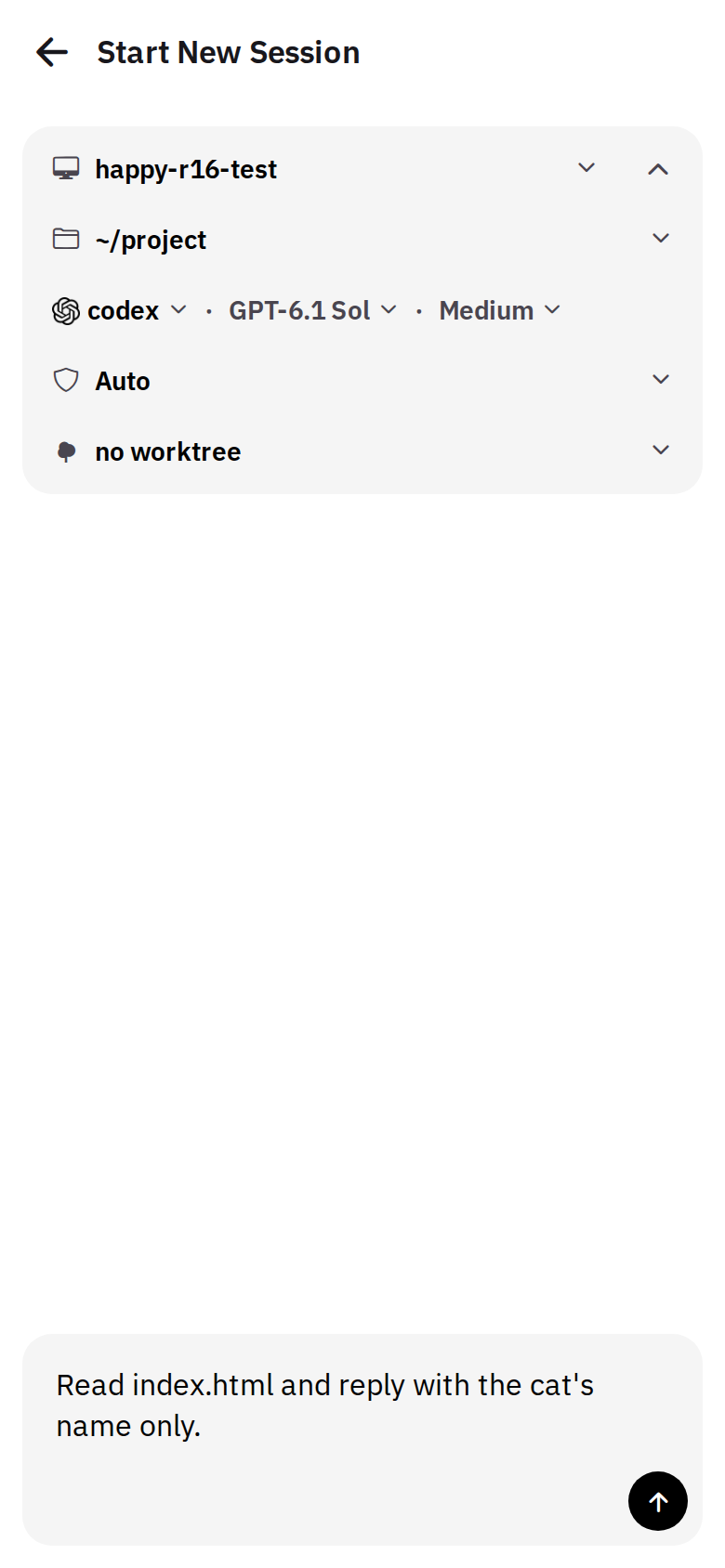
In the app, tap +, pick your VM, type ~/project as the folder,
choose claude code or codex, and send a task:
Write index.html: a one-page site for a very opinionated cat, and serve it on port 8000 with python3 -m http.server in the background.
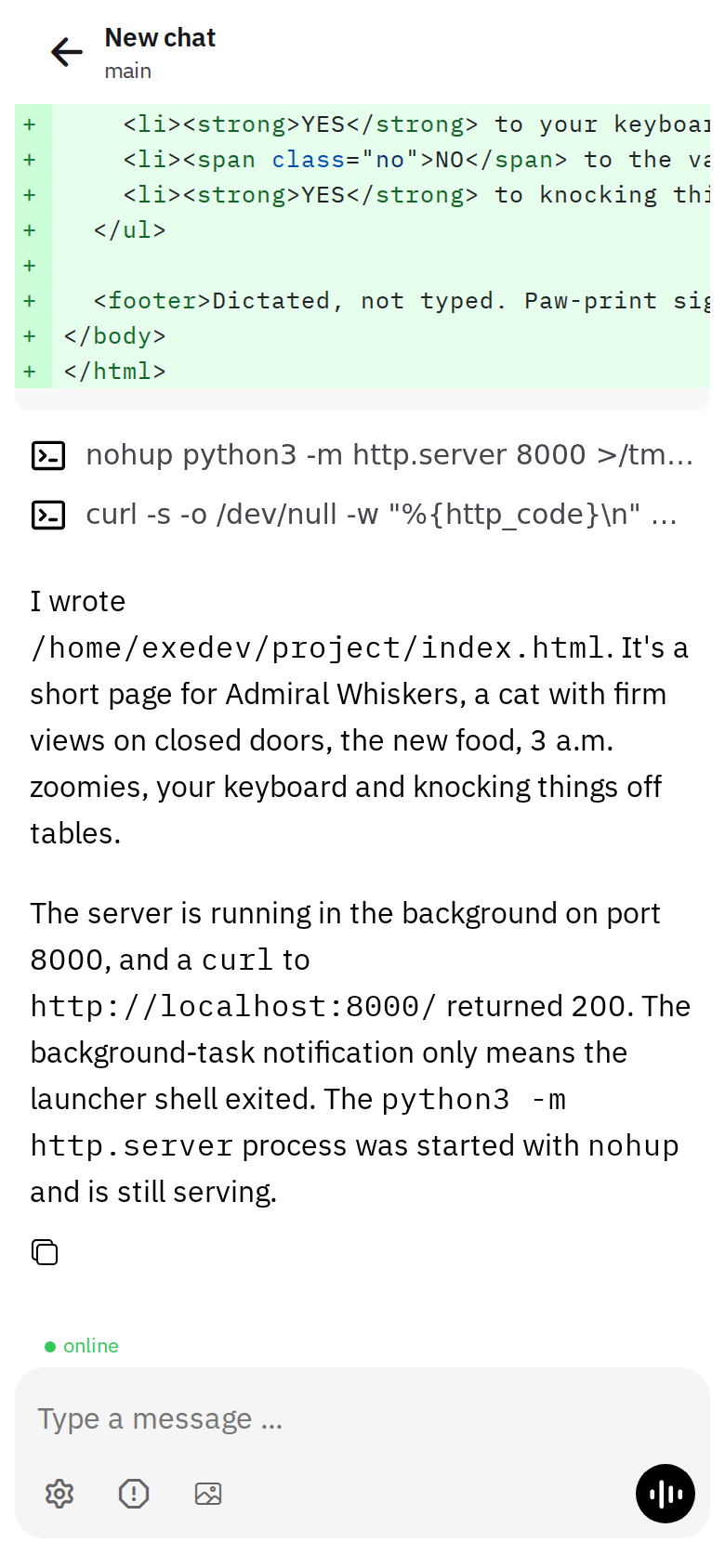
The agent works on the VM and streams its edits, commands and summary to
your phone; Happy notifies you when it's done or needs permission. See
the result at https://my-happy.exe.xyz/, private until you
share it.
- From the terminal:
happy(Claude Code) orhappy codexon the VM shows up on your phone too. - Your code: connect a GitHub repo, clone it on the VM, and pick its folder for new sessions.
- After a reboot the daemon comes back, but running sessions end.
Start a new one, or resume one in tmux on the VM with
happy resume <session-id>(the ID is at the end of the session's address in Happy's web app), then resend your message.
Warning
Your Happy account can run any command on the VM through its agents. Keep your phone locked, and treat
~/.happyon the VM like an SSH key.
Run your own relay#
Happy's relay sees which sessions exist and the text of push notifications, but not their content. To keep even that on your VM, run the relay there.
Self-host the relay
Do this before pairing, or pair again after: the app and the VM must use
the same relay. It has to be public, because the app can't sign in to
exe.dev, and it takes over https://my-happy.exe.xyz/ (previews move to
:8000). Anyone who finds it can create an account, but can't read
yours. We didn't test push notifications with it.
On the VM, build the relay from the commit we tested (about five minutes) and start it with a random master secret, which you must keep:
sudo systemctl enable --now docker.service
git clone --filter=blob:none https://github.com/slopus/happy ~/happy-src
git -C ~/happy-src checkout 92826ef40fc96daec2ac87e975ce14ff00ad3a43
cd ~/happy-src
sudo docker build -t happy-server:92826ef -f Dockerfile .
sudo docker builder prune -af
mkdir -p ~/happy-server && cd ~/happy-server
install -m 600 /dev/null .env
echo "HANDY_MASTER_SECRET=$(openssl rand -hex 32)" > .env
cat > docker-compose.yml <<YAML
services:
  happy-server:
    image: happy-server:92826ef
    restart: unless-stopped
    ports:
      - "3005:3005"
    environment:
      - HANDY_MASTER_SECRET=\${HANDY_MASTER_SECRET}
      - PORT=3005
      - PUBLIC_URL=https://$(hostname).exe.xyz
    volumes:
      - ./data:/data
YAML
sudo docker compose up -d
mkdir -p ~/.happy
echo '{"serverUrl": "http://localhost:3005"}' > ~/.happy/settings.json
The CLI uses localhost because the VM can't reach its own public
address. On your computer, make the relay public:
ssh exe.dev share port my-happy 3005
ssh exe.dev share set-public my-happy
curl -s https://my-happy.exe.xyz/health
It prints "status":"ok". In the app, before Create account, tap the
gear, choose Server, enter https://my-happy.exe.xyz and save. Then
pair as above. To back the relay up, stop it with sudo docker compose stop and archive ~/happy-server with sudo tar; it holds the secret.
Update and back up#
Stop the daemon before updating; two Happy versions can't share
~/.happy:
sudo systemctl stop happy-daemon
sudo npm install -g happy@latest
sudo systemctl start happy-daemon
Update the agents with sudo exeuntu update claude and
sudo exeuntu update codex. For a backup, push your code, or copy the
whole VM with ssh exe.dev cp my-happy my-happy-backup. Save your
account's Secret Key from the app's Settings › Account: it's the
only way to recover the account.
Troubleshooting#
- The VM is missing or offline in the app. Run
systemctl status happy-daemonon the VM. "Start condition unmet" means it isn't paired yet; otherwisejournalctl -u happy-daemon -n 50andhappy doctorsay why. happyasks to pair, or fails with a "raw mode" error. Pair withssh -t my-happy.exe.xyz happy auth login;-tgives it a terminal.- An agent doesn't answer. Check
claude -p "Reply with exactly: OK"andcodex exec "Reply with exactly: OK"on the VM, rerunexeuntu configure claudeorexeuntu configure codexif they fail, thensudo systemctl restart happy-daemon.
Next steps#
- Claude Code, Codex remote control and Antigravity CLI: the agents on their own.
- Paseo, T3 Code, Herdr, Rex and Pi Durable: other ways to run agents on a server.
- Cloud browser and Linux desktop: a browser and screen for the agents.
- exe.dev MCP lets an agent manage VMs; Agents lists every agent recipe.
Frequently asked questions#
Do I need a Happy account?
The app makes one when you tap Create account: a key pair on your phone, with no email or password. Happy is free and MIT licensed; you pay only for the VM and for model usage through exe.dev's LLM integration.
Can I use my own Claude or ChatGPT subscription?
Yes, your own. On the VM, remove apiKeyHelper and env.ANTHROPIC_BASE_URL from ~/.claude/settings.json and the exe-llm provider from ~/.codex/config.toml, run claude auth login or codex login, then sudo systemctl restart happy-daemon.
Do the agents keep working when I close the app?
Yes. Sessions started from the app run under the daemon on the VM. A session started with happy in a terminal ends when the terminal closes, unless it runs in tmux.
Can Happy's servers read my code?
No. Prompts, replies, command output and files are encrypted on the VM or phone before they reach the relay. It does see which machines and sessions exist, when they're active, and the text of push notifications. See Happy's security docs.
Happy, Paseo or Codex remote control?
All keep agents on the VM and steer them from a phone. Codex remote control is Codex only; Paseo adds a web app behind exe.dev's login. Happy's relay is one you can run yourself. The Happy team's newer Happy Agent, steered from Happy Desktop, is a separate project.
Does it run other agents?
Happy 1.2.7 also has happy agy for the Antigravity CLI and happy acp for Agent Client Protocol agents, but no Grok command. We tested Claude Code and Codex only.
Published Nov 26, 2026 · Updated Nov 26, 2026 · tested end to end Nov 26, 2026 · Markdown · manifest.json · Something wrong? Tell us