Self-host Arize Phoenix for your agents' traces and evals
OpenTelemetry traces and evals for your agents, on a private VM.
Shelley handles the setup. About 10 minutes.
Prefer a terminal?
curl -fsSL https://exe.dev/deploy/arize-phoenix/prompt.txt | ssh exe.dev new --prompt=/dev/stdinArize Phoenix shows you what your agents actually do. Each run becomes one trace: the agent's steps, every model call with its prompt, reply, tokens, and cost, and every tool call with its arguments and result. Phoenix then scores those runs with an LLM judge, and replays a dataset through a new prompt or model as an experiment, so you can see what changed. It is built on OpenTelemetry, so anything instrumented with OpenInference can send it traces.
On exe.dev, Phoenix is one container and PostgreSQL on a VM of your own. The disk keeps every trace across restarts, and the UI is private behind your exe.dev login before Phoenix's own sign-in even appears. Agents on your other VMs reach it with a VM token or a VM-to-VM integration. Your agents, the judge, and Phoenix's playground call GPT and Claude through exe.dev's LLM gateway, with no API keys anywhere. Shelley can set it all up, and then wire tracing into your other agents.
What you get#
- Phoenix at your VM's private URL on port 6006, with an admin account for your exe.dev email.
- An API key for your apps in ~/phoenix/client.env, and Phoenix refusing requests without one.
- A traced test agent, with GPT and tool calls through exe.dev's LLM gateway, tokens, and cost.
- A faithfulness score from an LLM judge on each answer, and a first experiment over a small dataset.
- Traces kept for 90 days, a restart after reboot, and nightly database backups, with one checked.
What's running, and where
https://my-phoenix.exe.xyz:6006/
The Phoenix UI and API, behind exe.dev's login, then Phoenix's own
https://my-phoenix.exe.xyz:6006/
Teammates you share the VM with, each with a Phoenix account
https://phoenix.int.exe.xyz/
Optional. Traces from your other VMs through a VM-to-VM integration, with no token
Deploy with Shelley#
Click Deploy and Shelley will set up Arize Phoenix on a new VM, then check that it works. No config-file wrangling required.
Prefer a terminal?
curl -fsSL \
  https://exe.dev/deploy/arize-phoenix/prompt.txt \
  | ssh exe.dev new --prompt=/dev/stdin
What Shelley is told
Set up Arize Phoenix on this VM by following the exe.dev recipe at https://exe.dev/deploy/arize-phoenix.md?via=deploy from top to bottom.

The recipe's example VM name is my-phoenix. This VM's name is the output of `hostname`: use it wherever the recipe writes my-phoenix. Skip the step that creates the VM; you are on it.

You are done when all of these are true. Check each one yourself:
- Phoenix at your VM's private URL on port 6006, with an admin account for your exe.dev email.
- An API key for your apps in ~/phoenix/client.env, and Phoenix refusing requests without one.
- A traced test agent, with GPT and tool calls through exe.dev's LLM gateway, tokens, and cost.
- A faithfulness score from an LLM judge on each answer, and a first experiment over a small dataset.
- Traces kept for 90 days, a restart after reboot, and nightly database backups, with one checked.

Read the whole recipe, including the closed details. For initial setup,
follow "Install by hand" first, skipping VM creation and SSH. Then stop:
the sections above it are for the owner. Do not run Restore, Update,
Opik, or anything under "Trace agents on other machines" unless the
owner asks. Work as exedev in ~/phoenix. Never overwrite an existing .env.
Make the VM's owner a Phoenix admin, using the email from the reflection
integration; if it prints nothing, ask the user for their exe.dev email.
At the end, tell the owner their Phoenix email and where the first
password is (~/phoenix/.env, PHOENIX_OWNER_PASSWORD), not the password
itself, and that Phoenix asks for a new one at first sign-in. Don't share
the VM or make it public. Verify docker.service is enabled and the
containers use unless-stopped; do not reboot.

Finish with the URLs I should open.
Also at /deploy/arize-phoenix/prompt.txt. The recipe it follows is /deploy/arize-phoenix.md.
Open Phoenix#
Open https://my-phoenix.exe.xyz:6006/ (with your VM's name). Sign in to
exe.dev if you're asked, then sign in to Phoenix with your exe.dev email
and the first password setup made for you. On the VM:
grep -E '^PHOENIX_OWNER_(EMAIL|PASSWORD)=' ~/phoenix/.env
Phoenix asks you for a new password right away; save that one in your
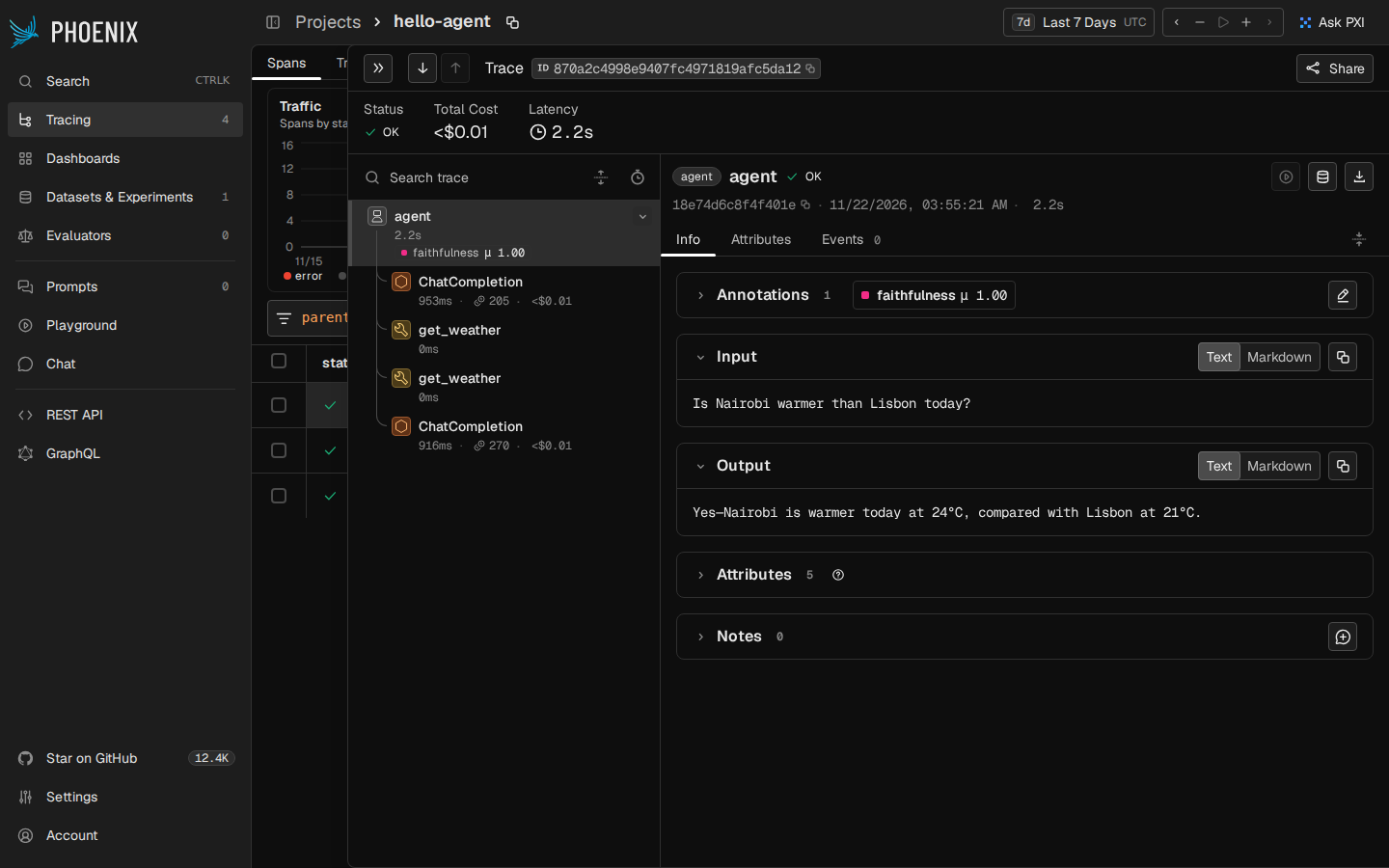
password manager. You're an admin. Open Tracing: the hello-agent
project has the test agent's trace from setup, with a faithfulness
verdict from the judge. The evaluators project holds the judge's own
model calls.
Setup also made a built-in admin, admin@localhost, with the password in
PHOENIX_ADMIN_PASSWORD. Keep it as a spare key: it's how you get back in
if you lose yours.
Trace an agent on the VM#
Setup left ~/phoenix/client.env, with Phoenix's address and an API key,
and three scripts. hello_agent.py is a small agent: GPT answers a travel
question through the gateway and calls a get_weather tool as often as it
needs. Run it with a question of your own:
cd ~/phoenix
set -a; . ./client.env; set +a
uv run hello_agent.py "Is it warmer in Tokyo or Nairobi today?"
It prints a trace ID and the answer, and the trace shows up under Tracing → hello-agent within seconds. The script shows the usual way in, a few lines at the top of any Python agent:
from phoenix.otel import register

tracer_provider = register(project_name="hello-agent", auto_instrument=True)
tracer = tracer_provider.get_tracer(__name__)
register() reads PHOENIX_COLLECTOR_ENDPOINT and PHOENIX_API_KEY from
the environment, which is all client.env sets. With
auto_instrument=True it turns on every OpenInference instrumentor
installed, here openinference-instrumentation-openai, so each OpenAI SDK
call becomes an LLM span with tokens and cost. @tracer.agent and
@tracer.tool wrap your own functions, so one run lands in one trace.
There are instrumentors for LangChain, LlamaIndex, the Anthropic SDK, the
Claude Agent SDK, CrewAI, and more; install the one you use.
Anything else that speaks OpenTelemetry can send traces too, over HTTP:
export OTEL_EXPORTER_OTLP_TRACES_ENDPOINT=http://localhost:6006/v1/traces
export OTEL_EXPORTER_OTLP_HEADERS="Authorization=Bearer%20$PHOENIX_API_KEY"
Ask Shelley on another VM to "add Arize Phoenix tracing to this agent" and point it at this page; it knows the gateway already.
Trace agents on other machines#
Port 6006 is private, so a request from another VM or your laptop gets
exe.dev's 401 before it reaches Phoenix. Each way in below still needs
the Phoenix API key from client.env. Use OpenTelemetry over HTTP, with
the endpoint ending in /v1/traces; gRPC on port 4317 doesn't pass
exe.dev's proxy.
From another exe.dev VM, with no token. Give that VM a VM-to-VM integration to Phoenix. On your computer:
ssh exe.dev integrations add http-proxy --name=phoenix \
  --target=https://my-phoenix.exe.xyz:6006/ --peer --attach=vm:my-agent
On my-agent, set PHOENIX_COLLECTOR_ENDPOINT=https://phoenix.int.exe.xyz/v1/traces
and PHOENIX_API_KEY. exe.dev adds a key at the network edge that
my-agent never sees, and only the VMs you attach can use it.
From your laptop or anywhere else, with a token. Make a token that opens this VM's HTTPS ports. On your computer:
ssh exe.dev ssh-key generate-api-key --vm=my-phoenix --label=phoenix-laptop --exp=1y
Phoenix's SDKs send extra headers from PHOENIX_CLIENT_HEADERS; exe.dev's
proxy checks X-Exedev-Authorization and removes it:
export PHOENIX_COLLECTOR_ENDPOINT=https://my-phoenix.exe.xyz:6006/v1/traces
export PHOENIX_API_KEY=...   # from ~/phoenix/client.env
export PHOENIX_CLIENT_HEADERS="X-Exedev-Authorization=Bearer%20$EXE_VM_TOKEN"
The scripts from setup then run unchanged on your laptop, tracing and
judging alike. With plain OpenTelemetry, add the same header to
OTEL_EXPORTER_OTLP_HEADERS, after a comma. The token gets its holder
past exe.dev's login to every port on this VM, though not past Phoenix's.
Keep it secret, add --ips= for a fixed address, and revoke it with
ssh exe.dev ssh-key remove phoenix-laptop.
Give each agent its own key under Settings → API Keys if you want to revoke one without the others.
Score answers with an LLM judge#
judge_agent.py fetches the last hour's agent runs from Phoenix, with the
tool results from the same trace, and asks gpt-5.4-mini through the
gateway whether each answer sticks to what the tools said. That's
Phoenix's built-in faithfulness evaluator, from arize-phoenix-evals. The
verdicts go back to Phoenix as faithfulness annotations, with the
judge's reasoning:
cd ~/phoenix
set -a; . ./client.env; set +a
uv run judge_agent.py
It prints faithful or unfaithful for each run. Open a trace to see the
annotation on its agent span, or filter spans by it. Each verdict is one
model call from your LLM allocation. Run it on a timer for a busy agent,
and change JUDGE_MODEL for a stronger judge. phoenix.evals has
evaluators for correctness, relevance, tool selection, and more, and
turns any prompt into a classifier of your own.
Compare prompts and models#
An experiment runs your agent over a dataset and scores each result, so
you can try a new prompt or model and see what got better or worse.
experiment_agent.py makes a dataset of three weather questions, runs
hello_agent.py on each one, and checks each answer names the right city:
cd ~/phoenix
set -a; . ./client.env; set +a
uv run experiment_agent.py
MODEL=gpt-5.5 uv run experiment_agent.py
Open Datasets & Experiments → weather-questions to see both runs side by side, with each answer, its score, latency, and cost. You can add production runs to a dataset from any trace with Add to Dataset.
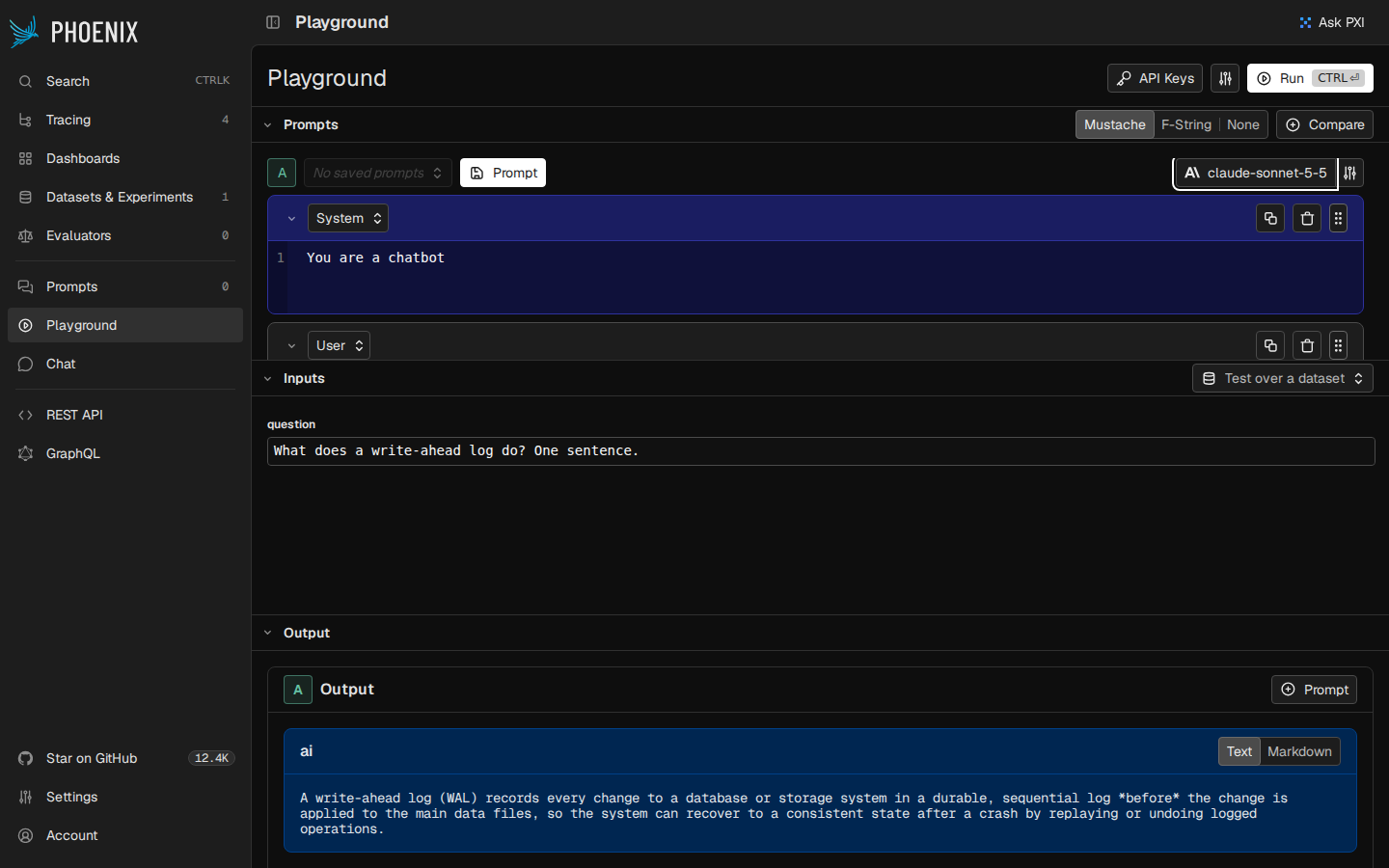
The Playground in the UI calls the gateway too: pick an OpenAI model
such as gpt-5.4-mini, or an Anthropic model such as claude-sonnet-5-5,
with no API key. Ask PXI, Phoenix's built-in assistant, uses the same
setup.
Bring your team#
Share the VM, then give each teammate a Phoenix account. On your computer:
ssh exe.dev share add my-phoenix teammate@example.com
In Phoenix, open Settings → Users → Add User, with their email, a
role (Member to work with traces, Viewer to look), and a first
password. They open the same URL, sign in to exe.dev, then to Phoenix,
and pick their own password. ssh exe.dev share remove my-phoenix teammate@example.com
locks someone out at exe.dev's door; delete their Phoenix user too.
Keep the disk in check#
Traces are most of what Phoenix stores. Setup keeps 90 days of them: every Sunday at midnight UTC, Phoenix deletes older traces. Change that, or set a different rule for one busy project, under Settings → Data Retention. Datasets, experiments, and prompts stay until you delete them. To see how much room traces take, on the VM:
df -h /
cd ~/phoenix && docker compose exec -T postgres psql -U phoenix -tc \
  "select pg_size_pretty(pg_database_size('phoenix'))"
If the disk fills, shorten retention, delete old projects, or grow the
disk with ssh exe.dev resize my-phoenix --disk=50GB and then
sudo resize2fs "$(findmnt -no SOURCE /)" on the VM.
Keep your traces#
Backups run nightly into ~/phoenix-backups: a PostgreSQL dump with
every trace, dataset, prompt, user, and API key, plus .env and the
scripts. Keep a copy off the VM. On your computer:
scp -r my-phoenix.exe.xyz:phoenix-backups .
Keep these files private: they hold your traces, and .env holds every
secret. To restore one or to update Phoenix, see the sections below, or
ask Shelley. For whole-VM backups to your own S3 bucket, see
VM backups. Something stuck? On the VM, try
cd ~/phoenix && docker compose ps and
docker compose logs --tail=100 phoenix.
Or run Opik#
Opik, from Comet, covers the same
ground: traces, LLM-as-a-judge metrics, datasets, experiments, and a
playground. Pick it over Phoenix if you want an Apache-2.0 license or
judges that run on the server as traces arrive. It is a bigger stack,
nine containers with MySQL, ClickHouse, Redis, ZooKeeper, and MinIO,
idling at about 2.6 GB of memory with 6 GB of images, and self-hosted
Opik has no user accounts: everyone you share the VM with sees
everything. Make the VM with room to spare, ssh exe.dev new --name=my-opik --disk=40GB,
then on it:
sudo systemctl enable --now docker.service
git clone --depth 1 --branch 2.2.152 https://github.com/comet-ml/opik.git ~/opik
cd ~/opik && OPIK_VERSION=2.2.152 ./opik.sh
The UI is at https://my-opik.exe.xyz:5173/, behind your exe.dev login.
On the VM, point the SDK at it with
OPIK_URL_OVERRIDE=http://localhost:5173/api and wrap your OpenAI client
with track_openai(OpenAI(base_url="https://llm.int.exe.xyz/v1", api_key="exe-llm-gateway")).
From your laptop, put a VM token in the URL as a password:
OPIK_URL_OVERRIDE=https://x:$EXE_VM_TOKEN@my-opik.exe.xyz:5173/api; the
SDK prints that URL, token and all, so keep its output private. Opik's
containers don't restart on their own, so after a reboot run the last line
again. To update, check out a newer tag and run it with that version.
The nuts and bolts#
Happy clicking Deploy? You can stop here. These are the same setup steps Shelley follows, plus the maintenance commands for later.
Install by hand
Create a VM#
On your computer (pick another name if my-phoenix is taken):
ssh exe.dev new --name=my-phoenix
ssh my-phoenix.exe.xyz
All remaining installation commands run on the VM, as exedev.
Commands use hostname, so your VM can have any name.
Get Docker ready#
Phoenix runs as two containers under Docker Compose. Enable Docker at
boot, or exe.dev's on-demand Docker won't restart Phoenix after a reboot.
Install jq and uv if needed:
sudo systemctl enable --now docker.service
systemctl is-enabled docker.service
command -v jq >/dev/null || sudo apt-get install -y jq
command -v uv >/dev/null || curl -LsSf https://astral.sh/uv/install.sh | sh
df -h /
The check should print enabled. The images take about 2 GB, so make sure
the disk has a few GB free.
Write the settings#
This makes ~/phoenix/.env, readable only by you, with random secrets, the
Phoenix version, how long to keep traces, and your account. It never
overwrites an existing .env:
mkdir -p ~/phoenix && cd ~/phoenix
if [ ! -e .env ]; then
  owner=$(curl -fsS https://reflection.int.exe.xyz/email | jq -r '.email // empty')
  touch .env && chmod 600 .env
  cat >> .env <<ENV
PHOENIX_VERSION=22.0.1
PHOENIX_SECRET=$(openssl rand -hex 32)
PHOENIX_ADMIN_PASSWORD=Px1-$(openssl rand -hex 12)
POSTGRES_PASSWORD=$(openssl rand -hex 24)
PHOENIX_RETENTION_DAYS=90
PHOENIX_OWNER_EMAIL=$owner
PHOENIX_OWNER_PASSWORD=Px1-$(openssl rand -hex 12)
ENV
fi
grep -E '^PHOENIX_(VERSION|OWNER_EMAIL)=' .env
Check the email is yours. If it's empty, the reflection integration didn't
answer: put the email you sign in to exe.dev with after
PHOENIX_OWNER_EMAIL=, with nano .env. PHOENIX_SECRET signs sessions
and encrypts any keys you save in Phoenix; don't change it later.
Write the Compose file#
The official image, pinned, with PostgreSQL, accounts and API keys on, and the gateway for the playground:
cd ~/phoenix
cat > compose.yaml <<'EOF'
# Arize Phoenix on one exe.dev VM, with PostgreSQL. Settings in .env.
name: phoenix

services:
  phoenix:
    image: docker.io/arizephoenix/phoenix:${PHOENIX_VERSION}
    restart: unless-stopped
    depends_on:
      postgres: { condition: service_healthy }
    ports:
      - "6006:6006"   # UI, REST API, and OpenTelemetry over HTTP (/v1/traces)
    environment:
      PHOENIX_SQL_DATABASE_URL: postgresql://phoenix:${POSTGRES_PASSWORD}@postgres:5432/phoenix
      PHOENIX_WORKING_DIR: /mnt/data
      PHOENIX_ENABLE_AUTH: "true"
      PHOENIX_SECRET: ${PHOENIX_SECRET}
      PHOENIX_DEFAULT_ADMIN_INITIAL_PASSWORD: ${PHOENIX_ADMIN_PASSWORD}
      PHOENIX_USE_SECURE_COOKIES: "true"
      # Only read on the first start; change it later under Settings.
      PHOENIX_DEFAULT_RETENTION_POLICY_DAYS: ${PHOENIX_RETENTION_DAYS}
      PHOENIX_TELEMETRY_ENABLED: "false"
      # The playground and assistant call models through exe.dev's LLM
      # gateway, which needs no key. The Anthropic SDK wants a value anyway.
      OPENAI_BASE_URL: https://llm.int.exe.xyz/v1
      ANTHROPIC_BASE_URL: https://llm.int.exe.xyz
      ANTHROPIC_API_KEY: exe-llm-gateway
    volumes:
      - ./data/phoenix:/mnt/data

  postgres:
    image: docker.io/postgres:17
    restart: unless-stopped
    environment:
      POSTGRES_USER: phoenix
      POSTGRES_PASSWORD: ${POSTGRES_PASSWORD}
      POSTGRES_DB: phoenix
    volumes:
      - ./data/postgres:/var/lib/postgresql/data
    healthcheck:
      test: ["CMD-SHELL", "pg_isready -U phoenix"]
      interval: 3s
      timeout: 3s
      retries: 10
EOF
mkdir -p data/phoenix data/postgres
docker compose config --quiet && echo config ok
Expect config ok. Only port 6006 is published, so PostgreSQL is
reachable from inside Docker's network alone. Port 4317, for gRPC, stays
closed; exe.dev's proxy can't carry it anyway.
Start Phoenix#
The first pull takes a minute or two:
cd ~/phoenix
docker compose up -d
until curl -fs http://localhost:6006/healthz >/dev/null; do sleep 3; done
curl -fsS http://localhost:6006/arize_phoenix_version; echo
docker compose ps --format '{{.Service}}: {{.Status}}'
Expect 22.0.1, then both services Up.
Make your account and an API key#
Sign in as the built-in admin, make you an admin account with a first
password, and make an API key for your agents, saved in client.env:
cd ~/phoenix
set -a; . ./.env; set +a
api=http://localhost:6006
jar=$(mktemp)
curl -fsS -c "$jar" -X POST $api/auth/login -H 'Content-Type: application/json' \
  -d "$(jq -n --arg p "$PHOENIX_ADMIN_PASSWORD" '{email: "admin@localhost", password: $p}')"
curl -fsS -b "$jar" -X POST $api/v1/users -H 'Content-Type: application/json' \
  -d "$(jq -n --arg e "$PHOENIX_OWNER_EMAIL" --arg p "$PHOENIX_OWNER_PASSWORD" \
    '{user: {email: $e, username: ($e | split("@")[0]), role: "ADMIN",
      auth_method: "LOCAL", password: $p}, send_welcome_email: false}')" \
  | jq -c '.data | {email, role}'
key=$(curl -fsS -b "$jar" -X POST $api/v1/system/api_keys -H 'Content-Type: application/json' \
  -d '{"data": {"name": "agents"}}' | jq -r .data.key)
(umask 077
 printf 'PHOENIX_COLLECTOR_ENDPOINT=%s\nPHOENIX_API_KEY=%s\n' "$api/v1/traces" "$key" > client.env)
rm -f "$jar"
cut -d= -f1 client.env
curl -s -o /dev/null -w 'without a key: %{http_code}\n' $api/v1/projects
Expect your email with role ADMIN, the two variable names, then
without a key: 401.
Send a test trace#
Fetch the three scripts. Each one is a uv script that brings its own dependencies:
- hello_agent.py:
a small GPT agent with a
get_weathertool, traced withphoenix.otel. - judge_agent.py: scores the last hour's answers with Phoenix's faithfulness evaluator and writes the verdicts back as annotations.
- experiment_agent.py: makes a three-question dataset and runs the agent over it as an experiment.
cd ~/phoenix
curl -fsSO https://exe.dev/deploy/arize-phoenix/hello_agent.py
curl -fsSO https://exe.dev/deploy/arize-phoenix/judge_agent.py
curl -fsSO https://exe.dev/deploy/arize-phoenix/experiment_agent.py
head -n 20 hello_agent.py
Run the agent, then the judge on its answer, then the first experiment:
cd ~/phoenix
set -a; . ./client.env; set +a
uv run hello_agent.py
uv run judge_agent.py
uv run experiment_agent.py
Expect a trace ID and an answer that Lisbon is warmer than Oslo by 17
degrees, then faithful (1.0) and Scored 1 answers., then an experiment
summary with three runs and three evaluations. Check the spans arrived:
cd ~/phoenix
set -a; . ./client.env; set +a
curl -fsS -H "Authorization: Bearer $PHOENIX_API_KEY" \
  'http://localhost:6006/v1/projects/hello-agent/spans?limit=100' \
  | jq -r '.data[] | .span_kind' | sort | uniq -c
Expect one AGENT span and a few LLM and TOOL spans, from the agent's
run. The experiment traces its runs in a project of its own, linked from
the experiment.
Set up nightly backups#
Phoenix keeps everything in PostgreSQL, so a dump while it runs is a complete backup:
cd ~/phoenix
cat > backup.sh <<'EOF'
#!/bin/sh
# Back up Phoenix: a PostgreSQL dump, plus .env, compose.yaml, and scripts.
set -eu
cd "$(dirname "$0")"
backups=$(dirname "$PWD")/phoenix-backups
out=$backups/phoenix-$(date -u +%Y%m%d-%H%M%S)
mkdir -p "$out"
chmod 700 "$backups" "$out"
docker compose exec -T postgres pg_dump -U phoenix -Fc phoenix > "$out/postgres.dump"
tar -czf "$out/files.tar.gz" --exclude=./data .
chmod 600 "$out"/*
# Keep the 7 newest backups.
ls -1d "$backups"/phoenix-*/ | head -n -7 | xargs -r rm -rf
echo "Backed up to $out"
EOF
chmod 755 backup.sh
sudo tee /etc/systemd/system/phoenix-backup.service >/dev/null <<EOF
[Unit]
Description=Back up Phoenix to ~/phoenix-backups
Requires=docker.service
After=docker.service

[Service]
Type=oneshot
User=$USER
ExecStart=$HOME/phoenix/backup.sh
EOF
sudo tee /etc/systemd/system/phoenix-backup.timer >/dev/null <<'EOF'
[Unit]
Description=Back up Phoenix every night

[Timer]
OnCalendar=*-*-* 03:30:00
RandomizedDelaySec=30m
Persistent=true

[Install]
WantedBy=timers.target
EOF
sudo systemctl daemon-reload
sudo systemctl enable --now phoenix-backup.timer
sudo systemctl start phoenix-backup.service
systemctl list-timers phoenix-backup.timer
ls -lh ~/phoenix-backups/*/
Check that the timer has a next run and the backup has postgres.dump and
files.tar.gz. For failures: journalctl -u phoenix-backup.service.
Test a backup#
Load the newest dump into a throwaway PostgreSQL container and count the spans, without touching the running one:
latest=$(ls -1d ~/phoenix-backups/phoenix-*/ | tail -n 1)
docker run -d --name phoenix-restore-test -e POSTGRES_PASSWORD=test postgres:17
until docker exec phoenix-restore-test pg_isready -U postgres >/dev/null 2>&1; do sleep 1; done; sleep 2
docker exec -i phoenix-restore-test pg_restore -U postgres -d postgres --no-owner < "$latest/postgres.dump"
docker exec phoenix-restore-test psql -U postgres -tc 'select count(*) from spans'
docker rm -f phoenix-restore-test
Expect a span count above zero. The last line removes only the test container.
Installation done. Leave sharing and other machines to the owner; continue with Open Phoenix.
Back up and restore
On the VM, ~/phoenix/backup.sh makes an extra backup and prints its
path. Copy backups off the VM as shown in Keep your traces.
Restore#
On a new VM, get Docker ready as in Install. Create
~/phoenix-backups there, then copy a backup over from your computer:
scp -r phoenix-backups/phoenix-20261122-033012 my-phoenix.exe.xyz:phoenix-backups/
Use your backup's actual name here and below. All remaining commands run on the VM. If Phoenix already runs there, stop it and keep its directory aside first:
cd ~/phoenix && docker compose down
sudo mv ~/phoenix ~/phoenix.before-restore
Unpack the backup, load the dump before Phoenix starts, then start it:
backup=~/phoenix-backups/phoenix-20261122-033012
mkdir ~/phoenix && cd ~/phoenix
tar -xzf "$backup/files.tar.gz"
mkdir -p data/phoenix data/postgres
docker compose up -d --wait postgres
docker compose exec -T postgres pg_restore -U phoenix -d phoenix --clean --if-exists --no-owner < "$backup/postgres.dump"
docker compose up -d
until curl -fs http://localhost:6006/healthz >/dev/null; do sleep 3; done; echo up
Sign in and check your traces are there; your API keys and accounts come
back too. If the VM's name changed, update the URL in your agents. On a
new VM, recreate the backup timer from Install.
Keep ~/phoenix.before-restore until you're happy everything is back.
Update Phoenix
PHOENIX_VERSION in .env pins the release. Phoenix ships often; read the
release notes and the
migration guide,
then on the VM back up, set the new version, and restart:
cd ~/phoenix
./backup.sh
sed -i 's/^PHOENIX_VERSION=.*/PHOENIX_VERSION=22.1.0/' .env
docker compose pull
docker compose up -d
until curl -fs http://localhost:6006/healthz >/dev/null; do sleep 3; done
curl -fsS http://localhost:6006/arize_phoenix_version; echo
docker image prune -f
Use the version you want in place of 22.1.0. Phoenix migrates its
database on start, and the version line shows the new one when it's
done. To roll back, restore the backup: an older version
won't run on a migrated database. Your agents' Phoenix packages update
separately.
Don't change PostgreSQL's major version in place; that needs a dump and restore.
Something not working?
The page says 401 or shows exe.dev's login. That's exe.dev's proxy: sign in to exe.dev with an account the VM is shared with. From scripts, use one of the ways in Trace agents on other machines.
A script gets 401 Invalid token or Unauthorized. That's Phoenix:
set PHOENIX_API_KEY, and check the key wasn't deleted under
Settings → API Keys.
Traces don't show up. The endpoint must end in /v1/traces. Without
a path, register() assumes gRPC on port 4317, which isn't open. Short
scripts must call tracer_provider.force_flush() before they exit. Look
for errors with docker compose logs --tail=100 phoenix.
The playground says a model has no credentials. Pick an OpenAI or Anthropic model that the gateway serves. If an older Claude model says adaptive thinking is not supported, pick a newer one, or turn thinking off in the model's settings. Keys saved under Settings → AI Providers override the gateway for that provider; delete them to go back.
Lost your password. Sign in as admin@localhost with
PHOENIX_ADMIN_PASSWORD from .env (or the password you changed it to),
and reset yours under Settings → Users.
The disk is filling up. See Keep the disk in check.
Frequently asked questions#
How much does it cost?
Phoenix is free to self-host. You pay for your VM plan, and your agents' model calls, the judge, and the playground use your exe.dev LLM allocation. Tracing itself makes no model calls.
What size VM do I need?
A default VM is plenty. Phoenix and PostgreSQL idle at about 600 MB of memory, and the images take about 2 GB of disk. Traces grow with your traffic: check with the commands in Keep the disk in check, and grow the VM with ssh exe.dev resize if you need to.
Is Arize Phoenix open source?
Its source is public under the Elastic License 2.0. You can run it for yourself and your company for free; you can't sell it as a hosted service. Every feature here, including accounts and API keys, is in the free version.
Who can see my traces?
Only people you share the VM with get past exe.dev's login, and they still need a Phoenix account. Traces hold your agents' prompts, tool results, and replies, so treat them like your app's data. Every API call needs a Phoenix API key as well.
Can I send traces over gRPC on port 4317?
Only from the VM itself. exe.dev's proxy carries HTTPS, so other machines use OpenTelemetry over HTTP at /v1/traces on port 6006, which every Phoenix and OpenTelemetry SDK supports. For gRPC from outside, put both machines on a private network such as Tailscale.
Does it work with LangChain, LlamaIndex, CrewAI, the Claude Agent SDK, and the rest?
Yes. Phoenix reads OpenTelemetry with OpenInference conventions, and OpenInference has instrumentors for most agent frameworks and model SDKs. Install the one you need next to arize-phoenix-otel and register(auto_instrument=True) picks it up.
Langfuse, Phoenix, or Opik?
All three trace agents, score them with LLM judges, and keep prompts and datasets. Phoenix is the lightest: one container on PostgreSQL, built on OpenTelemetry, with evals and experiments you run from Python. Langfuse also runs judges on the server as traces arrive, on a bigger stack with ClickHouse. Opik is Apache-2.0 and runs judges on the server too, but self-hosted it has no user accounts. See Or run Opik.
Published Nov 23, 2026 · Updated Nov 22, 2026 · tested end to end Nov 22, 2026 · Markdown · manifest.json · Something wrong? Tell us