---
title: "Self-host Kaneo"
description: "Run Kaneo, the MIT-licensed issue tracker, on an exe.dev VM: boards, backlog and Gantt, signed in with exe.dev, agents on its CLI and MCP."
url: https://exe.dev/deploy/kaneo
category: "Productivity"
updated: 2026-11-17
---
# Self-host Kaneo
> **For agents:** with your user's OK, this sets up Kaneo on a new exe.dev VM in their account: `curl -fsSL https://exe.dev/deploy/kaneo/prompt.txt | ssh exe.dev new --prompt=/dev/stdin` (or open https://exe.dev/deploy/kaneo/new). Already on the VM? Skip this.
A light, fully open-source issue tracker that your agents can work from too.
- **Software:** Kaneo (https://kaneo.app)
- **Source:** https://github.com/usekaneo/kaneo
- **License:** MIT
- **Time:** 10 minutes
- **Example VM name:** `my-kaneo` (yours will differ; on the VM, `hostname` prints it)
- **Machine-readable:** https://exe.dev/deploy/kaneo/manifest.json
## What you get
- Kaneo 2 with PostgreSQL at `https://my-kaneo.exe.xyz/`, behind your exe.dev login, restarted after a reboot.
- Sign-in with exe.dev, through Dex: no Kaneo passwords. Your account becomes the admin; teammates you invite get theirs on their first visit.
- Secrets generated on the VM in `~/kaneo/.env` (mode 600), which is also where the agents' API key goes.
- The `kaneo` CLI and the `kaneo-mcp` MCP server on the VM, ready for Claude Code, Codex and Shelley once there's an API key.
- Nightly database backups in `~/kaneo/backups`, keeping two weeks.
Running on the VM:
- **Kaneo 2**: ghcr.io/usekaneo/kaneo:2 in Docker Compose: the web app, REST API and MCP endpoint in one container
- **Dex**: ghcr.io/dexidp/dex: an OpenID Connect provider that signs people in to Kaneo from exe.dev's login headers
- **nginx**: nginx:stable-alpine on 127.0.0.1:8000: /dex/ to Dex, everything else to Kaneo, port 8000
- **PostgreSQL 16**: postgres:16-alpine in Docker Compose, data in `Docker volume kaneo_postgres_data`
- **Agent tools**: the `kaneo` CLI and `kaneo-mcp` (the official @kaneo/mcp server, in a Node 24 container), both using the API key in ~/kaneo/.env
- **Nightly backup**: a systemd timer running pg_dump; keeps two weeks, data in `~/kaneo/backups`
How it is reached:
- https://my-kaneo.exe.xyz/ (private): Kaneo, signed in with your exe.dev login
- https://my-kaneo.exe.xyz/api/ (private): the REST API, for agents elsewhere with an exe.dev VM token and a Kaneo API key
## Deploy with Shelley
Open https://exe.dev/deploy/kaneo/new to create a VM whose agent, Shelley, follows this recipe. From a terminal:
```sh
curl -fsSL https://exe.dev/deploy/kaneo/prompt.txt | ssh exe.dev new --prompt=/dev/stdin
```
Or follow the steps below by hand.
[Kaneo](https://kaneo.app) is a project tracker: boards, a backlog, list,
Gantt and calendar views, custom fields, time tracking, and two-way sync
with GitHub, GitLab and Gitea issues. It's MIT-licensed, with no paid
edition, and small: one application container plus PostgreSQL.
On an exe.dev VM it's always on, at an HTTPS address that only you and
the people you [share the VM with](/docs/sharing) can reach, and
everyone signs in with their exe.dev login: no Kaneo passwords. Kaneo's
REST API, its CLI and its MCP server let Claude Code, Codex or Shelley
file, update and close tasks next to you.
## Create your account
Open `https://my-kaneo.exe.xyz/` and sign in to exe.dev if asked. Kaneo
signs you in with that login and makes your account; the first account
on a new instance becomes its administrator, which is why setup leaves
the first visit to you. If Kaneo shows **Set up your Kaneo instance**
instead, choose **Continue with exe.dev** at the bottom, not the form.
Kaneo then asks for a workspace name (your team or company), who it's
for, and a first
project, which it fills with five starter tasks to show you around. A
project named `API` numbers its tasks `API-1`, `API-2` and so on.
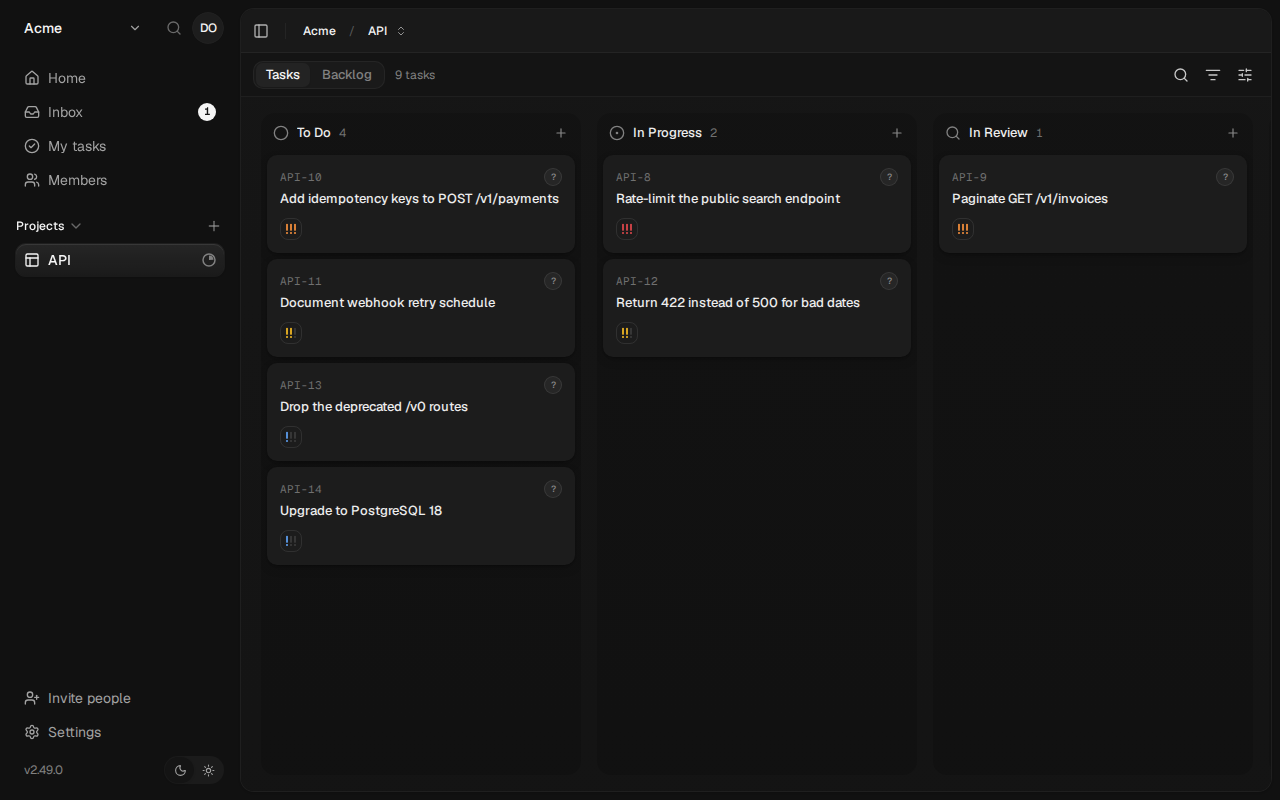
A project board. These tasks were filed, and moved, with the kaneo CLI.
From then on, opening Kaneo signs you straight in. Your name starts out
as your email address; change it under **Settings → Profile**. Signing
out of Kaneo leads to a page that can sign you out of exe.dev too;
otherwise **Sign in again** gets you back without a password.
## Bring your team
On your computer, give each teammate access to the VM:
```bash
ssh exe.dev share add my-kaneo alice@example.com
```
Then invite the same email in Kaneo: **Members** in the workspace
sidebar, **Invite member**. You can skip the link the dialog offers. They open `https://my-kaneo.exe.xyz/`,
sign in to exe.dev, and Kaneo makes their account and offers the
invitation to accept. Only people with an invitation get an account, and
invitations expire after two days.
`ssh exe.dev share remove my-kaneo alice@example.com` takes the VM away
again; to take them out of the workspace too, use **Members**, and to
lock their account, **Settings → Administration → Users**.
## Connect your agents
Agents use an API key that acts as you. In Kaneo, open **Settings**,
then **API keys** under **Account**, and choose **New key**. Name it
`agents`, pick when it expires, and copy it: Kaneo shows it only once. On the VM, save it in Kaneo's secrets file, then pick the
workspace the CLI works in by its slug (the first command lists them):
```bash
read -rsp 'Kaneo API key: ' key && echo "KANEO_API_KEY=$key" >> ~/kaneo/.env && unset key; echo
kaneo workspace list --jq '.[] | "\(.slug) \(.name)"'
kaneo workspace use your-workspace-slug
kaneo whoami --jq .user.email
```
Expect your workspaces, then your email. Setup installed two tools that read the key from
`~/kaneo/.env`, so it never has to be pasted anywhere else:
- `kaneo`, Kaneo's [CLI](https://kaneo.app/docs/cli): one binary with JSON
output, made for scripts and agents. Shelley, Claude Code and Codex on
this VM can use it from their shell with no setup.
- `kaneo-mcp`, Kaneo's [MCP server](https://kaneo.app/docs/core/integrations/mcp)
over stdio, for agents that prefer tools to commands.
To give Claude Code and Codex on this VM the MCP tools too:
```bash
claude mcp add kaneo --scope user -- kaneo-mcp
codex mcp add kaneo -- kaneo-mcp
claude mcp list
```
Expect `kaneo: kaneo-mcp - ✔ Connected`. The first start takes up to a
minute while Docker fetches the package; later starts take seconds.
The CLI's own [agent skill](https://github.com/usekaneo/kaneo/tree/main/skills/kaneo-cli)
teaches Claude Code its conventions. To add it:
```bash
mkdir -p ~/.claude/skills/kaneo-cli
curl -fsSL -o ~/.claude/skills/kaneo-cli/SKILL.md \
https://raw.githubusercontent.com/usekaneo/kaneo/main/skills/kaneo-cli/SKILL.md
```
## Try it
Create, update and close a task with the CLI, on the VM (use your
project's key in place of `API`):
```bash
id=$(kaneo task create "Rotate the staging TLS certificate" -p API --priority high --jq .ticketId)
kaneo task status "$id" in-progress
kaneo task comment "$id" "Renewed and deployed."
kaneo task status "$id" done
kaneo task view "$id" --jq '{ticketId, status}'
```
The last line shows `"status":"done"`, and the task sits in **Done** on
the board with the comment. Or ask an agent:
> Use the kaneo MCP tools: in project API, create a task "Write the
> release notes for 1.2" with priority high, move it to in-progress,
> comment "Drafted, see docs/release-1.2.md", then move it to done.
> Use the kaneo CLI to file a task in project API for each TODO comment
> in this repository, then list the open tasks.
Things agents do are signed with your name, because the key is yours. To
tell them apart, invite an account for your agents (say
`agents@example.com`) and create the API key while signed in as it.
### From your computer or another VM
The API is behind exe.dev's proxy too, so a remote script needs two
keys: an exe.dev [VM token](/docs/https-tokens-for-vms) for the proxy,
and the Kaneo API key. Create the VM token on your computer:
```bash
ssh exe.dev ssh-key generate-api-key --vm=my-kaneo --label=kaneo-agents --exp=90d
```
Then list your workspaces with both:
```bash
curl -sS https://my-kaneo.exe.xyz/api/workspace \
-H "X-Exedev-Authorization: Bearer exe1.paste-vm-token-here" \
-H "Authorization: Bearer paste-kaneo-api-key-here"
```
The proxy checks and removes `X-Exedev-Authorization`; Kaneo checks
`Authorization`. Every call in the
[API reference](https://kaneo.app/docs/api-reference/introduction) works
this way. Kaneo's CLI and MCP server can't send the extra header, so
run those on the Kaneo VM, or make Kaneo public (below).
## Open it to the internet (optional)
Making the VM public lets in things that can't send an exe.dev token:
`kaneo login` from your laptop, MCP clients that sign in with OAuth at
`https://my-kaneo.exe.xyz/api/mcp`, and the webhooks that
[GitHub sync](https://kaneo.app/docs/core/integrations/github/setup)
needs. On your computer:
```bash
ssh exe.dev share set-public my-kaneo
```
Signing in still goes through exe.dev: visitors who aren't signed in to
exe.dev are sent to its login first. Any exe.dev user can then get that
far, but only people you've invited get an account, so keep invitations
to people you know. `ssh exe.dev share set-private my-kaneo` closes the
VM again.
## The nuts and bolts
Happy with what Shelley set up? Stop here. Below are the steps it
followed, and maintenance for later.
Set up by hand
### Create the VM
On your computer (pick another name if `my-kaneo` is taken):
```bash
ssh exe.dev new --name=my-kaneo
ssh my-kaneo.exe.xyz
```
Everything else runs **on the VM**.
### Write the settings
This generates the database password and Kaneo's secrets into
`~/kaneo/.env`, readable only by you. `KANEO_CLIENT_URL` is the address
people use; Kaneo checks browser requests against it.
The `CUSTOM_OAUTH_` lines make exe.dev the way in. Kaneo signs people in
through [Dex](https://dexidp.io), an OpenID Connect provider that runs
beside it and takes who someone is from the `X-ExeDev-Email` and
`X-ExeDev-UserID` headers that exe.dev's proxy adds to every request
([Login with exe](/docs/login-with-exe)). Browsers reach Dex at `/dex/`
through the proxy; Kaneo's server reaches it directly at
`http://dex:5556`. The `DISABLE_` lines turn off Kaneo's own passwords
and open sign-up, so an account takes an exe.dev login and, after the
first, an invitation.
```bash
mkdir -p ~/kaneo && cd ~/kaneo
url=https://$(hostname).exe.xyz
(umask 077; cat > .env < dex.yaml < nginx.conf <<'EOF'
# Port 8000, where exe.dev's proxy sends everything: /dex/ to Dex, the rest to Kaneo.
map $http_upgrade $connection_upgrade {
default upgrade;
'' close;
}
server {
listen 80;
absolute_redirect off;
client_max_body_size 50m;
resolver 127.0.0.11 valid=10s;
set $kaneo http://kaneo:5173;
set $dex http://dex:5556;
location /dex/ {
# Visitors to a public VM may not be signed in to exe.dev yet.
if ($http_x_exedev_email = "") {
return 302 /__exe.dev/login?redirect=/;
}
proxy_pass $dex;
proxy_set_header Host $host;
}
location = /api/auth/sign-up/email {
default_type application/json;
return 403 '{"code":"LOCAL_REGISTRATION_DISABLED","message":"Use Continue with exe.dev."}';
}
location = /signed-out {
default_type text/html;
return 200 'Signed out of Kaneo
';
}
location / {
proxy_pass $kaneo;
proxy_set_header Host $host;
proxy_http_version 1.1;
proxy_set_header Upgrade $http_upgrade;
proxy_set_header Connection $connection_upgrade;
proxy_read_timeout 1h;
}
}
EOF
```
### Start Kaneo
This is Kaneo's [Compose file](https://kaneo.app/docs/core/installation/docker-compose),
with the image on the `2` tag (Kaneo 2's newest release), plus Dex and
nginx. Only nginx has a port, on 127.0.0.1, so from outside the VM, Dex
can be reached only through exe.dev's proxy, which sets the headers it
trusts. Docker is enabled at boot so Kaneo comes back after a reboot.
```bash
sudo systemctl enable --now docker.service
cd ~/kaneo
cat > compose.yml <<'EOF'
name: kaneo
services:
postgres:
image: postgres:16-alpine
environment:
POSTGRES_USER: ${POSTGRES_USER:-kaneo}
POSTGRES_DB: ${POSTGRES_DB:-kaneo}
POSTGRES_PASSWORD: ${POSTGRES_PASSWORD:?Set POSTGRES_PASSWORD in .env}
volumes:
- postgres_data:/var/lib/postgresql/data
restart: unless-stopped
healthcheck:
test: ["CMD-SHELL", 'pg_isready -U "$${POSTGRES_USER}" -d "$${POSTGRES_DB}"']
interval: 10s
timeout: 5s
retries: 5
kaneo:
image: ghcr.io/usekaneo/kaneo:2
env_file:
- .env
depends_on:
postgres:
condition: service_healthy
restart: unless-stopped
healthcheck:
test: ["CMD", "wget", "-Y", "off", "--quiet", "--spider", "http://127.0.0.1:5173/api/health"]
interval: 30s
timeout: 5s
start_period: 60s
retries: 3
dex:
image: ghcr.io/dexidp/dex:v2.46.1
command: ["dex", "serve", "/etc/dex/dex.yaml"]
environment:
DEX_CLIENT_SECRET: ${CUSTOM_OAUTH_CLIENT_SECRET:?Set CUSTOM_OAUTH_CLIENT_SECRET in .env}
volumes:
- ./dex.yaml:/etc/dex/dex.yaml:ro
restart: unless-stopped
web:
image: nginx:stable-alpine
ports:
- "127.0.0.1:8000:80"
volumes:
- ./nginx.conf:/etc/nginx/conf.d/default.conf:ro
depends_on:
- kaneo
- dex
restart: unless-stopped
volumes:
postgres_data:
EOF
docker compose up -d --wait --wait-timeout 300
docker compose ps
```
The first start downloads the images and runs the database migrations;
`postgres` and `kaneo` should end up `healthy`, `dex` and `web` `Up`.
Then:
```bash
curl -fsS http://localhost:8000/api/health; echo
curl -fsS http://localhost:8000/api/instance/status; echo
curl -fsS http://localhost:8000/dex/.well-known/openid-configuration -H 'X-ExeDev-Email: test' | grep '"issuer"'
```
Expect `{"status":"ok"}`, then `{"hasUsers":false,"hasAdmin":false}` (the
first account is still to be made), then Dex's issuer, this VM's address
followed by `/dex`.
### Add the agent tools
Kaneo's CLI is one binary. Install it out of the way, then put a small
`kaneo` command on everyone's `PATH` that points it at this Kaneo with
the API key from `~/kaneo/.env`. `kaneo-mcp` does the same for Kaneo's
MCP server, which needs Node 24, so it runs in Docker:
```bash
curl -fsSL https://kaneo.app/cli/install.sh | KANEO_INSTALL_DIR="$HOME/.local/share/kaneo-cli" sh
sudo tee /usr/local/bin/kaneo >/dev/null <<'EOF'
#!/bin/sh
# The Kaneo CLI, pointed at this VM's Kaneo with the API key in ~/kaneo/.env.
: "${KANEO_API_URL:=http://localhost:8000}"
[ -n "${KANEO_API_KEY:-}" ] || KANEO_API_KEY=$(sed -n 's/^KANEO_API_KEY=//p' "$HOME/kaneo/.env")
export KANEO_API_URL KANEO_API_KEY
exec "$HOME/.local/share/kaneo-cli/kaneo" "$@"
EOF
sudo tee /usr/local/bin/kaneo-mcp >/dev/null <<'EOF'
#!/bin/sh
# Kaneo's MCP server (stdio) for agents on this VM: the official @kaneo/mcp
# package, run in Docker because it needs Node 24, with the API key in ~/kaneo/.env.
KANEO_API_KEY=$(sed -n 's/^KANEO_API_KEY=//p' "$HOME/kaneo/.env")
[ -n "$KANEO_API_KEY" ] || { echo "kaneo-mcp: no KANEO_API_KEY in ~/kaneo/.env" >&2; exit 1; }
export KANEO_API_KEY KANEO_API_URL=http://localhost:8000
exec docker run -i --rm --network host -e KANEO_API_KEY -e KANEO_API_URL \
-e NPM_CONFIG_UPDATE_NOTIFIER=false -v kaneo-mcp-npm:/root/.npm \
node:24-alpine npx -y @kaneo/mcp@0.1 serve
EOF
sudo chmod 755 /usr/local/bin/kaneo /usr/local/bin/kaneo-mcp
docker pull -q node:24-alpine
kaneo doctor --human
```
The installer says its folder isn't on your `PATH` and suggests adding
it: don't. The `kaneo` in `/usr/local/bin` is the one that knows this
server and the API key; putting the installer's folder first on `PATH`
hides it, and `kaneo` then says it isn't signed in.
`kaneo doctor` should reach the server and report that you aren't signed
in yet: there's no API key until you create one in
[Connect your agents](#connect-your-agents).
### Back up nightly
`backup.sh` dumps the database with `pg_dump` while Kaneo runs, checks
that the dump reads back, adds `compose.yml` and `.env`, and keeps the 14
newest archives. A systemd timer runs it every night:
```bash
cd ~/kaneo
cat > backup.sh <<'EOF'
#!/bin/sh
# Back up Kaneo to ~/kaneo/backups/kaneo-Back up and restore
On the VM, `~/kaneo/backup.sh` backs up now and prints the archive's
path. To copy the backups to your computer:
```bash
scp 'my-kaneo.exe.xyz:kaneo/backups/kaneo-*.tar' .
```
The archives contain `.env`, with your secrets and API key: keep them
private.
### Restore
This replaces the database with the backup's, and carries over the
backup's `AUTH_SECRET`, notification key and API key; the database
password stays this VM's. It works on the same VM or, after
[Set up by hand](#create-the-vm), on a new one (copy the archive over
with `scp` first). On the VM, with your archive's name:
```bash
cd ~/kaneo
backup=backups/kaneo-20261117-033012.tar
rm -rf /tmp/kaneo-restore && mkdir -m 700 /tmp/kaneo-restore
tar -xf "$backup" -C /tmp/kaneo-restore
./backup.sh
docker compose stop kaneo
for k in AUTH_SECRET NOTIFICATION_SECRET_ENCRYPTION_KEY KANEO_API_KEY; do
v=$(sed -n "s/^$k=//p" /tmp/kaneo-restore/.env)
[ -n "$v" ] && sed -i "/^$k=/d" .env && echo "$k=$v" >> .env
done
docker compose exec -T postgres sh -c \
'dropdb -U "$POSTGRES_USER" --force "$POSTGRES_DB" && createdb -U "$POSTGRES_USER" "$POSTGRES_DB"'
docker compose exec -T postgres sh -c \
'pg_restore -U "$POSTGRES_USER" -d "$POSTGRES_DB" --no-owner --exit-on-error' \
< /tmp/kaneo-restore/database.dump
docker compose up -d --wait kaneo
rm -rf /tmp/kaneo-restore
```
The first `./backup.sh` saves what you're about to replace. Sign in and
check a few projects. Anything created after the backup is gone.
Update
Kaneo releases most weeks. The `2` tag follows Kaneo 2, so updating is
a pull. Back up first, then, on the VM:
```bash
cd ~/kaneo
./backup.sh && docker compose pull && docker compose up -d --wait
curl -fsS http://localhost:8000/api/health; echo
```
Kaneo runs its database migrations on start. Read the
[release notes](https://github.com/usekaneo/kaneo/releases) before moving
to a new major version. To update the CLI, rerun its install command
from [Set up by hand](#create-the-vm); `kaneo-mcp` picks up new 0.1
releases of the MCP server by itself. Dex stays on the version in
`compose.yml`; to move to a newer one, change its tag there, check Dex's
[release notes](https://github.com/dexidp/dex/releases), and run
`docker compose up -d dex`. Kaneo has its own guide for
[moving PostgreSQL 16 to 18](https://kaneo.app/docs/core/operations/postgresql-18).
Something not working?
On the VM, the containers and Kaneo's log:
```bash
cd ~/kaneo
docker compose ps
docker compose logs --tail=50 kaneo dex web
```
**Kaneo is down after a reboot.** Run
`sudo systemctl enable --now docker.service`; the containers restart
with Docker.
**Sign-in or live updates fail.** Every address in `~/kaneo/.env`
(`KANEO_CLIENT_URL` and the `CUSTOM_OAUTH_` URLs that start with
`https://`) and in `~/kaneo/dex.yaml` must use exactly the address in your
browser, `https://my-kaneo.exe.xyz`. After changing them, run
`docker compose up -d --force-recreate kaneo dex`; a plain restart keeps
the old settings.
**A teammate sees "Registration not allowed" ("Accounts here are invite-only").** Kaneo found no
open invitation for the email they're signed in to exe.dev with. Invite
exactly that address, or resend an invitation older than two days, then
have them open Kaneo again.
**"Use Continue with exe.dev" on the setup page.** Kaneo's form was used
for the first account. Choose **Continue with exe.dev** instead.
**`/dex/` redirects to `/__exe.dev/login`, or Dex says `required HTTP header
X-ExeDev-Email is not set`.** A request reached Dex without exe.dev's
headers, which happens only from the VM itself. Open Kaneo at
`https://my-kaneo.exe.xyz/`.
**Signed out, but signed straight back in.** That's exe.dev's login at
work: Kaneo sends you to it and it knows you. Use **Sign out of exe.dev
too** on the page after signing out.
**`kaneo` says it isn't signed in, or `kaneo-mcp` says there's no key.**
Check that `~/kaneo/.env` has a `KANEO_API_KEY=` line with the full key,
and that the key still exists, unexpired, under **Settings → API keys**.
**`429 Too Many Requests` for an agent.** An API key may make 100
requests a minute; wait the `Retry-After` seconds.
**An agent elsewhere gets `401` or an HTML login page.** No valid exe.dev
token reached the proxy. Check the `X-Exedev-Authorization` header, the
`Bearer ` before the token, and that the token is for this VM and hasn't
expired.
## Frequently asked questions
### Is Kaneo really free? What's paywalled?
Nothing in the software. Kaneo is MIT-licensed with one edition: single sign-on, the GitHub, GitLab and Gitea sync, time tracking, the API and MCP are all in the build you run here. The maintainers sell hosting ([Kaneo Cloud and managed instances](https://kaneo.app/pricing)), and the iPhone app is free with Kaneo Cloud but costs a one-time $9.99 per person to connect to a self-hosted server.
### How much does it cost to self-host Kaneo on exe.dev?
Just your [VM plan](https://exe.dev/pricing). Kaneo and PostgreSQL use 250–500 MB of memory together, Dex and nginx about 15 MB more, so they fit comfortably on a default VM next to other things. Your agents' model use bills wherever those agents run.
### How does the exe.dev sign-in work?
Kaneo signs people in with any OpenID Connect provider, and exe.dev isn't one, so [Dex](https://dexidp.io) stands in. Its `authproxy` connector believes the `X-ExeDev-Email` and `X-ExeDev-UserID` headers, which exe.dev's proxy sets on every request to a private VM and strips from what browsers send. Only nginx on 127.0.0.1:8000 leads to Dex, so from outside, those headers come from exe.dev. A program on the VM itself can send them too and sign in as anyone, as it could with any app that trusts its proxy; it could read the database anyway. Kaneo's own settings ([Custom OAuth/OIDC](https://kaneo.app/docs/core/social-providers/custom-oauth)) turn off its passwords and send everyone to Dex.
### Why does the MCP server run in Docker instead of using Kaneo's /api/mcp?
Kaneo's built-in endpoint at `/api/mcp` signs clients in with OAuth in a browser and doesn't accept API keys, and an agent on the VM can't complete that sign-in against the private URL. The official `@kaneo/mcp` package takes an API key, but needs Node 24, which exe.dev's image doesn't have, so `kaneo-mcp` runs it in the `node:24-alpine` image. If you [make Kaneo public](#open-it-to-the-internet-optional), MCP clients that support OAuth can use `https://my-kaneo.exe.xyz/api/mcp` directly.
### Can I attach files to tasks?
Not with this setup. Kaneo keeps attachments in S3-compatible storage, which it needs to reach from both the server and your browser. Add [Silo](https://kaneo.app/docs/core/installation/silo) or a bucket elsewhere if you need them; everything else works without it.
### Kaneo or Plane?
Kaneo is one container plus PostgreSQL with nothing held back for a paid edition. [Plane](/deploy/plane) has more (cycles, modules, pages, intake) but needs more machine and keeps some features for its commercial edition. The [issue tracker roundup](/deploy/issue-tracker) compares them all.
## Related
- [Self-hosted issue tracker](https://exe.dev/deploy/issue-tracker.md): Choose an issue tracker to run on your own VM, for your team and your agents.
- [Self-host Plane](https://exe.dev/deploy/plane.md): Linear-style issue tracking for your team and your agents, on your own VM.
- [Self-host Kanboard](https://exe.dev/deploy/kanboard.md): A small, sturdy kanban board that signs your team in with exe.dev.
- [Self-host OpenProject](https://exe.dev/deploy/openproject.md): Work packages, Gantt charts and boards that sign your team in with exe.dev.
- [Self-host Kanzo, one kanban board for you and your agents](https://exe.dev/deploy/kanzo.md): One kanban board, behind your exe.dev login, that all your agents work from.
- [Forgejo](https://exe.dev/deploy/forgejo.md): Self-hosted Git forge with exe.dev SSO