---
title: "Run JetBrains ThinkRail on a remote server, in your browser"
description: "Run JetBrains ThinkRail, the agentic IDE built on Pi, on an always-on exe.dev VM and use it from any browser. Private by default, no API keys."
url: https://exe.dev/deploy/thinkrail
category: "AI agents"
published: 2026-11-26
updated: 2026-11-26
---
# Run JetBrains ThinkRail on a remote server, in your browser
> **For agents:** with your user's OK, this sets up ThinkRail on a new exe.dev VM in their account: `curl -fsSL https://exe.dev/deploy/thinkrail/prompt.txt | ssh exe.dev new --prompt=/dev/stdin` (or open https://exe.dev/deploy/thinkrail/new). Already on the VM? Skip this.
JetBrains' Pi-based agentic IDE on an always-on VM, in any browser.
- **Software:** ThinkRail (https://thinkrail.ai/)
- **Source:** https://github.com/JetBrains/thinkrail
- **License:** Apache-2.0
- **Time:** 10 minutes
- **Example VM name:** `my-thinkrail` (yours will differ; on the VM, `hostname` prints it)
- **Machine-readable:** https://exe.dev/deploy/thinkrail/manifest.json
## What you get
- ThinkRail 0.4.0 (stable) running as a service on port 8000, back after a reboot
- Claude and GPT models in ThinkRail through exe.dev's LLM integration, with no API key to paste
- A Git project at `~/project`, ready to open in ThinkRail
- ThinkRail's web app at `https://my-thinkrail.exe.xyz/`, behind exe.dev login
Running on the VM:
- **ThinkRail 0.4.0**: the thinkrail binary (Pi built in), run as a systemd service, port 8000, data in `~/.thinkrail`
- **Pi configuration**: models from exe.dev's LLM integration, MCP servers, skills, data in `~/.pi/agent`
- **Your project**: a Git repository; each ThinkRail workspace is a worktree of it, data in `~/project`
How it is reached:
- https://my-thinkrail.exe.xyz/ (private): ThinkRail in your browser, behind exe.dev login
- https://my-thinkrail.exe.xyz:3000/ (private): whatever dev server you start in a ThinkRail terminal (ports 3000-9999)
- ssh my-thinkrail.exe.xyz (private): your terminal, for setup and upkeep
## Deploy with Shelley
Open https://exe.dev/deploy/thinkrail/new to create a VM whose agent, Shelley, follows this recipe. From a terminal:
```sh
curl -fsSL https://exe.dev/deploy/thinkrail/prompt.txt | ssh exe.dev new --prompt=/dev/stdin
```
Or follow the steps below by hand.
[ThinkRail](https://thinkrail.ai/) is JetBrains' open-source agentic IDE
built around the [Pi](/deploy/pi) coding agent: a web app where each task
gets its own Git worktree, a chat with the agent, a diff to review, and
terminals. It is a single `thinkrail` binary that serves the app to a
browser, so it can just as well run on a server.
[exe.dev](https://exe.dev/) gives you always-on Linux VMs with a persistent
disk and HTTPS behind exe.dev's login, so ThinkRail keeps working when your
laptop sleeps and you open it from any browser without port forwarding.
Models come from exe.dev's [LLM integration](/docs/integrations-llm), and
GitHub and MCP [integrations](/docs/integrations) keep tokens off the VM.
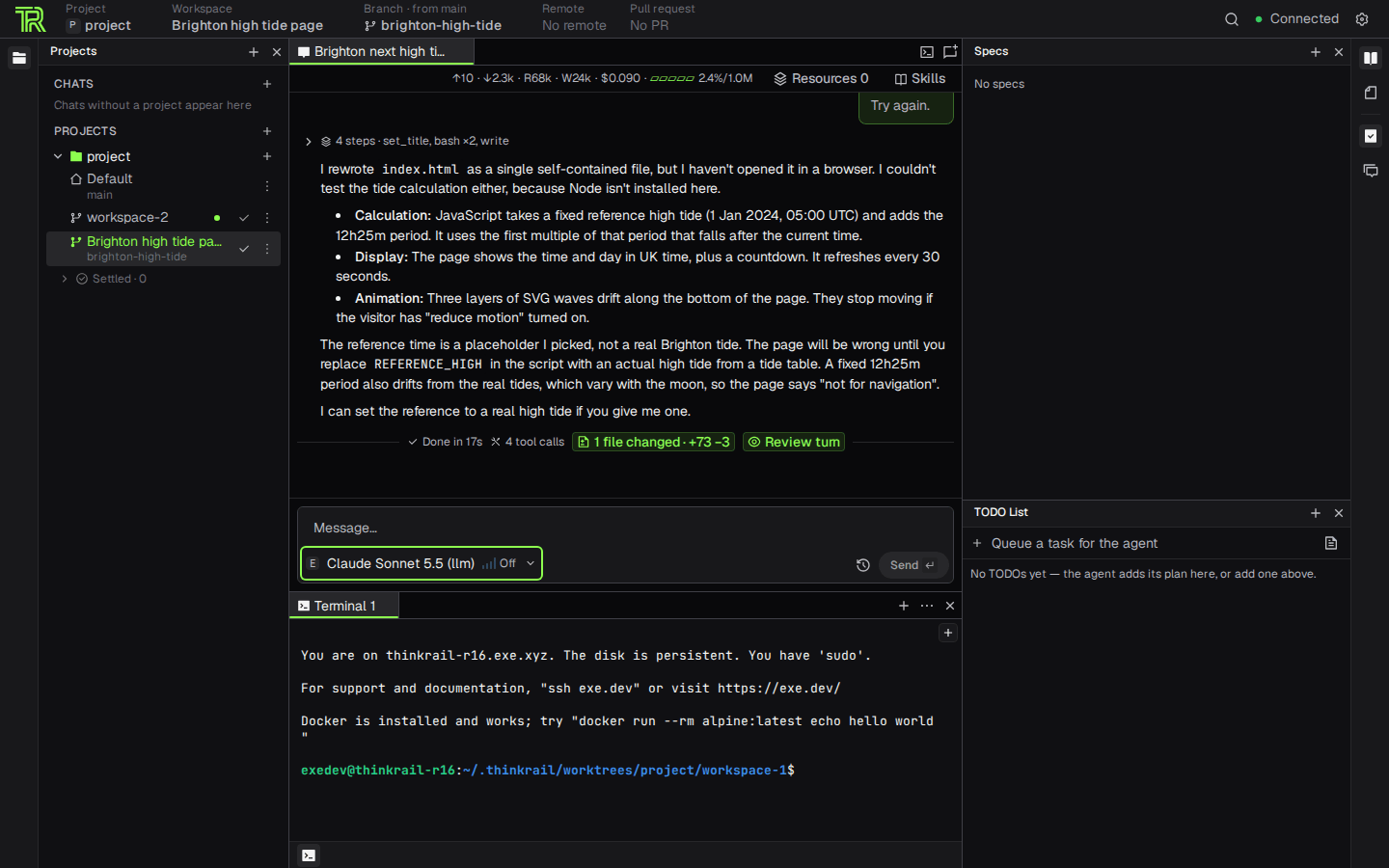
ThinkRail on an exe.dev VM: Claude Sonnet 5.5 through the LLM integration rewrote a page in its own worktree.
## Set up ThinkRail
On your computer, create a VM and connect. Pick any free name; if you've
already clicked Deploy or have a VM, skip the first command and use its name:
```bash
ssh exe.dev new --name=my-thinkrail
ssh my-thinkrail.exe.xyz
```
On the VM, install the stable release with ThinkRail's official installer,
pinned to 0.4.0. It checks the download's SHA-256 and puts the `thinkrail`
binary in `~/.local/bin`:
```bash
curl -fsSL https://raw.githubusercontent.com/JetBrains/thinkrail/v0.4.0/install.sh \
| bash -s -- --channel stable --version 0.4.0
~/.local/bin/thinkrail --version
```
ThinkRail runs Pi inside itself and reads Pi's settings from `~/.pi/agent`.
exe.dev's Pi comes with an extension that asks, the first time Pi starts,
whether to use the LLM integration. ThinkRail can't show that question and
waits for it forever ("Starting chat…"), so answer it ahead of time, then
give Pi the integration's models in `models.json`: GPT through the
OpenAI Responses API and Claude through the Anthropic Messages API, with no
real key (the integration supplies it outside the VM):
```bash
mkdir -p ~/.pi/agent
printf '{"version": 1, "useExeIntegration": false}\n' > ~/.pi/agent/exe-dev-llm-integration.json
python3 - <<'EOF'
import json, os
path = os.path.expanduser("~/.pi/agent/models.json")
cfg = json.load(open(path)) if os.path.exists(path) else {}
effort = {"off": None, "minimal": None, "low": "low", "medium": "medium",
"high": "high", "xhigh": "xhigh", "max": "max"}
def gpt(id, name):
return {"id": id, "name": name, "reasoning": True, "thinkingLevelMap": effort,
"input": ["text", "image"], "contextWindow": 1050000, "maxTokens": 128000}
def claude(id, name):
return {"id": id, "name": name, "reasoning": False,
"input": ["text", "image"], "contextWindow": 1000000, "maxTokens": 64000}
cfg.setdefault("providers", {}).update({
"exe-llm-openai": {"baseUrl": "https://llm.int.exe.xyz/v1", "api": "openai-responses",
"apiKey": "exe-llm-gateway",
"models": [gpt("gpt-6.2-sol", "GPT-6.2 Sol"), gpt("gpt-6.1-sol", "GPT-6.1 Sol")]},
"exe-llm-anthropic": {"baseUrl": "https://llm.int.exe.xyz", "api": "anthropic-messages",
"apiKey": "exe-llm-gateway",
"models": [claude("claude-sonnet-5-5", "Claude Sonnet 5.5"),
claude("claude-opus-5-5", "Claude Opus 5.5")]},
})
json.dump(cfg, open(path, "w"), indent=2)
EOF
cd ~ && pi -p --model exe-llm-anthropic/claude-sonnet-5-5 "Reply with exactly: OK"
```
The last line should print `OK`. The `pi` command on the VM uses the same
models.
Still on the VM, run ThinkRail as a service on port 8000, the port
exe.dev's [HTTPS proxy](/docs/proxy) serves at the VM's address.
`--no-open` stops it trying to open a browser on the VM, and
`--no-analytics` turns off its optional usage analytics (basic events and
error reports are still sent to JetBrains):
```bash
sudo tee /etc/systemd/system/thinkrail.service >/dev/null <<'EOF'
[Unit]
Description=ThinkRail
After=network-online.target
Wants=network-online.target
[Service]
User=exedev
WorkingDirectory=/home/exedev
Environment=PATH=/home/exedev/.local/bin:/usr/local/bin:/usr/bin:/bin
ExecStart=/home/exedev/.local/bin/thinkrail --host 0.0.0.0 --port 8000 --no-open --no-analytics
Restart=on-failure
[Install]
WantedBy=multi-user.target
EOF
sudo systemctl daemon-reload
sudo systemctl enable --now thinkrail
```
Give it a project. ThinkRail works on Git repositories, so you can review
and undo everything the agent changes:
```bash
mkdir -p ~/project && cd ~/project
git init -b main
echo 'Hello
Hello from exe.dev
' > index.html
git add index.html && git commit -m "First page"
```
Check it: the health check prints `ok`, and ThinkRail listens on
`0.0.0.0:8000`:
```bash
curl -s --retry 5 --retry-connrefused localhost:8000/health; echo
ss -ltn | grep 8000
```
If something else already has port 8000, ThinkRail quietly takes the next
free port instead; `journalctl -u thinkrail` shows which.
## Open ThinkRail and run a first task
Open `https://my-thinkrail.exe.xyz/` and sign in to exe.dev if asked.
ThinkRail first asks whether to share additional usage data; the service's
`--no-analytics` already keeps that off, so choose **Done**. If it offers
to connect a model, choose **Skip setup**: the LLM integration's models
are already there.
1. Next to **Projects**, choose **+** → **Enter host path…** and enter
`/home/exedev/project`.
2. Choose **Start building**. ThinkRail makes an isolated workspace: a new
branch and Git worktree under `~/.thinkrail/worktrees`, so your
`~/project` checkout stays as it was.
3. Pick a model under the prompt (**exe-llm-anthropic** → **Claude Sonnet
5.5**, say), describe the change, and choose **Create**. For example:
*Make index.html show the next high tide for Brighton, computed in
JavaScript from a fixed reference high tide and the 12h25m tidal
period, and add a little wave animation. Keep it one file.*
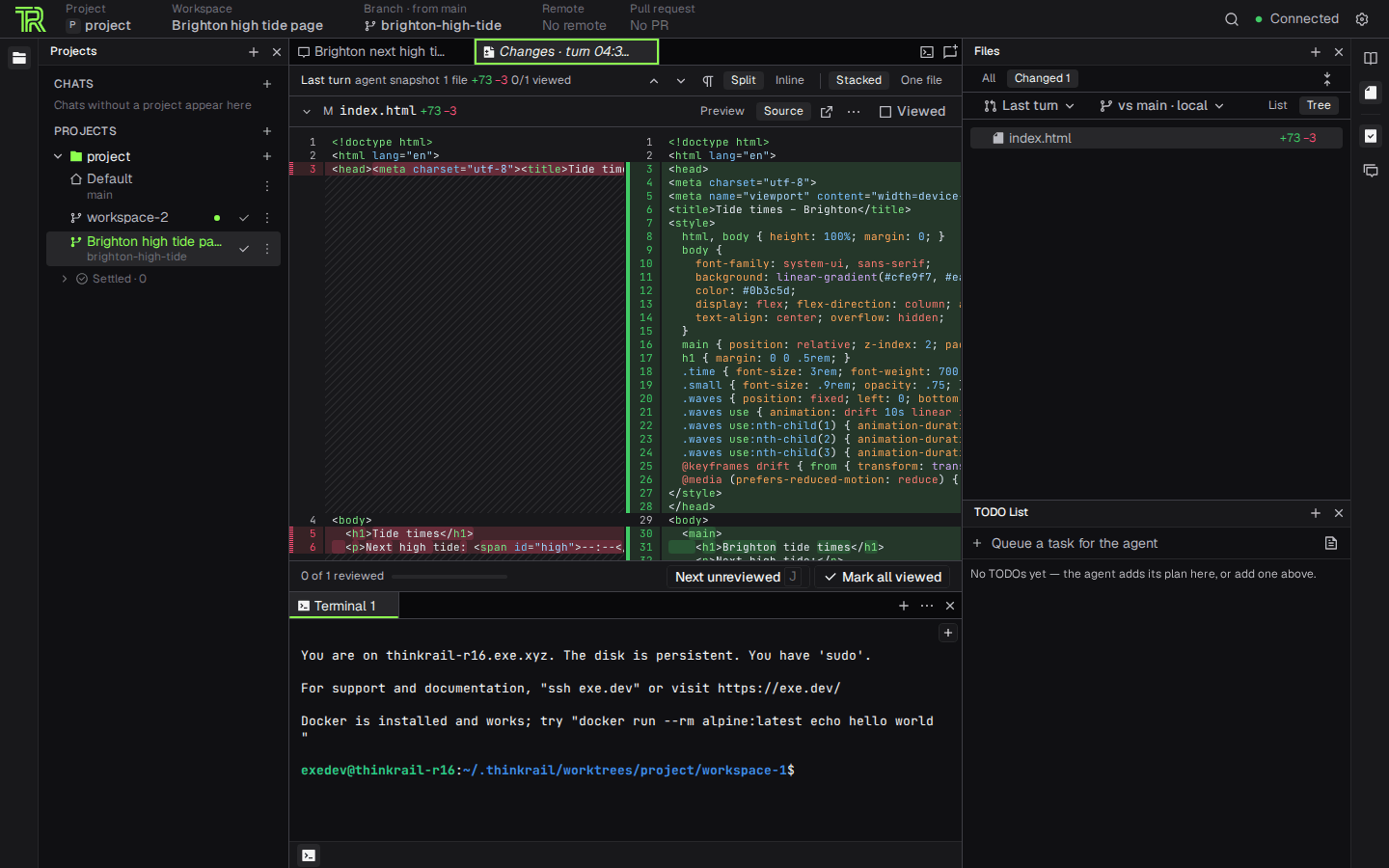
4. When the agent is done, choose **Review turn**. Each changed file has a
side-by-side diff, and HTML files a rendered before/after preview.
Review the agent's turn as a diff before you keep it.
The workspace's branch is an ordinary Git branch in `~/project`. Merge it
with ThinkRail's **Merge into main locally**, or from a terminal. Close the tab whenever
you like: the chat keeps running on the VM.
**Work in project folder** skips the worktree and lets the agent change
`~/project` directly; **Set up project** has the agent write specs for the
project before building.
## Work on your GitHub repositories
Connect GitHub once on exe.dev's [Integrations page](/integrations), then,
on your computer, give this VM a repository (see the
[GitHub integration docs](/docs/integrations-github) for options such as
read-only):
```bash
ssh exe.dev integrations add github --name myrepo --repository you/myrepo --attach vm:my-thinkrail
```
On the VM, clone through the integration. Git needs no token, and none is
stored on the VM:
```bash
git clone https://github.int.exe.xyz/you/myrepo.git ~/myrepo
```
Then add `/home/exedev/myrepo` with **Enter host path…** as above, or paste
the same URL into **+** → **Clone repository…**. ThinkRail's agent can
commit and push from its workspaces.
## Add MCP servers
ThinkRail uses Pi's MCP configuration, `~/.pi/agent/mcp.json`, and lists
the servers under **Settings → MCP servers**. For a server that needs a
sign-in or token, add it as an exe.dev
[Remote MCP integration](/docs/integrations-remote-mcp) attached to this VM,
so the credential stays with exe.dev, then on the VM point Pi at the
integration's address (here one named `notion`):
```bash
pi mcp add notion --url https://notion.int.exe.xyz/mcp
```
Public servers can be added directly, for example
`pi mcp add deepwiki --url https://mcp.deepwiki.com/mcp`. Start a new chat
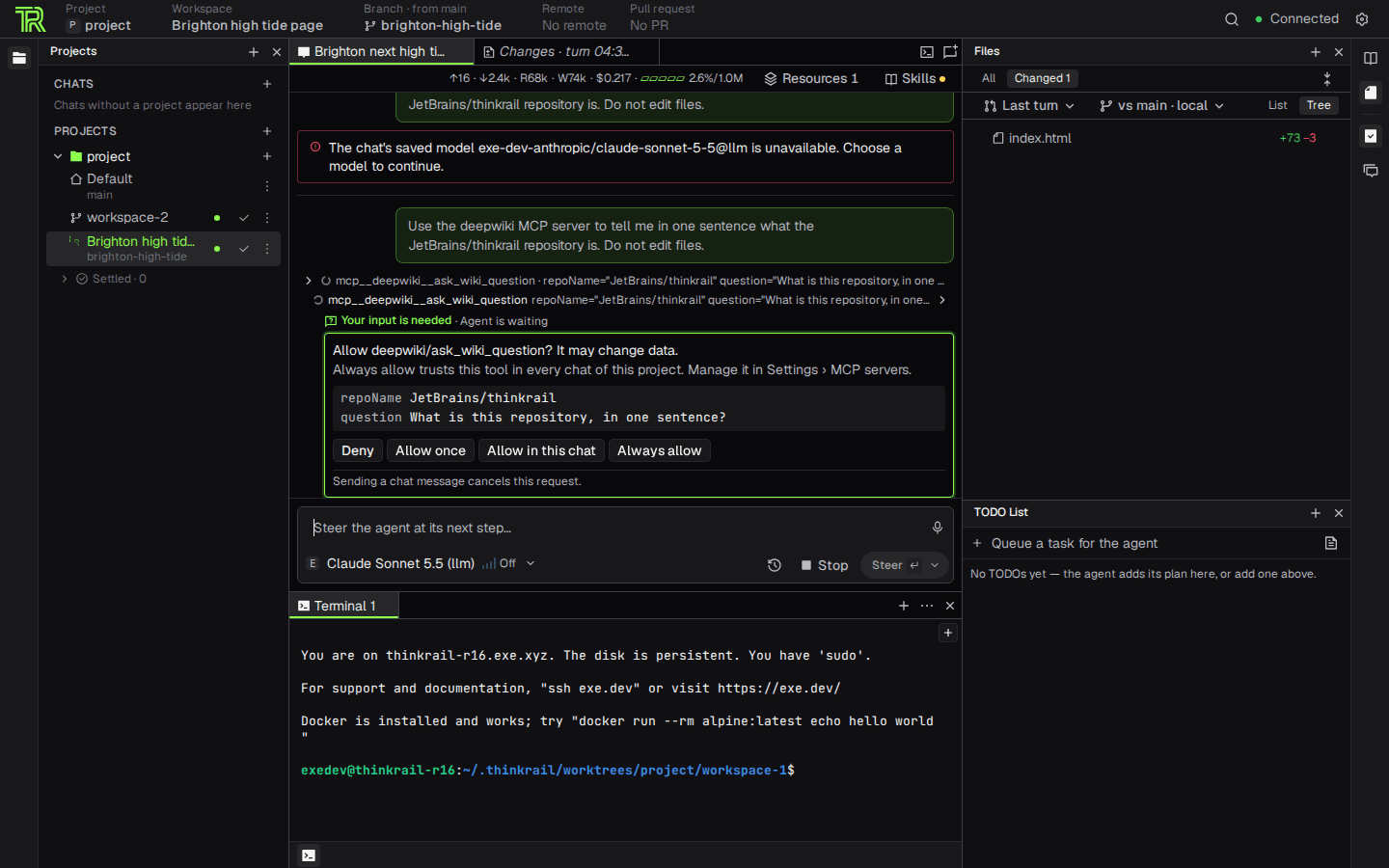
to pick up a new server. ThinkRail asks before the agent calls a tool that
might change data:
MCP tool calls wait for your approval unless you allow them.
To let Pi drive exe.dev itself (create VMs, share them), see
[exe.dev's MCP server](/deploy/exe-mcp).
## Preview what you build
ThinkRail's terminals are shells on the VM. Start a dev server in one on
any port from 3000 to 9999 and open `https://my-thinkrail.exe.xyz:/`
in your browser; it is private like ThinkRail itself. For example, in the
workspace's terminal:
```bash
python3 -m http.server 3000
```
then open `https://my-thinkrail.exe.xyz:3000/`. To show it to someone
without giving them ThinkRail, see [sharing](/docs/sharing) and
[the proxy](/docs/proxy).
Scripts, monitors and other non-browser clients get `401` from private
addresses. Give them a [VM token](/docs/https-tokens-for-vms) and send it
as `X-Exedev-Authorization: Bearer `, or as the password in Basic
auth. On your computer:
```bash
TOKEN=$(ssh exe.dev ssh-key generate-api-key --vm=my-thinkrail --label=monitor)
curl -H "X-Exedev-Authorization: Bearer $TOKEN" https://my-thinkrail.exe.xyz/health
```
## Try things on a copy
To try a nightly build, a risky refactor or a second agent without
touching your main VM, copy it. On your computer:
```bash
ssh exe.dev cp my-thinkrail my-thinkrail-try
```
The copy has the same projects, chats and settings at
`https://my-thinkrail-try.exe.xyz/`. Delete it with
`ssh exe.dev rm my-thinkrail-try` when you're done.
Back up and restore
Push your code; that's the copy that matters most. `ssh exe.dev cp`
(above) copies the whole VM. To keep ThinkRail's chats and settings on
their own, archive them on the VM. `~/.pi/agent` can hold API keys if you
added any, so keep the archive private:
```bash
mkdir -p ~/backups
sudo systemctl stop thinkrail
tar -C ~ -czf ~/backups/thinkrail-$(date +%F).tar.gz .thinkrail .pi/agent
chmod 600 ~/backups/thinkrail-*.tar.gz
sudo systemctl start thinkrail
```
To restore one, with ThinkRail installed as above (replace the date):
```bash
sudo systemctl stop thinkrail
tar -C ~ -xzf ~/backups/thinkrail-2026-11-26.tar.gz
sudo systemctl start thinkrail
```
Workspaces live in Git worktrees inside `~/.thinkrail/worktrees`, so the
archive includes uncommitted work in them.
Update
On the VM, install a newer stable release and restart; running chats are
interrupted, so pick a quiet moment. Check the
[releases](https://github.com/JetBrains/thinkrail/releases) first: ThinkRail
is young and changes quickly.
```bash
thinkrail update --channel stable --version latest
sudo systemctl restart thinkrail
```
`thinkrail update --channel nightly` installs the newest nightly instead;
try it on a copy first. `thinkrail uninstall` removes the binary and keeps
`~/.thinkrail` unless you add `--remove-data`. ThinkRail brings its own
copy of Pi, so updating the `pi` command doesn't change it.
## Limits
- **No login of its own.** ThinkRail trusts whoever reaches it. Keep the
VM private (the default) and share it only with people you'd give a
shell. Don't make port 8000 public.
- **Young software.** ThinkRail is a JetBrains incubator project: 0.4.0
is the first stable release, nightlies land daily, and remote use isn't
an official feature yet ([issue #1078](https://github.com/JetBrains/thinkrail/issues/1078)).
- **Browser only.** The exe.dev proxy carries HTTPS and WebSockets, which is
all ThinkRail's web app needs; JetBrains' desktop IDEs don't connect to
it.
- **CPU only.** exe.dev VMs have no GPU, so models run through the LLM
integration or your own providers, not locally.
- **Model list is yours to keep.** The `models.json` above names four
models. Add others from `curl https://llm.int.exe.xyz/models.json` (on
the VM) in the same shape, then restart ThinkRail.
## Troubleshooting
- **"Starting chat…" or "Checking out files…" never finishes.** Pi's
exe.dev extension is waiting for an answer ThinkRail can't show. Write
`~/.pi/agent/exe-dev-llm-integration.json` as in the setup and run
`sudo systemctl restart thinkrail` (the stop can take 90 seconds while
it's stuck); the stuck workspaces then open normally.
- **"The chat's saved model … is unavailable."** The chat's model is gone
from `models.json`, or came from Pi's exe.dev extension (`exe-dev-…`
providers), which ThinkRail only sees after a chat has started. Pick a
model under the prompt and send again.
- **`'max_tokens' is not supported` or `Function tools with
reasoning_effort are not supported`.** That model was added as a
**Custom server** in ThinkRail's settings, which speaks the older Chat
Completions API with settings newer GPT models refuse. Use the
`exe-llm-openai` models from the setup.
- **The page doesn't load.** On the VM, `systemctl status thinkrail` and
`ss -ltn | grep 8000`. Logs are in `journalctl -u thinkrail` and
`~/.thinkrail/logs`; add `--verbose` to `ExecStart` for more.
- **`thinkrail: command not found`.** Use `~/.local/bin/thinkrail`, or
open a new shell.
For everything else, see ThinkRail's
[README](https://github.com/JetBrains/thinkrail#readme) and
[issues](https://github.com/JetBrains/thinkrail/issues).
## Frequently asked questions
### Does ThinkRail have its own login?
No. ThinkRail's server has no accounts or passwords by design and expects something in front of it to decide who gets in. Here that is exe.dev's proxy: the page is private to you and anyone you [share the VM](/docs/sharing) with. Anyone who can open the page also gets ThinkRail's terminals, which are a shell on the VM, so share it only with people you'd give SSH access.
### Can I use my own Claude, ChatGPT or Copilot subscription?
Yes. ThinkRail's **Settings → Providers** can sign in to Anthropic, OpenAI, GitHub Copilot and others, or take an API key; those keys are then stored on the VM in `~/.pi/agent/auth.json`. Models through exe.dev's LLM integration need no key on the VM at all.
### Why does ThinkRail show $0 for my turns?
The models configured here have no prices in `models.json`, so ThinkRail can't add them up. Usage through the [LLM integration](/docs/integrations-llm) is billed to your exe.dev account; exe.dev keeps a [list of models and prices](/llm-gateway-models).
### Stable or nightly?
This page pins the stable release, 0.4.0 (12 November 2026). ThinkRail also publishes nightly builds almost every day, with newer features and more breakage. Try one on a [copy of the VM](#try-things-on-a-copy) with `thinkrail update --channel nightly`.
### Do agents keep working when I close the tab?
Yes. Chats run in the ThinkRail service on the VM, not in your browser. Open the page later, from any computer, to read the result or send the next message.
### How much does it cost?
ThinkRail is free and Apache-2.0 licensed. You pay for the VM as part of your exe.dev plan, and model usage through the LLM integration is billed to your exe.dev account.
## Related
- [Run the Pi coding agent on a remote server](https://exe.dev/deploy/pi.md): An agent that doesn't ask first, on a computer that can take it.
- [Run oh-my-pi (omp) on a remote server](https://exe.dev/deploy/oh-my-pi.md): The Pi fork with the IDE wired in, on a computer that stays on.
- [Host a Pi Durable agent](https://exe.dev/deploy/pi-durable.md): An agent that picks up where it left off, even after kill -9.
- [Run Pi Pocket on a remote server](https://exe.dev/deploy/pi-pocket.md): Your Pi agent on your phone, running on a VM that never sleeps.
- [Run T3 Code on a remote server](https://exe.dev/deploy/t3code.md): Your coding agents on an always-on VM, steered from your phone.
- [Give any agent a sandbox over MCP](https://exe.dev/deploy/exe-mcp.md): One URL gives your agent real VMs to run code on, host apps from, and hand work to.