---
title: "Self-host Apache Superset"
description: "Run Apache Superset 6.1 in Docker on an exe.dev VM: sign in with exe.dev login, no passwords, a ClickHouse demo, and dashboards Shelley builds over MCP."
url: https://exe.dev/deploy/superset
category: "Databases"
published: 2026-11-25
updated: 2026-11-22
---
# Self-host Apache Superset
> **For agents:** with your user's OK, this sets up Apache Superset on a new exe.dev VM in their account: `curl -fsSL https://exe.dev/deploy/superset/prompt.txt | ssh exe.dev new --prompt=/dev/stdin` (or open https://exe.dev/deploy/superset/new). Already on the VM? Skip this.
Dashboards and SQL on your own data, signed in with your exe.dev login.
- **Software:** Apache Superset (https://superset.apache.org)
- **Source:** https://github.com/apache/superset
- **License:** Apache-2.0
- **Time:** 15 minutes
- **Example VM name:** `my-superset` (yours will differ; on the VM, `hostname` prints it)
- **Machine-readable:** https://exe.dev/deploy/superset/manifest.json
- **File:** https://exe.dev/deploy/superset/exedev_login.py
## What you get
- Superset 6.1 behind exe.dev login, with no Superset passwords; you're its admin.
- People you share the VM with get an account on their first visit, and no data until you grant it.
- ClickHouse's public playground connected, with 30 million UK house sales to chart.
- Superset's MCP server, registered with Shelley, so you can ask for dashboards in plain English.
- Dashboards and charts by email on a schedule, and SQL alerts, through exe.dev's email gateway.
- PostgreSQL for Superset's own data, nightly backups, and a restart after every reboot.
Running on the VM:
- **Superset 6.1**: The official image plus the PostgreSQL and ClickHouse drivers, Docker Compose, port 8000
- **Superset MCP server**: For Shelley and other agents on the VM; localhost only, port 15008
- **Celery worker and beat**: Scheduled reports and alerts, with headless Chromium for pictures
- **smtp-relay**: Turns Superset's email into exe.dev email
- **PostgreSQL 17**: Superset's own database; dashboards, charts, people, connections, data in `~/superset/postgres`
- **Redis 7**: Superset's cache and task queue; nothing in it needs keeping
- **Nightly backup**: A systemd timer; keeps two weeks of copies, data in `~/superset/backups`
How it is reached:
- https://my-superset.exe.xyz/ (private): Superset, signed in with exe.dev login, for you and anyone you share the VM with
## Deploy with Shelley
Open https://exe.dev/deploy/superset/new to create a VM whose agent, Shelley, follows this recipe. From a terminal:
```sh
curl -fsSL https://exe.dev/deploy/superset/prompt.txt | ssh exe.dev new --prompt=/dev/stdin
```
Or follow the steps below by hand.
Apache Superset is the open-source answer to Tableau and Looker: connect a
database, explore it in SQL Lab, and turn the queries into charts and
dashboards your team can open. It's an Apache project with about 75,000
stars on GitHub, and it's especially good at fast databases like
[ClickHouse](/deploy/clickhouse) and [PostgreSQL](/deploy/postgres).
On exe.dev, Superset sits behind exe.dev login with HTTPS from the first
minute, and people sign in with that login: no Superset passwords to hand
out. It comes with 30 million real house sales to play with, and Shelley,
on the same VM, builds dashboards for you through Superset's own MCP server.
## Open Superset
Open the URL Shelley gives you, like `https://my-superset.exe.xyz/`, and
sign in to exe.dev. There's no Superset login: you land on its home page as
an admin, under your own email address.
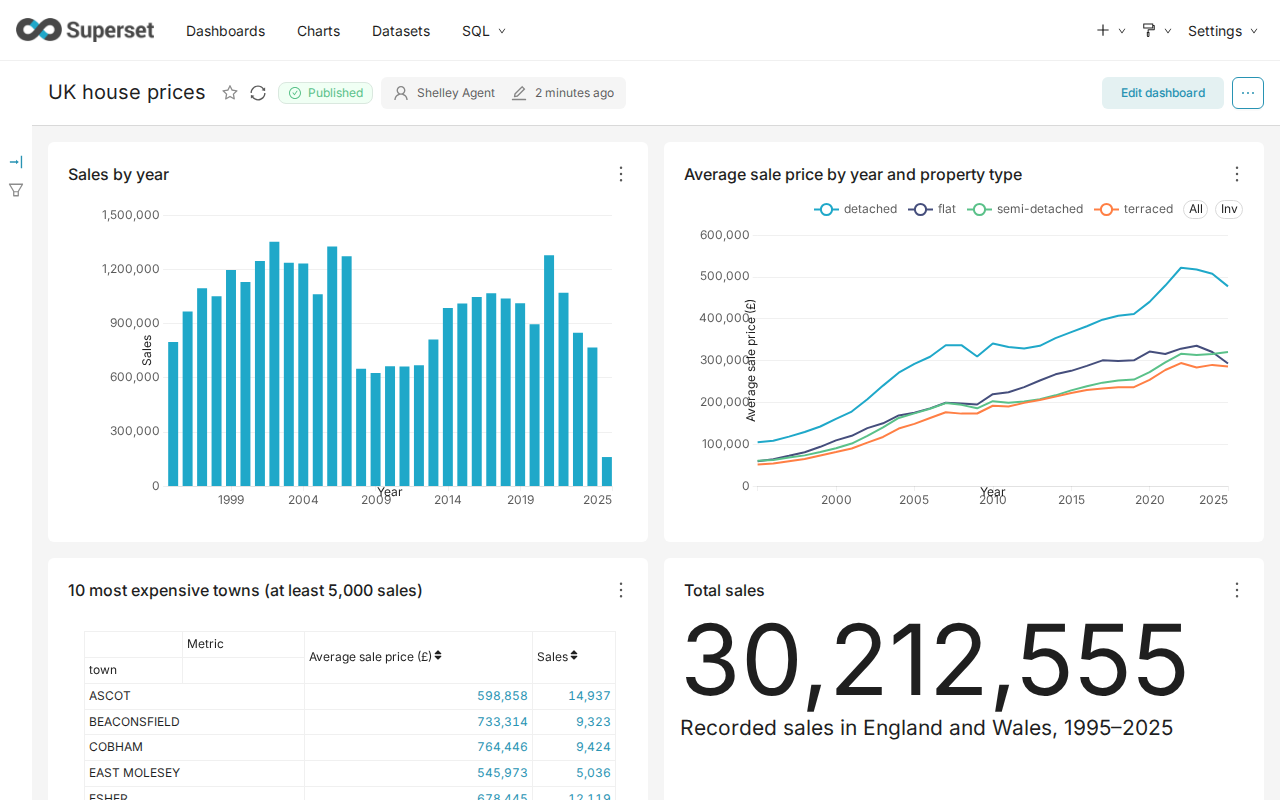
Shelley has already connected **ClickHouse playground**, ClickHouse's
public demo server, and built a dashboard on it. Open **Dashboards → UK
house prices**.
The dashboard Shelley built over MCP, on 30 million sales in ClickHouse's playground.
## Query 30 million house sales
The playground's `uk_price_paid` table holds every home sold in England
and Wales from 1995 to 2025. Open **SQL → SQL Lab**, press **Add a new
tab** if there isn't one, pick **ClickHouse playground** as the database,
and run:
```sql
SELECT town, count() AS sales, round(median(price)) AS median_price
FROM uk_price_paid
WHERE toYear(date) = 2024
GROUP BY town
HAVING sales > 1000
ORDER BY median_price DESC
LIMIT 10
```
St Albans and London top it, at well over half a million pounds, in a
fraction of a second. To chart it, press **Create chart** (the chart icon
above the results); to reuse the query in many charts, save it with
**Save dataset** in the toolbar.
## Ask Shelley for a dashboard
Shelley, the agent on your VM, can work Superset through its
[MCP server](https://superset.apache.org/admin-docs/configuration/mcp-server/):
list datasets, write SQL, make charts, and lay out dashboards. Open
Shelley at `https://my-superset.shelley.exe.xyz/` and ask, in plain
English. This is the
request behind the dashboard above:
```text
Superset runs on this VM (see ~/superset), and its MCP server is registered
with you as superset (use `shelley mcp`). Build me a dashboard called
"UK house prices" from the table default.uk_price_paid in "ClickHouse
playground": average price by year split by property type (leave out
"other"), the 10 most expensive towns with at least 5,000 sales, the number
of sales per year, and a big number with the total number of sales.
Use the MCP tools, not the REST API or the database directly.
```
It takes Shelley a few minutes, and you can ask for changes afterwards
("show prices in whole pounds"). The MCP tools can't delete anything, so if
Shelley leaves a half-made draft behind, delete it under **Dashboards**. The MCP server acts as a Superset user
called `shelley`, in the **Alpha** role: it can read every database
Superset is connected to and make charts and dashboards, but it can't
change people or permissions. Superset's built-in charts get their data
from your databases, so give it read-only database logins, as below.
Claude Code on the VM can use the same server:
```bash
claude mcp add --transport http superset http://localhost:15008/mcp
```
## Connect your database
Go to **Settings → Database Connections → + Database**, pick your
database, and fill in the form. Superset can read PostgreSQL and
ClickHouse as set up here; for others, add the driver to `~/superset/Dockerfile`
(the [list](https://superset.apache.org/user-docs/databases/)
says which) and rebuild as in [Update](#update).
exe.dev VMs don't share a private network or expose database ports, so:
- **ClickHouse on another VM**, from the [ClickHouse page](/deploy/clickhouse):
connect its HTTP API through a
[VM-to-VM integration](/docs/integrations-vm-to-vm), which keeps the
exe.dev token off this VM. On your computer:
```bash
ssh exe.dev integrations add http-proxy --name clickhouse \
--target https://my-clickhouse.exe.xyz:8123/ --peer --attach vm:my-superset
```
In Superset, choose ClickHouse and use host `clickhouse.int.exe.xyz`,
port `443`, database `app`, **SSL** on, and a ClickHouse user that can
only read. exe.dev adds the token on the way; Superset only needs the
ClickHouse password.
- **PostgreSQL on another VM**, from the [PostgreSQL page](/deploy/postgres):
put both VMs on your tailnet as in
[Connect from another VM](/deploy/postgres#connect-from-another-vm).
Superset runs in Docker, which doesn't use Tailscale's DNS, so for
**Host** use the address from `tailscale ip -4 my-postgres`.
Give Superset a login that can only read. Superset saves database
passwords encrypted with `SUPERSET_SECRET_KEY` from `~/superset/.env`.
## Bring in your team
On your computer, share the VM with a person or your whole team:
```bash
ssh exe.dev share add my-superset alice@example.com
ssh exe.dev share add my-superset team
```
The first time Alice opens the URL, she gets a Superset account named
`alice@example.com` in the **Gamma** role, which sees no dashboards or
data until you grant some. Either:
- open a dashboard, **Edit dashboard → ⋯ → Edit properties → Access &
ownership**, and add **Gamma** (or a role of your own) under **Roles**:
everyone in it sees that dashboard and its charts, and nothing else; or
- under **Settings → List Users**, give her **Alpha** (every database,
can make charts) or **sql_lab** too (SQL Lab on databases she can see).
To make someone an admin from the start, add their address to
`SUPERSET_ADMIN_EMAILS` in `~/superset/.env` (comma-separated) and run
`docker compose up -d` in `~/superset`.
> [!TIP]
> Removing someone? On your computer, run
> `ssh exe.dev share remove my-superset alice@example.com`; exe.dev stops
> letting them in at once. To also lock their Superset account, untick
> **Is Active** for them under **Settings → List Users**.
## Get dashboards by email
On a dashboard, open **⋯ → Set up an email report**, name it, pick a
schedule, and **Add**: a picture of the dashboard arrives in your inbox on
that schedule. Open a chart and its **⋯** menu does the same, and can send
the chart's data as CSV or a text table instead. To send a report to other people, or to
make an **alert**, a SQL query that emails you when its answer crosses a
line, use **Settings → Alerts & Reports**.
Superset's worker loads the dashboard in a headless Chromium on the VM,
takes the picture, and hands the email to `smtp-relay`, a small program
that sends it through exe.dev's [email gateway](/docs/send-email). There's
no SMTP server or mail account to set up.
exe.dev delivers only to you, your team, and people you've shared the VM
with who have signed in, and limits how much and how often. Emails arrive
as plain text with a link back to Superset and the picture or file
attached; ten attachments and 1 MB at most.
## Use the API from a script
Superset's [REST API](https://superset.apache.org/developer-docs/api/) is behind
exe.dev login too. A script on another machine uses a
[VM token](/docs/https-tokens-for-vms) and acts as you. On your computer:
```bash
ssh exe.dev ssh-key generate-api-key --vm=my-superset --label=superset-api
```
Then, with the token it printed:
```bash
curl -s -H "X-Exedev-Authorization: Bearer $TOKEN" \
https://my-superset.exe.xyz/api/v1/dashboard/ | jq '.result[].dashboard_title'
```
Requests that change things also need Superset's CSRF token: fetch it
from `/api/v1/security/csrf_token/`, keep the cookie, and send it back as
`X-CSRFToken` with a `Referer` header.
## Keep your data
Dashboards, charts, datasets, people, and saved connections live in
Superset's PostgreSQL database in `~/superset/postgres`, and nightly
backups go to `~/superset/backups`. Your business data stays in your own
database. Keep a copy **off the VM**. On your computer:
```bash
scp -r my-superset.exe.xyz:superset/backups .
```
Backups hold the key that unlocks the database passwords Superset saved,
so keep them private. For updates or trouble, ask Shelley, or open the
instructions below.
## The nuts and bolts
Happy clicking Deploy? You can stop here. These are Shelley's setup steps
and your maintenance reference.
Install by hand
### Create a VM
On your computer (pick another name if `my-superset` is taken):
```bash
ssh exe.dev new --name=my-superset
ssh my-superset.exe.xyz
```
The default VM (8 GB of memory) suits a team. All remaining installation
commands run **on the VM**, as `exedev`. Make Docker start at boot, so
Superset comes back after a restart:
```bash
sudo systemctl enable --now docker.service
```
### Write the secrets
Superset signs sessions and encrypts the database passwords it saves with
`SUPERSET_SECRET_KEY`. This writes it, PostgreSQL's password, and your
exe.dev address (from the VM's [reflection](/docs/integrations-reflection)
service) to a file only you can read, once:
```bash
mkdir -p ~/superset && cd ~/superset
if [ ! -e .env ]; then
owner=$(curl -fsS https://reflection.int.exe.xyz/email | jq -r .email)
touch .env && chmod 600 .env
cat >> .env < Dockerfile <<'EOF'
# Apache Superset 6.1.0 with the drivers it needs here, its MCP server, and
# a headless Chromium for emailed dashboard and chart images.
FROM apache/superset:6.1.0
USER root
ENV PLAYWRIGHT_BROWSERS_PATH=/usr/local/share/playwright-browsers
RUN apt-get update && apt-get install -y --no-install-recommends libatomic1 \
&& . /app/.venv/bin/activate && uv pip install --no-cache \
psycopg2-binary==2.9.9 \
clickhouse-connect==0.15.1 \
fastmcp==3.4.11 \
playwright==1.65.2 \
&& playwright install-deps chromium \
&& playwright install chromium \
&& rm -rf /var/lib/apt/lists/*
USER superset
EOF
```
Superset's settings: PostgreSQL for its data, Redis for its cache and
task queue, email reports through `smtp-relay`, trust in the proxy's
`X-Forwarded-*` headers, and exe.dev login:
```bash
cat > superset_config.py <<'EOF'
# Superset's settings for an exe.dev VM. Secrets come from ~/superset/.env;
# this file is mounted into every Superset container.
import os
from celery.schedules import crontab
SECRET_KEY = os.environ["SUPERSET_SECRET_KEY"]
SQLALCHEMY_DATABASE_URI = (
"postgresql+psycopg2://superset:" + os.environ["POSTGRES_PASSWORD"] + "@db:5432/superset"
)
# Redis keeps Superset's caches and the queue for scheduled reports; nothing
# in it needs to survive a restart.
REDIS_URL = "redis://redis:6379/0"
CACHE_CONFIG = {
"CACHE_TYPE": "RedisCache",
"CACHE_DEFAULT_TIMEOUT": 300,
"CACHE_KEY_PREFIX": "superset_",
"CACHE_REDIS_URL": REDIS_URL,
}
DATA_CACHE_CONFIG = {**CACHE_CONFIG, "CACHE_KEY_PREFIX": "superset_data_", "CACHE_DEFAULT_TIMEOUT": 3600}
# Celery runs reports and alerts: beat checks the schedules every minute,
# the worker does the work.
class CeleryConfig:
broker_url = "redis://redis:6379/1"
result_backend = "redis://redis:6379/1"
imports = ("superset.sql_lab", "superset.tasks.scheduler")
worker_prefetch_multiplier = 1
task_acks_late = False
beat_schedule = {
"reports.scheduler": {"task": "reports.scheduler", "schedule": crontab(minute="*", hour="*")},
"reports.prune_log": {"task": "reports.prune_log", "schedule": crontab(minute=10, hour=0)},
}
CELERY_CONFIG = CeleryConfig
# Reports email through smtp-relay, which hands them to exe.dev's email
# gateway. Headless Chromium loads Superset directly, inside Docker's
# network, for chart and dashboard images.
SMTP_HOST = "smtp-relay"
SMTP_PORT = 2525
SMTP_STARTTLS = False
SMTP_SSL = False
SMTP_USER = None
SMTP_PASSWORD = None
SMTP_MAIL_FROM = "superset@" + os.environ["SUPERSET_URL"].split("//")[-1]
WEBDRIVER_BASEURL = "http://superset:8088/"
WEBDRIVER_BASEURL_USER_FRIENDLY = os.environ["SUPERSET_URL"] + "/"
EMAIL_REPORTS_SUBJECT_PREFIX = "[Superset]"
# exe.dev's proxy terminates HTTPS and sends X-Forwarded-Proto and -Host.
ENABLE_PROXY_FIX = True
PROXY_FIX_CONFIG = {"x_for": 1, "x_proto": 1, "x_host": 1, "x_port": 0, "x_prefix": 0}
# Sign people in with their exe.dev login: see exedev_login.py.
from exedev_login import init_app as FLASK_APP_MUTATOR # noqa: E402
# Superset's address, for the links the MCP server hands out.
MCP_SERVICE_URL = os.environ["SUPERSET_URL"]
# The MCP server, on the VM's localhost only, acts as this Superset user.
MCP_DEV_USERNAME = "shelley"
FEATURE_FLAGS = {
# Let dashboards be shared with roles, not only through dataset access.
"DASHBOARD_RBAC": True,
# Scheduled reports and alerts by email, with images from Playwright.
"ALERT_REPORTS": True,
"PLAYWRIGHT_REPORTS_AND_THUMBNAILS": True,
}
EOF
```
[exedev_login.py](https://exe.dev/deploy/superset/exedev_login.py) signs
people in with exe.dev login, in about 60 lines of Python. On every
request that comes through the proxy, it reads the `X-ExeDev-Email`
header, creates the person's Superset account the first time (Admin if
they're in `SUPERSET_ADMIN_EMAILS`, Gamma otherwise), and signs them in.
The proxy removes any `X-ExeDev-Email` a browser sends, and the module
ignores the header on requests from other containers. Fetch it:
```bash
curl -fsSLo exedev_login.py https://exe.dev/deploy/superset/exedev_login.py
```
Anything that can reach port 8000 on the VM could send that header too,
which is why Superset's ports listen on the VM's localhost only. A shell
on the VM is admin access to Superset anyway: the keys are in `.env`.
[smtp-relay.py](https://exe.dev/deploy/metabase/smtp-relay.py), from the
[Metabase page](/deploy/metabase), is a short Python program, standard
library only, that accepts Superset's email and sends it through exe.dev's
email gateway. It listens only inside Docker's network. Fetch it:
```bash
curl -fsSLo smtp-relay.py https://exe.dev/deploy/metabase/smtp-relay.py
```
### Start Superset
The Compose file runs the web app on port 8000, where the
[HTTPS proxy](/docs/proxy) sends `https://my-superset.exe.xyz/`, the MCP
server on port 15008 (localhost only, out of the proxy's 3000-9999 range),
a Celery worker and scheduler for reports, `smtp-relay`, PostgreSQL, and
Redis. `superset-init` updates Superset's database, then stops:
```bash
cat > compose.yaml <<'EOF'
# Apache Superset behind exe.dev's HTTPS proxy: the web app, its MCP server
# for agents on the VM, Celery for emailed reports, PostgreSQL for Superset's
# own data, Redis as its cache and queue, and smtp-relay for email.
# Secrets come from .env in this directory.
name: superset
x-superset: &superset
# Built from the Dockerfile here by the superset service below.
image: superset-exe:6.1.0
pull_policy: never
env_file: .env
restart: unless-stopped
volumes:
- ./superset_config.py:/app/pythonpath/superset_config.py:ro
- ./exedev_login.py:/app/pythonpath/exedev_login.py:ro
- ./superset_home:/app/superset_home
depends_on:
db:
condition: service_healthy
redis:
condition: service_healthy
services:
superset:
<<: *superset
build: .
pull_policy: build
# The proxy serves https://.exe.xyz/ from port 8000.
ports:
- "127.0.0.1:8000:8088"
depends_on:
superset-init:
condition: service_completed_successfully
# Brings Superset's database up to date, then stops.
superset-init:
<<: *superset
restart: "no"
command: ["sh", "-c", "superset db upgrade && superset init"]
healthcheck:
disable: true
# Superset's MCP server, for agents on this VM (Shelley, Claude Code).
# Port 15008 is on the VM's localhost only, out of the proxy's reach.
superset-mcp:
<<: *superset
command: ["superset", "mcp", "run", "--host", "0.0.0.0", "--port", "5008"]
ports:
- "127.0.0.1:15008:5008"
# The image's check is for the web server; this one just says the
# process is running, so "docker compose up --wait" can finish.
healthcheck:
test: ["CMD-SHELL", "kill -0 1"]
interval: 30s
depends_on:
superset-init:
condition: service_completed_successfully
# Runs reports and alerts, taking pictures with headless Chromium.
superset-worker:
<<: *superset
command: ["celery", "--app=superset.tasks.celery_app:app", "worker", "-O", "fair", "-l", "INFO", "--concurrency=2"]
healthcheck:
test: ["CMD-SHELL", "kill -0 1"]
interval: 30s
depends_on:
superset-init:
condition: service_completed_successfully
# Checks report and alert schedules every minute.
superset-beat:
<<: *superset
command: ["celery", "--app=superset.tasks.celery_app:app", "beat", "--pidfile=", "-l", "INFO", "-s", "/app/superset_home/celerybeat-schedule"]
healthcheck:
test: ["CMD-SHELL", "kill -0 1"]
interval: 30s
depends_on:
superset-init:
condition: service_completed_successfully
# Takes Superset's email and sends it through exe.dev's email gateway.
# Only reachable inside Docker's network.
smtp-relay:
image: python:3.13-alpine
restart: unless-stopped
command: ["python3", "-u", "/smtp-relay.py"]
environment:
SMTP_RELAY_LISTEN: 0.0.0.0
volumes:
- ./smtp-relay.py:/smtp-relay.py:ro
db:
image: postgres:17
restart: unless-stopped
environment:
POSTGRES_DB: superset
POSTGRES_USER: superset
POSTGRES_PASSWORD: ${POSTGRES_PASSWORD:?set in .env}
volumes:
- ./postgres:/var/lib/postgresql/data
healthcheck:
test: ["CMD", "pg_isready", "-U", "superset", "-d", "superset"]
interval: 10s
timeout: 5s
retries: 5
redis:
image: redis:7
restart: unless-stopped
# A cache and a queue: nothing in it needs to survive a restart.
command: ["redis-server", "--save", "", "--appendonly", "no"]
healthcheck:
test: ["CMD", "redis-cli", "ping"]
interval: 10s
timeout: 5s
retries: 5
EOF
mkdir -p superset_home
docker compose build -q && docker compose up -d --wait --wait-timeout 300
docker compose ps --format '{{.Service}}: {{.Status}}'
curl -fs localhost:8000/health; echo
```
The first start takes a few minutes, mostly downloading and building
images (about 3.5 GB). `ps` should list `superset`, `superset-mcp`,
`superset-worker`, `superset-beat`, `db`, and `redis` as healthy and
`smtp-relay` as up, and `curl` should print `OK`.
### Connect the playground and Shelley
This connects ClickHouse's public playground (read-only, no password),
creates the `shelley` user the MCP server acts as, and registers the MCP
server with Shelley on this VM:
```bash
cd ~/superset
docker compose exec -T superset superset set-database-uri \
-d "ClickHouse playground" \
-u "clickhousedb://play@play.clickhouse.com:443/default?secure=true"
docker compose exec -T superset superset fab create-user --role Alpha \
--username shelley --firstname Shelley --lastname Agent \
--email shelley@localhost --password "$(openssl rand -hex 24)"
shelley mcp add superset -d "Apache Superset on this VM: databases, datasets, charts, dashboards, SQL" \
http://localhost:15008/mcp
shelley mcp call superset.get_instance_info | jq '.current_user.username, .instance_summary.total_databases'
```
The last line should print `"shelley"` and `1`.
### Set up nightly backups
This dumps Superset's database while it runs, checks the dump, saves it
with `.env` and the files above, and keeps two weeks of backups:
```bash
cd ~/superset
cat > backup.sh <<'EOF'
#!/bin/sh
# Back up Superset: its database (dashboards, charts, users, saved
# connections) and the files that run it, including .env with its keys.
set -eu
umask 077
cd "$(dirname "$0")"
mkdir -p -m 700 backups
out="backups/superset-$(date +%Y%m%d-%H%M%S).tar.gz"
work=$(mktemp -d)
trap 'rm -rf "$work"' EXIT
docker compose exec -T db pg_dump -U superset -d superset -Fc > "$work/superset.dump"
docker compose exec -T db pg_restore --list < "$work/superset.dump" > /dev/null
cp .env Dockerfile compose.yaml superset_config.py exedev_login.py smtp-relay.py "$work/"
tar -C "$work" -czf "$out.tmp" .
mv "$out.tmp" "$out"
find backups -name 'superset-*.tar.gz' -mtime +14 -delete
EOF
chmod +x backup.sh
sudo tee /etc/systemd/system/superset-backup.service >/dev/null <<'EOF'
[Unit]
Description=Back up Superset
After=docker.service
[Service]
Type=oneshot
User=exedev
ExecStart=/home/exedev/superset/backup.sh
EOF
sudo tee /etc/systemd/system/superset-backup.timer >/dev/null <<'EOF'
[Unit]
Description=Back up Superset nightly
[Timer]
OnCalendar=daily
Persistent=true
[Install]
WantedBy=timers.target
EOF
sudo systemctl daemon-reload
sudo systemctl enable --now superset-backup.timer
sudo systemctl start superset-backup.service
systemctl list-timers superset-backup.timer
tar -tzf backups/superset-*.tar.gz
printf 'Superset: https://%s.exe.xyz/\n' "$(hostname)"
```
The timer should list its next run, and the archive should hold
`superset.dump`, `.env`, and the other files. Open the URL it prints:
you're in.
Back up and restore
To take an extra backup, on the VM:
```bash
cd ~/superset
./backup.sh
```
### Restore
Pick an archive in `backups/` and substitute its filename below. On a new
VM, run **Install by hand** first and copy your archive into that folder.
These commands run **on the VM**. They take Superset's key from the
backup, keep this VM's PostgreSQL password, and set the current database
aside rather than delete it:
```bash
cd ~/superset
backup=backups/superset-YYYYMMDD-HHMMSS.tar.gz
work=$(mktemp -d)
tar -C "$work" -xzf "$backup" &&
docker compose exec -T db pg_restore --list < "$work/superset.dump" >/dev/null &&
sudo systemctl stop superset-backup.timer superset-backup.service &&
docker compose stop superset superset-mcp &&
cp -p .env ".env.before-restore-$(date +%s)" &&
line=$(grep '^SUPERSET_SECRET_KEY=' "$work/.env") &&
sed -i "s|^SUPERSET_SECRET_KEY=.*|$line|" .env &&
docker compose exec -T db psql -U superset -d postgres \
-c "ALTER DATABASE superset RENAME TO superset_before_restore_$(date +%s)" \
-c "CREATE DATABASE superset" &&
docker compose exec -T db pg_restore -U superset -d superset --no-owner --exit-on-error < "$work/superset.dump" &&
docker compose up -d --wait --wait-timeout 300 &&
sudo systemctl start superset-backup.timer &&
rm -rf "$work"
```
Open your dashboards and check that **Settings → Database Connections**
still connect. Once you're happy, drop the set-aside database; list it with
`docker compose exec db psql -U superset -d postgres -c '\l'`, then
`docker compose exec db dropdb -U superset superset_before_restore_...`.
Update
Superset's image tags are exact versions. On the VM, back up first, change
the version on the `FROM` line of `Dockerfile` and the `image:` line of
`compose.yaml` (here to a hypothetical 6.1.1), then rebuild;
`superset-init` updates Superset's database on start:
```bash
cd ~/superset
./backup.sh
sed -i 's/6\.1\.0/6.1.1/' Dockerfile compose.yaml
docker compose build --pull -q && docker compose up -d --wait --wait-timeout 300
```
Before a major version (7.0, say), read
[UPDATING.md](https://github.com/apache/superset/blob/master/UPDATING.md):
it lists breaking changes and settings that moved, and the driver versions
in `Dockerfile` may need to follow `pyproject.toml` of that release.
Superset can't go back to an older version on an upgraded database: to
undo an update, put the old version back and
[restore](#back-up-and-restore) the backup you took first.
Something's not happy?
Start with the logs. On the VM:
```bash
cd ~/superset
docker compose ps -a
docker compose logs --tail=50 superset superset-init
```
- **502 right after a start?** Superset needs about 30 seconds to boot,
after `superset-init` finishes.
- **Down after a reboot?** Run `sudo systemctl enable --now docker.service`.
- **Superset's login page instead of your dashboards?** The request didn't
come through exe.dev's proxy, or `exedev_login.py` isn't loaded: look for
`exe.dev login` and `exedev_login` in the `superset` logs.
- **Someone sees no data?** New people are Gamma. Add their role to the
dashboard, or give them more under **Settings → List Users**.
- **"Could not load database driver"?** The driver isn't in the image:
add it to `Dockerfile` and run `docker compose build -q && docker compose up -d --wait`.
- **No email?** Look at **Settings → Alerts & Reports →** the report's
log, then `docker compose logs superset-worker smtp-relay`. A recipient
outside your team must accept the VM share and sign in first.
- **Shelley can't reach Superset?** Check `docker compose logs superset-mcp`
and `shelley mcp list superset`; the MCP server needs the `shelley`
user to exist.
- **Can't reach a database?** Try it from the container:
`docker compose exec superset python -c "import socket; socket.create_connection(('100.x.y.z', 5432), 5)"`.
## Frequently asked questions
### Is Apache Superset free?
Yes. Superset is an Apache Software Foundation project under the Apache 2.0 license, with no paid edition. You pay for your [VM plan](https://exe.dev/pricing); Shelley's work on dashboards uses your exe.dev [LLM allocation](/docs/integrations-llm).
### How does signing in with exe.dev work?
exe.dev's [HTTPS proxy](/docs/proxy) lets in only you and the people you share the VM with, and tells Superset who each one is in a [header](/docs/login-with-exe). A small module, `exedev_login.py`, signs them in as that person, creating their Superset account the first time. Superset's login page never shows up.
### Superset or Metabase?
Superset if your team writes SQL and wants lots of chart types, SQL Lab, and fast databases like ClickHouse; it's fully open source, with no paid tier. [Metabase](/deploy/metabase) if people would rather click questions together. On exe.dev, Superset also signs people in with their exe.dev login; Metabase's open-source edition can't.
### How big a VM do I need?
The default VM (8 GB of memory, 25 GB of disk) is plenty. The whole stack uses about 1.3 GB of memory idle, and Superset's image, with Chromium for emailed pictures, takes about 3 GB of disk. Superset holds query results in memory while it draws a chart, so give it more with `ssh exe.dev resize` if you chart huge results.
### Does my data leave the VM?
Queries go from the VM to your database and back. When you ask Shelley for a chart, the table names, columns, and query results it looks at go to the model provider through exe.dev's [LLM gateway](/docs/integrations-llm). Nothing else leaves the VM.
### Who can Superset email?
You, your team, and people you've shared the VM with who have signed in: Superset's email goes out through exe.dev's [email gateway](/docs/send-email), which delivers to no one else and limits how much and how often. There's no mail service to sign up for.
### Why Superset 6.1 and not 7.0?
6.1.0 is the latest release. 7.0 was still a release candidate when this page was tested, in November 2026. See [Update](#update) for moving up when it's out.
## Related
- [Self-host ClickHouse](https://exe.dev/deploy/clickhouse.md): Fast SQL analytics on events and logs, on a real disk, private by default.
- [Self-host Metabase](https://exe.dev/deploy/metabase.md): Charts for the whole team. Questions answered before the meeting.
- [Self-host PostgreSQL](https://exe.dev/deploy/postgres.md): Your own Postgres on a real disk, with backups you've actually restored.
- [Self-host Grafana and Prometheus](https://exe.dev/deploy/grafana.md): Dashboards and alerts for every VM you run, signed in with exe.dev.
- [Self-host Redis](https://exe.dev/deploy/redis.md): Your own Redis on a real disk, private by default, with backups you've restored.
- [Self-host Chroma](https://exe.dev/deploy/chroma.md): The vector database for your RAG app, on a VM you own, before Chroma Cloud goes dark.