---
title: "Self-host SeaweedFS"
description: "Run SeaweedFS 4.54 on an exe.dev VM: an S3 API with scoped keys, the admin UI behind exe.dev login, WebDAV and FUSE, and continuous backups elsewhere."
url: https://exe.dev/deploy/seaweedfs
category: "Databases"
published: 2026-11-19
updated: 2026-11-19
---
# Self-host SeaweedFS
> **For agents:** with your user's OK, this sets up SeaweedFS on a new exe.dev VM in their account: `curl -fsSL https://exe.dev/deploy/seaweedfs/prompt.txt | ssh exe.dev new --prompt=/dev/stdin` (or open https://exe.dev/deploy/seaweedfs/new). Already on the VM? Skip this.
S3-compatible object storage and a file system on one VM's disk, private by default.
- **Software:** SeaweedFS (https://seaweedfs.com)
- **Source:** https://github.com/seaweedfs/seaweedfs
- **License:** Apache-2.0
- **Time:** 10 minutes
- **Example VM name:** `my-seaweedfs` (yours will differ; on the VM, `hostname` prints it)
- **Machine-readable:** https://exe.dev/deploy/seaweedfs/manifest.json
- **File:** https://exe.dev/deploy/seaweedfs/exedev_token.py
- **File:** https://exe.dev/deploy/seaweedfs/s3-check.py
## What you get
- SeaweedFS 4.54 running `weed mini` under systemd, with its data in /var/lib/seaweedfs, back after a reboot.
- An S3 API that refuses requests without a valid key, and an admin key in /etc/seaweedfs/seaweedfs.env.
- An `app` bucket and a key that can use only that bucket, in `~/seaweedfs/app.env`, checked with put, get, a multipart upload and a presigned URL.
- The admin UI at the VM's private URL, behind exe.dev login and its own password.
- The VM still private, with the choices for reaching S3 from elsewhere explained.
Running on the VM:
- **SeaweedFS 4.54**: `weed mini`: master, volume server, filer, S3 API, WebDAV and admin UI in one systemd service, port 8333, data in `/var/lib/seaweedfs`
- **Admin UI**: Buckets, users, keys and policies, behind exe.dev login and its own password, port 8000
- **Filer, master and WebDAV**: The file system view of your buckets, on private ports, port 8888
- **Keys**: The S3 admin key and admin UI password, mode 600, data in `/etc/seaweedfs/seaweedfs.env`
How it is reached:
- https://my-seaweedfs.exe.xyz/ (private): the SeaweedFS admin UI
- https://my-seaweedfs.exe.xyz:8333/ (private): the S3 API, for clients that send a VM token; you can make it public
- https://my-seaweedfs.exe.xyz:8888/ (private): the filer UI, every bucket as folders
- https://my-seaweedfs.exe.xyz:7333/ (private): WebDAV, for clients that send a VM token as their password
## Deploy with Shelley
Open https://exe.dev/deploy/seaweedfs/new to create a VM whose agent, Shelley, follows this recipe. From a terminal:
```sh
curl -fsSL https://exe.dev/deploy/seaweedfs/prompt.txt | ssh exe.dev new --prompt=/dev/stdin
```
Then, on your own computer:
```sh
ssh my-seaweedfs.exe.xyz cat seaweedfs/app.env
ssh my-seaweedfs.exe.xyz sudo cat /etc/seaweedfs/seaweedfs.env
```
Or follow the steps below by hand.
[SeaweedFS](https://github.com/seaweedfs/seaweedfs) is an Apache-licensed
storage system written in Go. It speaks the S3 API, so apps, backup tools and
libraries that want "an S3 bucket" can use it, and it keeps the same files in
a file system you can browse, mount with FUSE, or open over WebDAV. It packs
small files into large volume files, one disk read per file, so millions of
thumbnails or log chunks don't turn into millions of inodes.
Here it runs as one `weed mini` service on an exe.dev VM, with its data on the
VM's persistent disk. Everything starts private behind exe.dev login: the
admin UI, the filer, WebDAV, and the S3 API itself. Your apps on the VM use
S3 at `localhost`; laptops and scripts elsewhere send a VM token, and you can
open the S3 port to the internet when you want presigned URLs or public files.
Shelley, the agent on the VM, can install it, add buckets and keys, and keep
it updated.
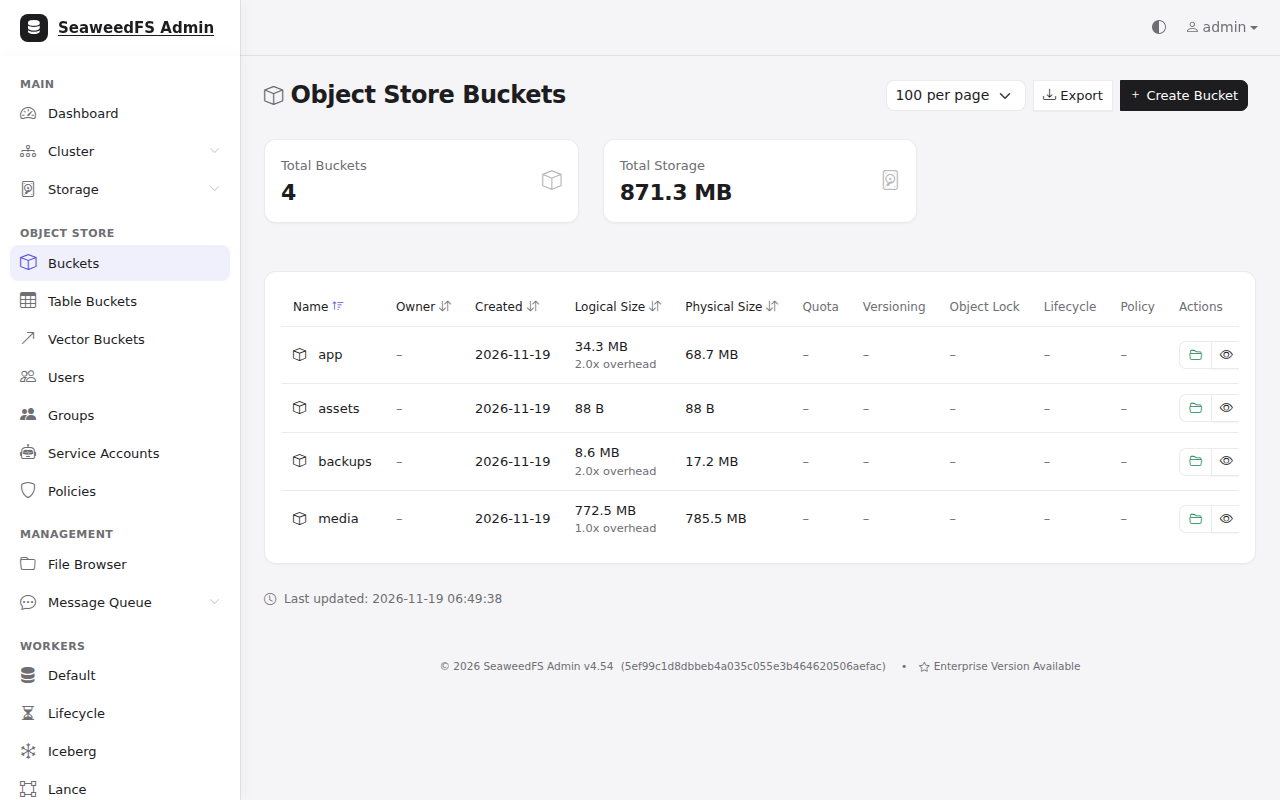
The admin UI at https://my-seaweedfs.exe.xyz/, behind exe.dev login.
## Open the admin UI
When Shelley finishes, open `https://my-seaweedfs.exe.xyz/`. Sign in to
exe.dev, then to SeaweedFS as `admin`, with the password in
`WEED_ADMIN_PASSWORD`. On your computer:
```bash
ssh my-seaweedfs.exe.xyz sudo cat /etc/seaweedfs/seaweedfs.env
```
The same file holds the S3 admin key. Keep a copy somewhere safe, such as
your password manager.
The dashboard shows the volumes, disk use and the one-node cluster.
**Object Store** has your buckets, users, access keys and policies; you can
create a bucket or a user there, and see each bucket's size. **File Browser**
shows the same objects as folders.
The admin UI has its own password because anyone you
[share the VM with](/docs/sharing) gets past exe.dev's login, and this page
can create keys for every bucket. The other private ports (the filer UI on
8888, the master on 9333, WebDAV on 7333) have no login of their own, so
anyone who can reach the VM can read and change every bucket through them.
Share this VM only with people you'd trust with all of its data.
## Use S3 on the VM
An app on the same VM talks to SeaweedFS directly, with no proxy in between.
Its settings are in `~/seaweedfs/app.env`:
```bash
AWS_ENDPOINT_URL=http://localhost:8333
AWS_REGION=us-east-1
AWS_ACCESS_KEY_ID=…
AWS_SECRET_ACCESS_KEY=…
S3_BUCKET=app
```
The AWS SDKs and the AWS CLI read these variables as they are. Other tools
want the same four things: endpoint `http://localhost:8333`, any region
(`us-east-1` is safest), the key, and **path-style** addressing
(`force_path_style`, `use_path_style`, `s3ForcePathStyle` or
`addressing_style: path`), since buckets aren't subdomains here.
This key can read, write, list and delete in the `app` bucket and nothing
else. It can't create buckets or see the others.
To check everything at once, run the test script the setup ran. It writes,
reads, lists and deletes, does a multipart upload, and fetches a presigned
URL:
```bash
curl -fsSLO https://exe.dev/deploy/seaweedfs/s3-check.py
set -a; . ~/seaweedfs/app.env; set +a
uv run s3-check.py
```
[s3-check.py](https://exe.dev/deploy/seaweedfs/s3-check.py) is about 60 lines
of boto3. It ends with `All checks passed`.
Apps in Docker on this VM can't use `localhost` for the host; use
`http://172.17.0.1:8333` (Docker's bridge address), which SeaweedFS listens
on too.
## Reach S3 from elsewhere
S3 clients sign every request with your secret key, in the `Authorization`
header. exe.dev's login page can't sit in front of that, so a private
`https://my-seaweedfs.exe.xyz:8333/` answers `401` to a plain S3 client.
[Self-hosted S3](/deploy/s3-storage#where-clients-connect-from) explains the
choices for all three servers; here is how each one works with SeaweedFS.
| From | Endpoint | What gets you past exe.dev |
|---|---|---|
| This VM | `http://localhost:8333` | nothing to get past |
| Your laptop, scripts, other VMs (clients that can add a header) | `https://my-seaweedfs.exe.xyz:8333` | a VM token in `X-Exedev-Authorization` |
| Your laptop, any client | `http://localhost:8333` through `ssh -L` | your SSH key |
| Apps that can't add a header, browsers with presigned URLs | `https://my-seaweedfs.exe.xyz` | nothing: the S3 port is public, S3 keys are the gate |
### Keep it private, with a VM token
A [VM token](/docs/https-tokens-for-vms) is a bearer token for this VM
only. The client sends it in `X-Exedev-Authorization`; exe.dev checks it,
removes it, and passes the request on with the S3 signature untouched. The
client has to add the header *after* it signs the request, so the signature
doesn't cover a header SeaweedFS never sees.
On your computer, make a token (keep it like a password):
```bash
ssh exe.dev ssh-key generate-api-key --vm=my-seaweedfs --label=s3 --exp=90d
```
**rclone** adds headers after signing with `--header`. In
`~/.config/rclone/rclone.conf`:
```ini
[seaweedfs]
type = s3
provider = SeaweedFS
access_key_id = …
secret_access_key = …
endpoint = https://my-seaweedfs.exe.xyz:8333
```
```bash
export EXEDEV_TOKEN=…
rclone ls seaweedfs:app --header "X-Exedev-Authorization: Bearer $EXEDEV_TOKEN"
rclone copy ./photos seaweedfs:app/photos --header "X-Exedev-Authorization: Bearer $EXEDEV_TOKEN"
```
**boto3** (Python) adds it in a `before-send` event, the last step before
the request leaves:
```python
import os, boto3
s3 = boto3.client("s3", endpoint_url="https://my-seaweedfs.exe.xyz:8333")
def add_exedev_token(request, **kwargs):
request.headers["X-Exedev-Authorization"] = "Bearer " + os.environ["EXEDEV_TOKEN"]
s3.meta.events.register("before-send.s3", add_exedev_token)
print(s3.list_objects_v2(Bucket="app").get("KeyCount"))
```
`s3-check.py` does the same when `EXEDEV_TOKEN` is set: copy
`~/seaweedfs/app.env` to your computer, change `AWS_ENDPOINT_URL` to
`https://my-seaweedfs.exe.xyz:8333`, and run it there.
The **AWS CLI** can't add headers by itself. A small plugin,
[exedev_token.py](https://exe.dev/deploy/seaweedfs/exedev_token.py), does it
for every S3 request when `EXEDEV_TOKEN` is set. Save it in a directory of
its own and point `~/.aws/config` at it:
```bash
mkdir -p ~/.aws/plugins
curl -fsSL -o ~/.aws/plugins/exedev_token.py https://exe.dev/deploy/seaweedfs/exedev_token.py
cat >> ~/.aws/config </dev/null <<'EOF'
[sink.s3]
enabled = true
endpoint = "https://backup-target.example.com"
region = "us-east-1"
bucket = "seaweedfs-backup"
directory = "/my-seaweedfs"
aws_access_key_id = "…"
aws_secret_access_key = "…"
s3_force_path_style = true
is_incremental = false
EOF
sudo chown seaweedfs:seaweedfs /etc/seaweedfs/replication.toml
sudo chmod 600 /etc/seaweedfs/replication.toml
sudo tee /etc/systemd/system/seaweedfs-backup.service >/dev/null <<'EOF'
[Unit]
Description=SeaweedFS continuous backup (weed filer.backup)
After=seaweedfs.service
Requires=seaweedfs.service
[Service]
User=seaweedfs
Group=seaweedfs
WorkingDirectory=/etc/seaweedfs
ExecStart=/usr/local/bin/weed filer.backup -filer=localhost:8888 -filerPath=/buckets -initialSnapshot
Restart=always
RestartSec=10
[Install]
WantedBy=multi-user.target
EOF
sudo systemctl daemon-reload
sudo systemctl enable --now seaweedfs-backup
journalctl -u seaweedfs-backup -f
```
The log shows the first copy of everything (`initialSnapshot: done`), then
it follows changes. For Amazon S3, leave out `endpoint` and set the bucket's
`region`. The backup target must be reachable without exe.dev login: if it's
another exe.dev VM, make its S3 port public. Tested with a second VM running
SeaweedFS as the target: 800 MB in 525 objects copied in a minute, then new
objects within seconds, deletes left alone.
The backup holds objects, not users and keys. SeaweedFS keeps those in the
filer under `/etc`, and `weed shell` can save them to a file. Do it after
adding or changing users, and copy the file off the VM along with
`/etc/seaweedfs/seaweedfs.env`; it contains secret keys:
```bash
weed shell <<< 'fs.meta.save -o /home/exedev/seaweedfs/iam.meta /etc'
chmod 600 ~/seaweedfs/iam.meta
```
`fs.meta.load /path/to/iam.meta` in `weed shell` puts them back (tested).
Restore from the backup
### Restore objects
The backup bucket has one folder per bucket under `directory`. Copy a
bucket back with rclone, from any machine that reaches both (here, the VM
itself, with remotes `backup` for the target and `local` for
`http://localhost:8333` with the admin key):
```bash
rclone sync backup:seaweedfs-backup/my-seaweedfs/app local:app --transfers 16
rclone check backup:seaweedfs-backup/my-seaweedfs/app local:app
```
`rclone check` may say some hashes couldn't be checked: multipart objects
have no plain MD5. It compares their sizes instead. Tested: 513 objects,
800 MB, restored into a new bucket in a minute.
### Restore a whole VM
On a new VM, follow "Install by hand" up to the service, but before
starting it, copy `/etc/seaweedfs/seaweedfs.env` and the whole
`/var/lib/seaweedfs` from the old VM or a disk backup (`rsync -a`, as root,
keeping ownership). Start the service: the buckets, users and keys are
there. If you only have the object backup, install fresh, load
`iam.meta` (or recreate the users), recreate the buckets, restore the
objects as above, and restart SeaweedFS.
## More than one VM
One `weed mini` is one master, one volume server and one filer. SeaweedFS
scales by adding volume servers, and it can keep two or more copies of
every volume on different servers (`-master.defaultReplication=001` for one
extra copy on another server; `010` and `100` spread copies over racks and
data centers). Every server has to reach the master's and each other's
gRPC ports, which exe.dev's HTTPS proxy doesn't carry, so the VMs need to
share a [Tailscale](https://tailscale.com/) network. In outline:
- On the first VM, change `-ip=127.0.0.1` to its Tailscale name
(`-ip=my-seaweedfs`) and add `-master.defaultReplication=001`.
- On each other VM, run a volume server pointing at it:
`weed volume -master=my-seaweedfs:9333 -ip=$(hostname) -dir=/var/lib/seaweedfs -max=0`.
- Existing volumes keep their old setting; `weed shell`'s
`volume.fix.replication` adds the missing copies.
We haven't tested a multi-VM setup for this page; see the
[replication](https://github.com/seaweedfs/seaweedfs/wiki/Replication) and
[production setup](https://github.com/seaweedfs/seaweedfs/wiki/Production-Setup)
wiki pages. For a cluster that survives losing the master, SeaweedFS runs
three masters with `weed master -peers`, which `weed mini` doesn't do.
Until then, the continuous backup above is the simpler second copy.
## The nuts and bolts
Shelley follows these steps when you click Deploy. Open them to do it by
hand, update SeaweedFS, or fix something.
Install by hand
### Create a VM
On your computer (pick any free name; `--disk` is optional, the default is
25 GB):
```bash
ssh exe.dev new --name=my-seaweedfs --disk=100GB
ssh my-seaweedfs.exe.xyz
```
### Install the weed binary
SeaweedFS is one static binary, `weed`. On the VM, download release 4.54,
check it, and install it:
```bash
V=4.54; ARCH=$(dpkg --print-architecture)
cd /tmp
curl -fsSLO https://github.com/seaweedfs/seaweedfs/releases/download/$V/linux_$ARCH.tar.gz
curl -fsSLO https://github.com/seaweedfs/seaweedfs/releases/download/$V/linux_$ARCH.tar.gz.md5
echo "$(cat linux_$ARCH.tar.gz.md5) linux_$ARCH.tar.gz" | md5sum -c
tar xzf linux_$ARCH.tar.gz weed
sudo install -m 755 weed /usr/local/bin/weed
weed version 2>&1 | grep '^version'
```
It prints `version 30GB 4.54 …`. ("30GB" is the largest volume file this
build supports; `weed mini` uses smaller ones.)
### Keys and data directory
SeaweedFS runs as its own system user, with its data in `/var/lib/seaweedfs`.
Generate the S3 admin key and the admin UI password, once:
```bash
sudo useradd --system --home-dir /var/lib/seaweedfs --shell /usr/sbin/nologin seaweedfs || true
sudo install -d -o seaweedfs -g seaweedfs -m 750 /var/lib/seaweedfs
sudo install -d -m 755 /etc/seaweedfs
if ! sudo test -f /etc/seaweedfs/seaweedfs.env; then
sudo install -m 600 /dev/null /etc/seaweedfs/seaweedfs.env
sudo tee /etc/seaweedfs/seaweedfs.env >/dev/null </dev/null <<'EOF'
[Unit]
Description=SeaweedFS (weed mini: master, volume, filer, S3, WebDAV, admin UI)
After=network-online.target
Wants=network-online.target
[Service]
User=seaweedfs
Group=seaweedfs
EnvironmentFile=/etc/seaweedfs/seaweedfs.env
ExecStart=/usr/local/bin/weed mini -dir=/var/lib/seaweedfs -ip=127.0.0.1 \
-admin.port=8000 -admin.port.legacy=0 \
-s3.port.iceberg=0 -s3.port.lance=0 -webdav.filer.path=/buckets \
-master.telemetry=false
Restart=always
RestartSec=5
LimitNOFILE=65536
[Install]
WantedBy=multi-user.target
EOF
sudo systemctl daemon-reload
sudo systemctl enable --now seaweedfs
until curl -s -o /dev/null http://localhost:8333/; do sleep 1; done
curl -s -o /dev/null -w '%{http_code}\n' http://localhost:8333/
```
The last line prints `403`: S3 is up and wants a key. `journalctl -u
seaweedfs` shows each part starting and a summary of the ports.
| Port | What | Reached at |
|---|---|---|
| 8000 | Admin UI (password) | `https://my-seaweedfs.exe.xyz/` |
| 8333 | S3 API (keys) | `:8333`, private until you make it public |
| 8888 | Filer UI and HTTP API | `:8888`, private |
| 9333 | Master UI | `:9333`, private |
| 9340 | Volume server | `:9340`, private |
| 7333 | WebDAV | `:7333`, private |
| 18888, 19333, 19340, 18333 | gRPC between the parts | the VM only |
### Make a bucket and a key for your app
```bash
install -d -m 700 ~/seaweedfs
if [ ! -f ~/seaweedfs/app.env ]; then
out=$(weed shell <<'EOF'
s3.bucket.create -name app
s3.user.provision -name app -bucket app -role readwrite
EOF
)
ak=$(echo "$out" | awk '/^Access Key:/ {print $3}')
sk=$(echo "$out" | awk '/^Secret Key:/ {print $3}')
[ -n "$ak" ] && [ -n "$sk" ] || { echo "$out"; false; }
install -m 600 /dev/null ~/seaweedfs/app.env
cat > ~/seaweedfs/app.env <Update SeaweedFS
SeaweedFS releases about once a week; the
[release notes](https://github.com/seaweedfs/seaweedfs/releases) say what
changed. Updating is replacing the binary and restarting, which takes the
S3 API away for a few seconds. On the VM, with the version you want:
```bash
V=4.55; ARCH=$(dpkg --print-architecture)
cd /tmp && rm -f weed linux_$ARCH.tar.gz*
curl -fsSLO https://github.com/seaweedfs/seaweedfs/releases/download/$V/linux_$ARCH.tar.gz
curl -fsSLO https://github.com/seaweedfs/seaweedfs/releases/download/$V/linux_$ARCH.tar.gz.md5
echo "$(cat linux_$ARCH.tar.gz.md5) linux_$ARCH.tar.gz" | md5sum -c
tar xzf linux_$ARCH.tar.gz weed
sudo cp /usr/local/bin/weed /usr/local/bin/weed.previous
sudo install -m 755 weed /usr/local/bin/weed
sudo systemctl restart seaweedfs
systemctl is-active seaweedfs-backup >/dev/null && sudo systemctl restart seaweedfs-backup
weed version 2>&1 | grep '^version'
```
Then run `s3-check.py` again. To go back, copy `weed.previous` over `weed`
and restart. Tested from 4.53 to 4.54. `weed mini`'s defaults can change
between releases, so read the notes before skipping many versions.
Troubleshooting
- **`401 Unauthorized` with a `WWW-Authenticate: Basic realm="exe.dev"`
header**: exe.dev's proxy stopped the request before SeaweedFS saw it.
The port is private and the client sent no valid VM token. Check the
token hasn't expired, that it's for this VM, and, for the AWS CLI, that
`preferred_transfer_client = classic` is set.
- **`403 AccessDenied` or `SignatureDoesNotMatch`**: SeaweedFS saw the
request and rejected the key or signature. Check the key pair, use
path-style addressing, and make sure the token header is added after
signing (rclone's `--header`, boto3's `before-send`), not as a signed
header.
- **Uploads fail with `no free volumes` in the log**: the disk is nearly
full. Grow it and restart SeaweedFS.
- **The service won't start**: `journalctl -u seaweedfs -n 50`. A port
already in use shows as `bind: address already in use`; something else
on the VM has 8000, 8333, 8888 or 9333.
- **Admin UI login fails**: the user is `admin`, the password is
`WEED_ADMIN_PASSWORD` in `/etc/seaweedfs/seaweedfs.env`. After changing
it, restart SeaweedFS.
- **Lost an app's secret key**: SeaweedFS can't show it again. Make a new
one with `weed shell <<< 's3.accesskey.rotate -h'` for the options, or
in the admin UI, and update the app.
- **Backup not copying**: `journalctl -u seaweedfs-backup -n 50`. The
target must be reachable without exe.dev login, and its bucket must
exist.
## Frequently asked questions
### Is SeaweedFS a drop-in replacement for MinIO?
For most apps, yes: anything that speaks the S3 API with path-style addressing works, including the AWS CLI, boto3, rclone, multipart uploads and presigned URLs, all tested here. The admin tools differ: SeaweedFS has `weed shell` and its admin UI rather than `mc admin`. To copy data across, run `rclone sync` from the old store to the new one. [Self-hosted S3](/deploy/s3-storage) compares it with RustFS and Garage.
### Can I use it from another server or my laptop?
Yes. S3 clients sign their requests themselves, so exe.dev's login page can't sit in front of them. Either keep the port private and have the client send a VM token in an extra header (rclone, boto3 and the AWS CLI can), or make the S3 port public and let SeaweedFS's keys guard it. [Reach S3 from elsewhere](#reach-s3-from-elsewhere) shows both.
### Is my data safe on one VM?
It's on the VM's persistent disk and survives restarts, but one VM is one copy. Keep a [continuous backup](#keep-your-data) in a second place. SeaweedFS can also replicate across volume servers on several VMs; see [More than one VM](#more-than-one-vm).
### How much disk do I need?
A new VM's disk is 25 GB, of which about 20 GB is free for data. Grow it any time with `ssh exe.dev resize my-seaweedfs --disk=200GB` and restart SeaweedFS so it uses the space; disk is billed by what you use, not by its size.
### Why SeaweedFS rather than RustFS or Garage?
SeaweedFS is more than an S3 server: the same data is a file system you can mount, browse and reach over WebDAV, and it is built for huge numbers of small files. RustFS is the closest to MinIO, and Garage is the lightest for several machines. The [comparison](/deploy/s3-storage#choose-one) has the details.
### Is SeaweedFS free?
Yes, under the Apache 2.0 license. Its authors also sell an enterprise edition with extra recovery and erasure coding features, which this page doesn't use. You pay for the VM; see [exe.dev plans](https://exe.dev/pricing).
## Related
- [Self-hosted S3 storage](https://exe.dev/deploy/s3-storage.md): Your own S3 bucket on a real disk. RustFS, Garage or SeaweedFS, tested.
- [Self-host RustFS](https://exe.dev/deploy/rustfs.md): S3-compatible object storage on your own disk, with a console only you can open.
- [Self-host Garage S3 storage](https://exe.dev/deploy/garage.md): Small, S3-compatible object storage on a disk you own, private by default.
- [MinIO is archived. Here's what to do](https://exe.dev/deploy/minio.md): The open-source server is archived. Copy your buckets and keys somewhere maintained.
- [Self-host PostgreSQL](https://exe.dev/deploy/postgres.md): Your own Postgres on a real disk, with backups you've actually restored.
- [SQLite in production](https://exe.dev/deploy/sqlite.md): One file on a real disk, streamed to your own bucket every second.