---
title: "Run New API, an LLM gateway with quotas for your team"
description: "Run New API on exe.dev: one OpenAI-, Claude-, and Gemini-compatible API over your own provider accounts, with users, keys, quotas, and usage logs."
url: https://exe.dev/deploy/new-api
category: "AI apps"
published: 2026-11-22
updated: 2026-11-22
---
# Run New API, an LLM gateway with quotas for your team
> **For agents:** with your user's OK, this sets up New API on a new exe.dev VM in their account: `curl -fsSL https://exe.dev/deploy/new-api/prompt.txt | ssh exe.dev new --prompt=/dev/stdin` (or open https://exe.dev/deploy/new-api/new). Already on the VM? Skip this.
One API over your model accounts, with a quota on every person and key.
- **Software:** New API (https://www.newapi.ai)
- **Source:** https://github.com/QuantumNous/new-api
- **License:** AGPL-3.0
- **Time:** 15 minutes
- **Example VM name:** `my-new-api` (yours will differ; on the VM, `hostname` prints it)
- **Machine-readable:** https://exe.dev/deploy/new-api/manifest.json
- **File:** https://exe.dev/deploy/new-api/prices.sh
## What you get
- New API's console at your VM's private URL, with you as its admin.
- Sign-in with exe.dev, so sharing the VM gives each person an account, with no password to manage.
- Claude, GPT, Kimi, and GLM from exe.dev's LLM gateway, priced at list prices, behind one OpenAI-, Claude-, and Gemini-compatible API.
- Accounts for your team, each with a quota in dollars, and keys with their own quota, expiry, and model list.
- A usage log of every request with its person, key, model, tokens, and cost; prompts aren't stored.
- An API-only address you can make public, while the console stays behind exe.dev login.
- Restarts after a reboot; nightly backups, with one checked.
Running on the VM:
- **exe-oidc-proxy**: Signs people in to the console with their exe.dev login, port 3000
- **New API v1.0.0-rc.51**: The gateway and its console, in Docker Compose, data in `~/new-api/.env`
- **nginx**: Serves only the model APIs, so this port can go public without the console, port 8000, data in `~/new-api/nginx.conf`
- **PostgreSQL 18**: Users, keys, channels, prices, and the usage log, data in `~/new-api/postgres`
- **Redis 8**: New API's cache, in memory
- **exe.dev LLM gateway**: Claude, GPT, Kimi, and GLM, without API keys
How it is reached:
- https://my-new-api.exe.xyz:3000/ (private): New API's console, for you and anyone you share the VM with, signed in with exe.dev
- https://my-new-api.exe.xyz/v1 (private): The model APIs, with an exe.dev VM token and a New API key; make it public and the key is enough
## Deploy with Shelley
Open https://exe.dev/deploy/new-api/new to create a VM whose agent, Shelley, follows this recipe. From a terminal:
```sh
curl -fsSL https://exe.dev/deploy/new-api/prompt.txt | ssh exe.dev new --prompt=/dev/stdin
```
Or follow the steps below by hand.
[New API](https://www.newapi.ai) is an open-source LLM gateway: one
OpenAI-, Claude-, and Gemini-compatible API in front of your model
accounts, with a web console where you give people accounts, keys, and
quotas, and see who used what. It's one of the most popular projects of
its kind, with over 52,000 stars on
[GitHub](https://github.com/QuantumNous/new-api). This recipe runs it on
an exe.dev VM with PostgreSQL and Redis, with exe.dev's
[LLM gateway](/docs/integrations-llm) as its first provider, so Claude,
GPT, Kimi, and GLM work without pasting a key.
The VM keeps New API in two parts. The console, on port 3000, is always
behind exe.dev login, and people sign in to it with that login too: share
the VM, and a teammate clicks **Continue with exe.dev** and has an
account. The model APIs, on port 8000, are private too,
until you decide that apps outside exe.dev should reach them with only a
New API key: then you make that port public, and nothing but `/v1` is
there.
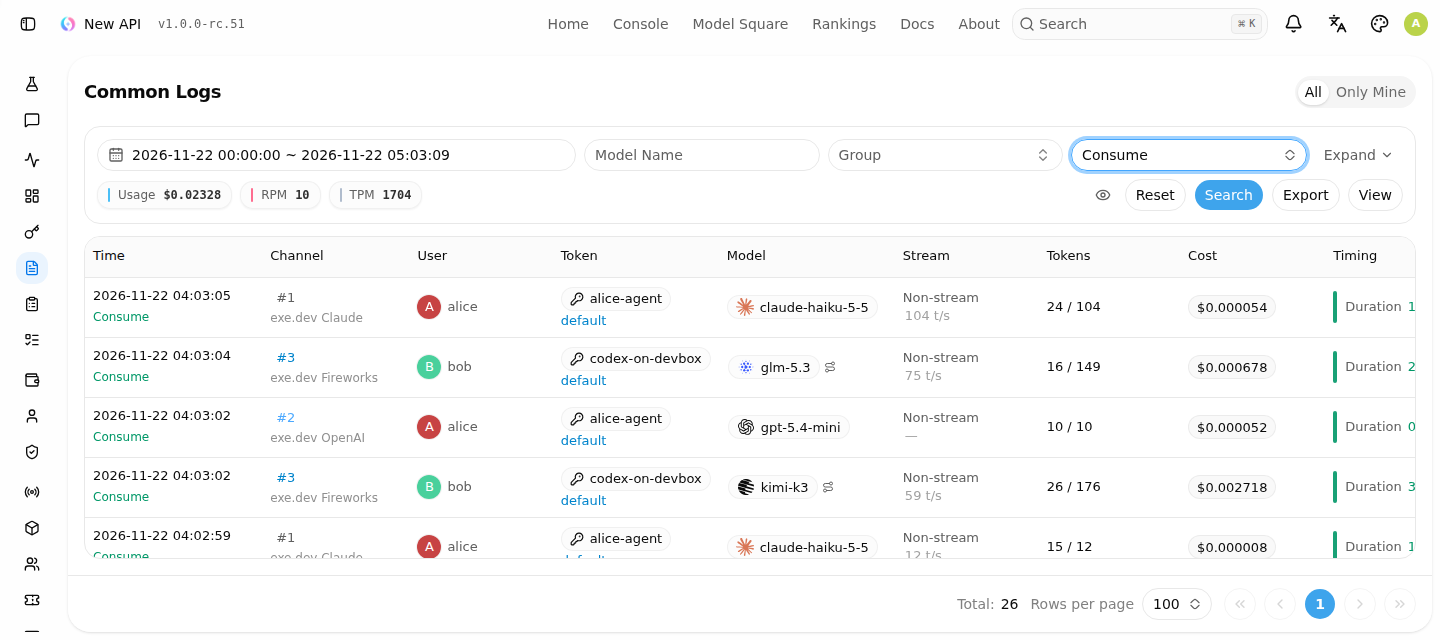
Two people, two keys, four model families, one log: each request priced in dollars.
## Sign in
Open `https://my-new-api.exe.xyz:3000/` and click **Continue with
exe.dev**. Your exe.dev login is linked to New API's admin account, so
that's all: no password. Only people you share the VM with can reach the
page; exe.dev asks for their login first.
The admin account also has a password, for the `api` helper on the VM
and for when you'd rather type one. On your computer,
`ssh my-new-api.exe.xyz grep ADMIN_PASSWORD new-api/.env` shows it; with
the username `admin`, it works in the same sign-in form. If you change it
under **Profile**, put the new one in `.env` too.
Open **Playground**, pick a model, and say hello. **Usage Logs** shows the
request, its tokens, and what it cost.
## Models, channels, and prices
A *channel* is one upstream account: a base URL, a key, and the models it
serves. **Channels** starts with three, all through exe.dev's gateway,
which supplies the provider keys:
| Channel | Models |
| --- | --- |
| exe.dev Claude | `claude-sonnet-5-5`, `claude-haiku-5-5`, `claude-opus-5-5` |
| exe.dev OpenAI | `gpt-5.5`, `gpt-5.4-mini` |
| exe.dev Fireworks | `kimi-k3`, `glm-5.3` |
Clients ask for the names on the right. The Fireworks channel's **Model
mapping** turns them into Fireworks' own names,
`accounts/fireworks/models/kimi-k3` and so on; use mapping to give any
model a short or stable name. When two channels serve the same model, New
API picks one by **Priority**, then spreads requests by **Weight**; set
**Max Retries**, at the top of **Channels**, to retry a failed request on
another channel. To add a model from the
gateway, edit a channel and add its name; a new channel or model starts
serving within a minute. On the VM,
`curl -s https://llm.int.exe.xyz/models.json | jq -r '.models[].id'` lists
what the gateway serves.
New API refuses a model it has no price for, so quotas can't be
bypassed. The install priced the seven models above from
[models.dev](https://models.dev)'s list prices, in dollars per million
tokens. To price more, run
[`prices.sh`](https://exe.dev/deploy/new-api/prices.sh) with the
provider and model as models.dev names them, and the name in New API
after `=` if it differs. On the VM:
```bash
cd ~/new-api
./prices.sh openai:gpt-5.4-nano fireworks-ai:accounts/fireworks/models/glm-5p3-flash=glm-5.3-flash
```
Or set prices by hand under **System Settings** → **Billing & Payment** →
**Model Pricing**, which also lists models without a price.
### Add your own provider accounts
For models outside the gateway, or to bill a provider account of your
own, add a channel. Keep its key in an exe.dev
[integration](/docs/integrations) rather than in New API's database. For
[OpenRouter](https://openrouter.ai),
[connect it](https://exe.dev/integrations/add?service=openrouter&attach=vm:my-new-api)
with its default name, `openrouter`, and attach it to this VM. Then in
**Channels** → **Create Channel**, pick the type **OpenRouter**, set the
base URL to `https://openrouter.int.exe.xyz/api`, the key to any
placeholder such as `exe-integration`, and list the models you want. The
integration swaps in your real key on the way out; see
[Agent secrets](/deploy/agent-secrets) for how that works.
Your own Anthropic or OpenAI key works the same way through a
[BYOK LLM integration](/docs/integrations-llm): on your computer,
```bash
printf '%s' "$ANTHROPIC_API_KEY" | ssh exe.dev integrations add llm \
--name team-keys --anthropic=byok --anthropic-key=- --attach vm:my-new-api
```
and a channel of type **Anthropic** with the base URL
`https://team-keys.int.exe.xyz/anthropic`. You can also paste a
provider's key straight into a channel; New API keeps it in PostgreSQL on
the VM, and in its backups.
## Give your team accounts and keys
Each person gets an account with a quota in dollars, and makes keys
under it. [Share the VM](/docs/sharing) with them; on your computer:
```bash
ssh exe.dev share add my-new-api alice@example.com
```
Alice opens the console's URL and clicks **Continue with exe.dev**. The
first time, New API makes her an account, named `alice` after her email
(or `exe-dev_` and a number if that's taken), and links it to her exe.dev
login. People can also **Sign up** with a username and password, and
under **Users**, **Add user** makes an account for someone who isn't on
exe.dev.
New accounts start with no quota, so nobody spends until you top them up.
On the VM, `~/new-api/api` calls New API's admin API as you; this gives
Alice $20:
```bash
cd ~/new-api
id=$(./api GET '/api/user/search?keyword=alice' | jq -r '.data.items[0].id')
./api POST /api/user/manage "{\"id\": $id, \"action\": \"add_quota\", \"mode\": \"add\", \"value\": 10000000}" | jq .success
```
Quota is counted in units of 500,000 per dollar. Once Alice's account
runs out, her requests fail with `insufficient_user_quota`.
In **API Keys** → **Create API Key**, each person makes keys for their
programs. A key can have its own quota on top of the account's, an
expiry, and, under **Advanced Settings**, a list of models it may use; a
key limited to `claude-haiku-5-5` gets
`This token has no access to model claude-sonnet-5-5` for anything else.
**Usage Logs** shows each person only their own requests, and shows you
everyone's.
To cap how often each person may call models, turn on **System
Settings** → **Security & Limits** → **Rate Limiting**; over the limit,
requests get `429` until the minute rolls over.
## Call it
The base URL is `https://my-new-api.exe.xyz/v1`, and every request
needs a New API key (`sk-...`) from **API Keys**. **API Keys** →
**API Addresses** shows that URL too.
While the VM is private, exe.dev's [HTTPS proxy](/docs/proxy) also wants
a [VM token](/docs/https-tokens-for-vms), so only people you share the VM
with get through. Make one per computer, on your computer:
```bash
ssh exe.dev ssh-key generate-api-key --vm=my-new-api \
--label=new-api-laptop --exp=90d --json | jq -r .token
```
The proxy checks the VM token and drops it; New API checks the key and
bills the request to it:
```bash
export EXE_TOKEN=exe0.... # the VM token
export NEW_API_KEY=sk-.... # the New API key
curl -s https://my-new-api.exe.xyz/v1/chat/completions \
-H "X-Exedev-Authorization: Bearer $EXE_TOKEN" \
-H "Authorization: Bearer $NEW_API_KEY" \
-H 'Content-Type: application/json' \
-d '{"model": "claude-sonnet-5-5", "messages": [{"role": "user", "content": "Say hi."}]}' \
| jq -r '.choices[0].message.content'
```
Without the VM token, the proxy answers `401`; without the key, New API
answers `Invalid token`. If you [make the API public](#make-the-api-public),
leave the VM token out.
### OpenAI SDKs
Any OpenAI-compatible client works with the base URL and the key. In
Python:
```python
import os
from openai import OpenAI
client = OpenAI(
base_url="https://my-new-api.exe.xyz/v1",
api_key=os.environ["NEW_API_KEY"],
# Only while the VM is private:
default_headers={"X-Exedev-Authorization": "Bearer " + os.environ["EXE_TOKEN"]},
)
r = client.chat.completions.create(
model="kimi-k3", messages=[{"role": "user", "content": "Say hi."}]
)
print(r.choices[0].message.content)
```
Streaming, the Responses API, and `client.models.list()`, which lists the
models the key may use, work the same way.
### Claude Code
New API also speaks Anthropic's Messages API, so
[Claude Code](/deploy/claude-code) can use it with a key limited to
Claude models:
```bash
export ANTHROPIC_BASE_URL=https://my-new-api.exe.xyz
export ANTHROPIC_AUTH_TOKEN=$NEW_API_KEY
export ANTHROPIC_CUSTOM_HEADERS="X-Exedev-Authorization: Bearer $EXE_TOKEN"
claude
```
### Codex
[Codex](/deploy/codex) needs a provider in `~/.codex/config.toml`:
```toml
[model_providers.newapi]
name = "New API"
base_url = "https://my-new-api.exe.xyz/v1"
wire_api = "responses"
env_key = "NEW_API_KEY"
env_http_headers = { "X-Exedev-Authorization" = "EXE_NEW_API_AUTH" }
```
Then:
```bash
export EXE_NEW_API_AUTH="Bearer $EXE_TOKEN"
codex -c model_provider=newapi -m gpt-5.5
```
### From your other VMs
A program on another of your VMs, such as [Open WebUI](/deploy/open-webui),
[LibreChat](/deploy/librechat), or an agent, can use the same URL with a
VM token and a key. Or keep both off that VM with a
[peer integration](/docs/integrations-vm-to-vm) that carries the key for
it. On your computer:
```bash
ssh exe.dev integrations add http-proxy --name new-api \
--target https://my-new-api.exe.xyz/ --peer --bearer sk-.... \
--attach vm:my-agent-vm
```
On `my-agent-vm`, the base URL is then `https://new-api.int.exe.xyz/v1`,
with any placeholder as the API key: exe.dev vouches for the VM and swaps
in the New API key at its edge, so the VM never holds either, and the
usage log shows its requests under that key. Give each VM its own
integration and key, so the log tells them apart.
For Claude Code there, set `ANTHROPIC_BASE_URL=https://new-api.int.exe.xyz`
and `ANTHROPIC_AUTH_TOKEN=exe`, not `ANTHROPIC_API_KEY`: New API reads an
`x-api-key` header before the injected one, and rejects the placeholder.
## Make the API public
To let apps outside exe.dev call New API with only a key, make the VM's
main port public. On your computer:
```bash
ssh exe.dev share set-public my-new-api
```
Port 8000 serves `/v1` and `/v1beta` and nothing else: the console, the
sign-in page, and New API's own `/api` stay on port 3000, which is never
public. Anyone on the internet can now try keys against your API, and a
leaked key spends until you disable it, so give public keys a quota and
an expiry, and watch **Usage Logs**. To make it private again,
`ssh exe.dev share set-private my-new-api`.
## Play by the rules
New API is popular for running paid relays, and has payments, redemption
codes, and subscriptions for that. This recipe is for your team's own use
of accounts you pay for.
> [!WARNING]
> Don't put Claude, ChatGPT, Gemini, or Copilot subscription logins
> behind New API to share them, and don't resell a provider's models
> unless your agreement with the provider allows it. Most providers'
> terms forbid both, and accounts get banned for it. Everything through
> exe.dev's gateway is billed to your exe.dev account.
## Keep your data
Users, keys, channels, prices, and the usage log live in PostgreSQL in
`~/new-api/postgres`, and nightly backups go to `~/new-api/backups`. Keep
a copy **off the VM**. On your computer:
```bash
scp -r my-new-api.exe.xyz:new-api/backups .
```
Backups hold `.env` and any provider keys pasted into channels, so keep
them private. For updates or trouble, ask Shelley, or open the
instructions below.
## The nuts and bolts
Happy clicking Deploy? You can stop here. These are Shelley's setup steps
and your maintenance reference.
Install by hand
### Create a VM
On your computer (pick another name if `my-new-api` is taken):
```bash
ssh exe.dev new --name=my-new-api
ssh my-new-api.exe.xyz
```
The default VM (8 GB) is plenty; New API, PostgreSQL, and Redis use well
under 1 GB. All remaining installation commands run **on the VM**, as
`exedev`.
### Write the secrets
New API signs sessions with `SESSION_SECRET`. This writes it, the admin
password, PostgreSQL's password, and the secret New API and the exe.dev
sign-in share to a file only you can read, once:
```bash
mkdir -p ~/new-api && cd ~/new-api
if [ ! -e .env ]; then
touch .env && chmod 600 .env
cat >> .env < nginx.conf <<'EOF'
# Port 8000: New API's model APIs and nothing else. The console, sign-in,
# and setup stay on port 3000, which exe.dev never makes public.
map $http_upgrade $connection_upgrade {
default upgrade;
'' close;
}
server {
listen 8000;
client_max_body_size 64m;
location ~ ^/(v1|v1beta)/ {
proxy_pass http://new-api:3000;
proxy_http_version 1.1;
proxy_set_header Host $host;
proxy_set_header X-Forwarded-For $proxy_add_x_forwarded_for;
proxy_set_header X-Forwarded-Proto https;
proxy_set_header Upgrade $http_upgrade;
proxy_set_header Connection $connection_upgrade;
proxy_buffering off;
proxy_read_timeout 600s;
}
location / {
default_type text/plain;
return 404 "Not here: this address serves New API's /v1 API.\n";
}
}
EOF
```
Then the Compose file:
```bash
cd ~/new-api
cat > compose.yaml <<'EOF'
# New API with PostgreSQL and Redis. Secrets come from .env.
# Port 3000: the console and everything else, through exe-login
# (private, exe.dev login).
# Port 8000: only the model APIs, through nginx (private until you say).
name: new-api
services:
new-api:
image: calciumion/new-api:v1.0.0-rc.51
restart: unless-stopped
command: --log-dir /app/logs
environment:
SQL_DSN: postgresql://newapi:${POSTGRES_PASSWORD:?set in .env}@postgres:5432/newapi
REDIS_CONN_STRING: redis://redis:6379
SESSION_SECRET: ${SESSION_SECRET:?set in .env}
CRYPTO_SECRET: ${CRYPTO_SECRET:?set in .env}
SESSION_COOKIE_SECURE: "true"
SESSION_COOKIE_TRUSTED_URL: ${SESSION_COOKIE_TRUSTED_URL:?set in .env}
TZ: UTC
ERROR_LOG_ENABLED: "true"
BATCH_UPDATE_ENABLED: "true"
NODE_NAME: new-api
volumes:
- ./data:/data
- ./logs:/app/logs
depends_on:
postgres:
condition: service_healthy
redis:
condition: service_started
healthcheck:
test: ["CMD-SHELL", "wget -q -O - http://localhost:3000/api/status | grep -q '\"success\":true'"]
interval: 15s
timeout: 5s
retries: 5
start_period: 1m
# "Continue with exe.dev": an OpenID Connect provider that signs people
# in as the email exe.dev's proxy vouches for. Everything that isn't
# /_oidc/ goes on to New API.
exe-login:
build:
context: https://github.com/boldsoftware/exe-oidc-proxy.git#988147d5e5da7ab2c658e146634e2bc244a7e4aa
dockerfile_inline: |
FROM golang:1.25-alpine AS build
WORKDIR /src
COPY . .
RUN CGO_ENABLED=0 go build -trimpath -o /exe-oidc-proxy .
FROM alpine:3.22
COPY --from=build /exe-oidc-proxy /usr/local/bin/exe-oidc-proxy
USER nobody
ENTRYPOINT ["exe-oidc-proxy"]
image: exe-oidc-proxy:988147d
restart: unless-stopped
ports:
- "3000:3000"
environment:
LISTEN: ":3000"
UPSTREAM: http://new-api:3000
ISSUER: ${SESSION_COOKIE_TRUSTED_URL:?set in .env}/_oidc
CLIENT_ID: new-api
CLIENT_SECRET: ${OIDC_CLIENT_SECRET:?set in .env}
depends_on:
- new-api
api:
image: nginx:1.29-alpine
restart: unless-stopped
ports:
- "8000:8000"
volumes:
- ./nginx.conf:/etc/nginx/conf.d/default.conf:ro
depends_on:
- new-api
postgres:
image: postgres:18
restart: unless-stopped
environment:
POSTGRES_DB: newapi
POSTGRES_USER: newapi
POSTGRES_PASSWORD: ${POSTGRES_PASSWORD:?set in .env}
volumes:
- ./postgres:/var/lib/postgresql
healthcheck:
test: ["CMD", "pg_isready", "-U", "newapi", "-d", "newapi"]
interval: 10s
timeout: 5s
retries: 5
redis:
image: redis:8
restart: unless-stopped
command: ["redis-server", "--save", "", "--appendonly", "no"]
EOF
docker compose config --quiet && echo compose ok
```
Enable Docker at boot, download the images, build exe-login, and start:
```bash
sudo systemctl enable --now docker.service
docker compose pull -q --ignore-buildable
docker compose build -q exe-login
docker compose up -d --wait --wait-timeout 300
curl -fsS localhost:3000/api/status | jq -r '.data.version'
curl -sS localhost:8000/
```
The first `curl` should print `v1.0.0-rc.51`, and the second
`Not here: ...`. The HTTPS proxy adds HTTPS and exe.dev login in front of
both ports.
### Create the admin account
New API's first visitor creates its admin, so do it now, with the
password from `.env`:
```bash
cd ~/new-api
pw=$(sed -n 's/^ADMIN_PASSWORD=//p' .env)
curl -fsS localhost:3000/api/setup -H 'Content-Type: application/json' \
-d "$(jq -nc --arg p "$pw" '{username: "admin", password: $p, confirmPassword: $p,
SelfUseModeEnabled: false, DemoSiteEnabled: false}')" | jq -r .message
```
It should print `System initialized successfully`.
Write `api`, a helper that signs in as admin and calls New API's admin
API, and download [`prices.sh`](https://exe.dev/deploy/new-api/prices.sh),
which prices models from models.dev:
```bash
cd ~/new-api
cat > api <<'EOF'
#!/bin/sh
# Call New API's admin API as admin: ./api METHOD /path ['{json}']
# Signs in with ADMIN_PASSWORD from .env and reuses the 15-minute session
# token from .api-token. Changed the admin password in New API? Update .env.
set -eu
cd "$(dirname "$0")"
umask 077
if [ "$(jq -r '.exp // 0' .api-token 2>/dev/null || echo 0)" -le "$(( $(date +%s) + 60 ))" ]; then
pw=$(sed -n 's/^ADMIN_PASSWORD=//p' .env)
curl -fsS localhost:3000/api/user/login -H 'Content-Type: application/json' \
-d "$(jq -nc --arg p "$pw" '{username: "admin", password: $p}')" |
jq -ce '{token: .data.access_token, exp: .data.access_expires_at}' > .api-token ||
{ rm -f .api-token; echo "api: can't sign in as admin; check ADMIN_PASSWORD in .env" >&2; exit 1; }
fi
token=$(jq -r .token .api-token)
if [ $# -ge 3 ]; then
exec curl -sS -X "$1" "localhost:3000$2" -H "Authorization: Bearer $token" \
-H 'Content-Type: application/json' -d "$3"
fi
exec curl -sS -X "$1" "localhost:3000$2" -H "Authorization: Bearer $token"
EOF
curl -fsSLo prices.sh https://exe.dev/deploy/new-api/prices.sh
chmod 700 api prices.sh
./api GET /api/user/self | jq -r '.data.username + " is role " + (.data.role | tostring)'
```
It should print `admin is role 100`.
### Turn on exe.dev sign-in
This adds exe-login to New API as a sign-in provider called exe.dev,
tells New API the console's address (for the sign-in redirect) and the
API's (for **API Keys** → **API Addresses**), and links your exe.dev
email, from the [reflection integration](/docs/integrations-reflection),
to the admin account. Running it again, say on a renamed VM, updates the
same provider:
```bash
cd ~/new-api
. ./.env
opt() {
./api PUT /api/option/ "$(jq -nc --arg k "$1" --arg v "$2" '{key: $k, value: $v}')" |
jq -r --arg k "$1" '$k + ": " + (.success | tostring)'
}
opt ServerAddress "$SESSION_COOKIE_TRUSTED_URL"
opt console_setting.api_info "$(jq -nc --arg u "https://$(hostname).exe.xyz" '[{url: $u, route: "API", description: "Add /v1 for OpenAI clients", color: "blue"}]')"
provider=$(jq -nc --arg c "$SESSION_COOKIE_TRUSTED_URL" --arg s "$OIDC_CLIENT_SECRET" '{
name: "exe.dev", slug: "exe-dev", enabled: true, client_id: "new-api", client_secret: $s,
authorization_endpoint: ($c + "/_oidc/authorize"),
token_endpoint: "http://exe-login:3000/_oidc/token",
user_info_endpoint: "http://exe-login:3000/_oidc/userinfo",
scopes: "openid email profile", user_id_field: "email",
username_field: "preferred_username", display_name_field: "name", email_field: "email"}')
pid=$(./api GET /api/custom-oauth-provider/ | jq -r '.data[] | select(.slug == "exe-dev") | .id')
if [ -n "$pid" ]; then ./api PUT /api/custom-oauth-provider/$pid "$provider"
else ./api POST /api/custom-oauth-provider/ "$provider"; fi | jq -r '"provider: " + .message'
pid=$(./api GET /api/custom-oauth-provider/ | jq -r '.data[] | select(.slug == "exe-dev") | .id')
owner=$(curl -fsS https://reflection.int.exe.xyz/email | jq -r .email)
docker compose exec -T postgres psql -U newapi -d newapi -qAt -v pid="$pid" -v owner="$owner" <<'SQL'
INSERT INTO user_oauth_bindings (user_id, provider_id, provider_user_id, created_at)
SELECT id, :pid, :'owner', now() FROM users WHERE username = 'admin'
ON CONFLICT DO NOTHING;
SQL
./api GET /api/user/1/oauth/bindings | jq -r '.data[] | "admin signs in as " + .provider_user_id'
```
It should print `ServerAddress: true`, `console_setting.api_info: true`,
a provider message, and `admin signs in as` your exe.dev email. If the reflection integration
isn't attached to the VM, set `owner=` to your email by hand. People
sign in by email, so someone whose exe.dev email changes gets a new
account.
### Add the models
This adds the three channels through exe.dev's gateway
(`exe-llm-gateway` is a placeholder key; the gateway adds the real ones),
and prices their models:
```bash
cd ~/new-api
channel() {
./api POST /api/channel/ "$(jq -nc --argjson c "$1" '{mode: "single", channel: $c}')" |
jq -r --argjson c "$1" '$c.name + ": " + (.success | tostring)'
}
channel '{"type": 14, "name": "exe.dev Claude", "group": "default",
"base_url": "https://llm.int.exe.xyz/anthropic", "key": "exe-llm-gateway",
"models": "claude-sonnet-5-5,claude-haiku-5-5,claude-opus-5-5"}'
channel '{"type": 1, "name": "exe.dev OpenAI", "group": "default",
"base_url": "https://llm.int.exe.xyz/openai", "key": "exe-llm-gateway",
"models": "gpt-5.5,gpt-5.4-mini"}'
channel '{"type": 1, "name": "exe.dev Fireworks", "group": "default",
"base_url": "https://llm.int.exe.xyz/fireworks/inference", "key": "exe-llm-gateway",
"models": "kimi-k3,glm-5.3",
"model_mapping": "{\"kimi-k3\": \"accounts/fireworks/models/kimi-k3\", \"glm-5.3\": \"accounts/fireworks/models/glm-5p3\"}"}'
./prices.sh anthropic:claude-sonnet-5-5 anthropic:claude-haiku-5-5 anthropic:claude-opus-5-5 \
openai:gpt-5.5 openai:gpt-5.4-mini \
fireworks-ai:accounts/fireworks/models/kimi-k3=kimi-k3 \
fireworks-ai:accounts/fireworks/models/glm-5p3=glm-5.3
```
Each channel should print `true`, and `prices.sh` a price for each model.
### Check the models
New API picks up new channels within a minute. This makes a key for
you, calls a model on each channel through port 8000, waiting for the
channels if needed, and deletes the key:
```bash
cd ~/new-api
./api POST /api/token/ '{"name": "setup-check", "remain_quota": 0, "unlimited_quota": true, "expired_time": -1}' >/dev/null
id=$(./api GET '/api/token/?p=1&page_size=100' | jq -r '.data.items[] | select(.name == "setup-check") | .id' | head -1)
key=sk-$(./api POST /api/token/$id/key | jq -r .data.key)
for m in claude-haiku-5-5 gpt-5.4-mini glm-5.3; do
for try in 1 2 3 4 5 6 7 8 9; do
out=$(curl -sS localhost:8000/v1/chat/completions -H "Authorization: Bearer $key" \
-H 'Content-Type: application/json' \
-d "{\"model\": \"$m\", \"messages\": [{\"role\": \"user\", \"content\": \"Say hi.\"}]}" |
jq -r '.choices[0].message.content // .error.message')
case $out in "No available channel"*) sleep 10 ;; *) break ;; esac
done
echo "$m: $out"
done
./api DELETE /api/token/$id | jq -r .success
```
Each model should answer, and **Usage Logs** in the console shows the
three requests with their cost.
### Set up nightly backups
This dumps New API's database while it runs, checks the dump, saves it
with the files in `~/new-api`, and keeps two weeks of backups:
```bash
cd ~/new-api
cat > backup.sh <<'EOF'
#!/bin/sh
# Back up New API: its database, its config, and the .env with its secrets.
set -eu
umask 077
cd "$(dirname "$0")"
mkdir -p -m 700 backups
out="backups/new-api-$(date +%Y%m%d-%H%M%S).tar.gz"
work=$(mktemp -d)
trap 'rm -rf "$work"' EXIT
docker compose exec -T postgres pg_dump -U newapi -d newapi -Fc > "$work/newapi.dump"
docker compose exec -T postgres pg_restore --list < "$work/newapi.dump" > /dev/null
cp .env compose.yaml nginx.conf api prices.sh "$work/"
tar -C "$work" -czf "$out.tmp" .
mv "$out.tmp" "$out"
find backups -name 'new-api-*.tar.gz' -mtime +14 -delete
EOF
chmod +x backup.sh
sudo tee /etc/systemd/system/new-api-backup.service >/dev/null <<'EOF'
[Unit]
Description=Back up New API
After=docker.service
[Service]
Type=oneshot
User=exedev
ExecStart=/home/exedev/new-api/backup.sh
EOF
sudo tee /etc/systemd/system/new-api-backup.timer >/dev/null <<'EOF'
[Unit]
Description=Back up New API nightly
[Timer]
OnCalendar=daily
Persistent=true
[Install]
WantedBy=timers.target
EOF
sudo systemctl daemon-reload
sudo systemctl enable --now new-api-backup.timer
sudo systemctl start new-api-backup.service
systemctl list-timers new-api-backup.timer
tar -tzf backups/new-api-*.tar.gz
```
The timer should list its next run, and the archive should hold
`newapi.dump`, `.env`, and the config files. You're ready: sign in and try
the walkthrough above.
Back up and restore
To take an extra backup, on the VM:
```bash
cd ~/new-api
./backup.sh
```
### Restore
Pick an archive in `backups/` and substitute its filename below. On a new
VM, run **Install by hand** first, stopping after **Start New API**, and
copy your archive into `~/new-api/backups`. These commands run **on the
VM**. They take New API's secrets and admin password from the backup,
keep this VM's PostgreSQL password, and set the current database aside
rather than delete it:
```bash
cd ~/new-api
backup=backups/new-api-YYYYMMDD-HHMMSS.tar.gz
work=$(mktemp -d)
tar -C "$work" -xzf "$backup" &&
docker compose exec -T postgres pg_restore --list < "$work/newapi.dump" >/dev/null &&
sudo systemctl stop new-api-backup.timer new-api-backup.service &&
docker compose stop new-api &&
cp -p .env ".env.before-restore-$(date +%s)" &&
for key in SESSION_SECRET CRYPTO_SECRET ADMIN_PASSWORD OIDC_CLIENT_SECRET; do
line=$(grep "^$key=" "$work/.env") && sed -i "s|^$key=.*|$line|" .env
done &&
docker compose exec -T postgres psql -U newapi -d postgres \
-c "ALTER DATABASE newapi RENAME TO newapi_before_restore_$(date +%s)" \
-c "CREATE DATABASE newapi" &&
docker compose exec -T postgres pg_restore -U newapi -d newapi --no-owner --exit-on-error < "$work/newapi.dump" &&
docker compose exec -T redis redis-cli FLUSHALL >/dev/null &&
rm -f .api-token &&
docker compose up -d --wait --wait-timeout 300 &&
sudo systemctl start new-api-backup.timer &&
rm -rf "$work"
```
Sign in and check **Channels**, **Users**, and **Usage Logs**. On a new
VM with a different name, run **Turn on exe.dev sign-in** again so the
sign-in redirect and API address follow. Once you're happy, drop the set-aside
database; list it with
`docker compose exec postgres psql -U newapi -d postgres -c '\l'`, then
`docker compose exec postgres dropdb -U newapi newapi_before_restore_...`.
Update
New API releases often. Read the
[release notes](https://github.com/QuantumNous/new-api/releases), then
change the image tag in `compose.yaml` to the new release. On the VM,
back up first, then pull and restart; New API updates its database on
start:
```bash
cd ~/new-api
sed -i 's|new-api:v1.0.0-rc.51|new-api:v1.0.0-rc.52|' compose.yaml # the new tag
./backup.sh && docker compose pull -q --ignore-buildable && docker compose up -d --wait --wait-timeout 300
curl -fsS localhost:3000/api/status | jq -r '.data.version'
```
exe-login stays at its pinned commit; to move it, change the commit in
both `context` and `image`, and run `docker compose build exe-login`
before `up`. To undo an update, put the old tag back and
[restore](#back-up-and-restore) the backup you took first.
Something's not happy?
Start with the logs. On the VM:
```bash
cd ~/new-api
docker compose ps
docker compose logs --tail=50 new-api
```
- **Down after a reboot?** Run `sudo systemctl enable --now docker.service`.
- **401 with an exe.dev login page or no JSON?** The request didn't get
past the proxy: the `X-Exedev-Authorization` header is missing, or the
VM token expired or was made for another VM. Or make the API public.
- **`Invalid token`?** That's New API: the request has no `sk-...` key,
or the key is wrong, disabled, or expired.
- **`price not configured`?** The model has no price; run `./prices.sh`
for it, or set one under **Model Pricing**.
- **`insufficient_user_quota`, or the key's quota is used up?** Top up
the account under **Users**, or raise the key's quota under **API Keys**.
- **`This token has no access to model ...`?** The key's model list
doesn't include it.
- **`No available channel for model ...`?** No enabled channel serves
that model name. New API disables a channel that keeps failing; check
**Channels** and test it there.
- **A model fails with a 4xx from the gateway?** Check the name in
`curl -s https://llm.int.exe.xyz/models.json | jq -r '.models[].id'`,
and that your [LLM integration](/docs/integrations-llm) is attached to
the VM.
- **`Not here: ...`?** That's port 8000, which serves only `/v1` and
`/v1beta`; the console is on port 3000.
- **Continue with exe.dev fails?** `email is already in use` means
someone already has a password account with that email: they can keep
using the password, or clear the account's email under **Users** and
sign in again for a new, linked account. For anything
else, `docker compose logs --tail=50 exe-login new-api`, and check that
**Server Address** under **System Settings** → **Site & Branding** is
the console's URL, with `:3000`.
- **`./api` can't sign in?** `ADMIN_PASSWORD` in `.env` must match the
admin's password. New API also allows only 20 sign-ins every 20
minutes; wait, or `rm .api-token` if it's stale.
## Frequently asked questions
### Do I need New API, or is exe.dev's LLM gateway enough?
For yourself, the [gateway](/docs/integrations-llm) is enough: every VM of yours reaches Claude, GPT, and open models with no keys. The [LLM router](/deploy/llm-router) adds a budget and a log per person for a team that shares a VM, with no keys to hand out. New API is for when you hand out keys: to people outside exe.dev, to apps on a public API, with quotas in dollars, a console where each person sees their own usage, and many providers' native APIs.
### How much does it cost?
New API is free and open source. You pay for your [VM plan](https://exe.dev/pricing); the gateway's models use your exe.dev [LLM allocation](/docs/integrations-llm), and providers you add bill you directly. New API's quotas count spending at the prices you set, so they track your bill but aren't the bill.
### Does New API keep our prompts?
No. The usage log keeps each request's person, key, model, tokens, cost, and timing, not the messages. Everything it keeps is in PostgreSQL on the VM.
### Can I sell access, or share my Claude or ChatGPT subscription through it?
New API has payment and redemption features because many people run it as a paid relay. Don't put subscription accounts behind it, and don't resell a provider's models unless your agreement with them allows it; most providers' terms forbid both. See [Play by the rules](#play-by-the-rules).
### What does AGPL-3.0 mean for me?
Running New API for your team is fine. If you change its code and let others use it over a network, the license says you must offer them your changed source.
### Do people need another password?
No. Share the VM with them and they click Continue with exe.dev: exe-oidc-proxy, a small open-source program on the VM, signs them in to New API as the email exe.dev's proxy vouches for, and New API makes their account the first time. Password accounts still work for people who aren't on exe.dev.
### How does New API compare with LiteLLM?
Both put many providers behind one API with keys and spending limits. [LiteLLM](/deploy/llm-router) is configured in a YAML file and fits developer teams; New API is run from its web console, has accounts people sign up for themselves, quotas in dollars, and native Claude and Gemini endpoints next to OpenAI's.
## Related
- [Run a private LLM router for your team](https://exe.dev/deploy/llm-router.md): One private endpoint for every model. Share the VM, and each person gets a budget.
- [Self-host Open WebUI](https://exe.dev/deploy/open-webui.md): A private ChatGPT for you and your team. No API keys.
- [Self-host LibreChat](https://exe.dev/deploy/librechat.md): GPT, Claude, Grok, and open models in one private team chat. No API keys.
- [Give agents API access without giving them the keys](https://exe.dev/deploy/agent-secrets.md): Your agents call your APIs. The keys stay with exe.dev, outside the VM.
- [Run Claude Code on a remote server](https://exe.dev/deploy/claude-code.md): A computer for Claude. A breather for your laptop.
- [Run Codex on a remote server](https://exe.dev/deploy/codex.md): A computer for Codex. An early night for your laptop.