---
title: "Self-host Meilisearch"
description: "Run Meilisearch, the open-source Algolia alternative, on an exe.dev VM: a private admin API with VM tokens, a public search-only endpoint, and AI hybrid search."
url: https://exe.dev/deploy/meilisearch
category: "Databases"
published: 2026-11-25
updated: 2026-11-22
---
# Self-host Meilisearch
> **For agents:** with your user's OK, this sets up Meilisearch on a new exe.dev VM in their account: `curl -fsSL https://exe.dev/deploy/meilisearch/prompt.txt | ssh exe.dev new --prompt=/dev/stdin` (or open https://exe.dev/deploy/meilisearch/new). Already on the VM? Skip this.
A search API that's private for your backend and public for your search box.
- **Software:** Meilisearch (https://www.meilisearch.com)
- **Source:** https://github.com/meilisearch/meilisearch
- **License:** MIT (Enterprise Edition features BUSL-1.1)
- **Time:** 10 minutes
- **Example VM name:** `my-meilisearch` (yours will differ; on the VM, `hostname` prints it)
- **Machine-readable:** https://exe.dev/deploy/meilisearch/manifest.json
- **File:** https://exe.dev/deploy/meilisearch/search.html
## What you get
- Meilisearch 1.57.0 as a systemd service, its data and a daily snapshot on the VM's disk, back after a reboot.
- A master key in one file with mode 600, and a search-only key that can search only the movies index.
- 31,944 movies indexed with filters, facets and sorting, and a search page at the VM's address.
- The admin API at port 7700 behind exe.dev login, and port 8000 serving only the search page and search routes, ready to make public.
- A snapshot made and listed, with the restore and update steps on the page.
Running on the VM:
- **Meilisearch 1.57**: The official single binary, run by systemd, port 7700, data in `~/meilisearch/data`
- **nginx**: The search page and the search route only, rate limited, port 8000, data in `/var/www/meilisearch`
- **exe.dev LLM gateway**: Embeddings for AI search, with no OpenAI key on the VM (optional)
How it is reached:
- https://my-meilisearch.exe.xyz:7700/ (private): The whole Meilisearch API, for you and for backends with a VM token
- https://my-meilisearch.exe.xyz/ (private): The movie search page, until you make it public
- https://my-meilisearch.exe.xyz/indexes/movies/search (public): After share set-public, search with a search-only key or tenant token, nothing else
## Deploy with Shelley
Open https://exe.dev/deploy/meilisearch/new to create a VM whose agent, Shelley, follows this recipe. From a terminal:
```sh
curl -fsSL https://exe.dev/deploy/meilisearch/prompt.txt | ssh exe.dev new --prompt=/dev/stdin
```
Or follow the steps below by hand.
Meilisearch is an open-source search engine with a REST API: send it JSON
documents and get search-as-you-type results in milliseconds, with typo
tolerance, filters, facets and hybrid AI search. It's Algolia-style search
on your own server.
Your backend needs the full API; your website's visitors need only search.
On exe.dev each gets its own door: Meilisearch's API on port 7700 stays
behind your login, reachable by backends with a [VM token](/docs/https-tokens-for-vms),
while port 8000, the one you can make public, serves a search page and the
search route and nothing else. AI search gets embeddings from exe.dev's
[LLM gateway](/docs/integrations-llm), with no OpenAI key on the VM.
## Search the movies
The setup indexes Meilisearch's sample dataset of 31,944 movies. Open
`https://my-meilisearch.exe.xyz/`, sign in if asked, and type.
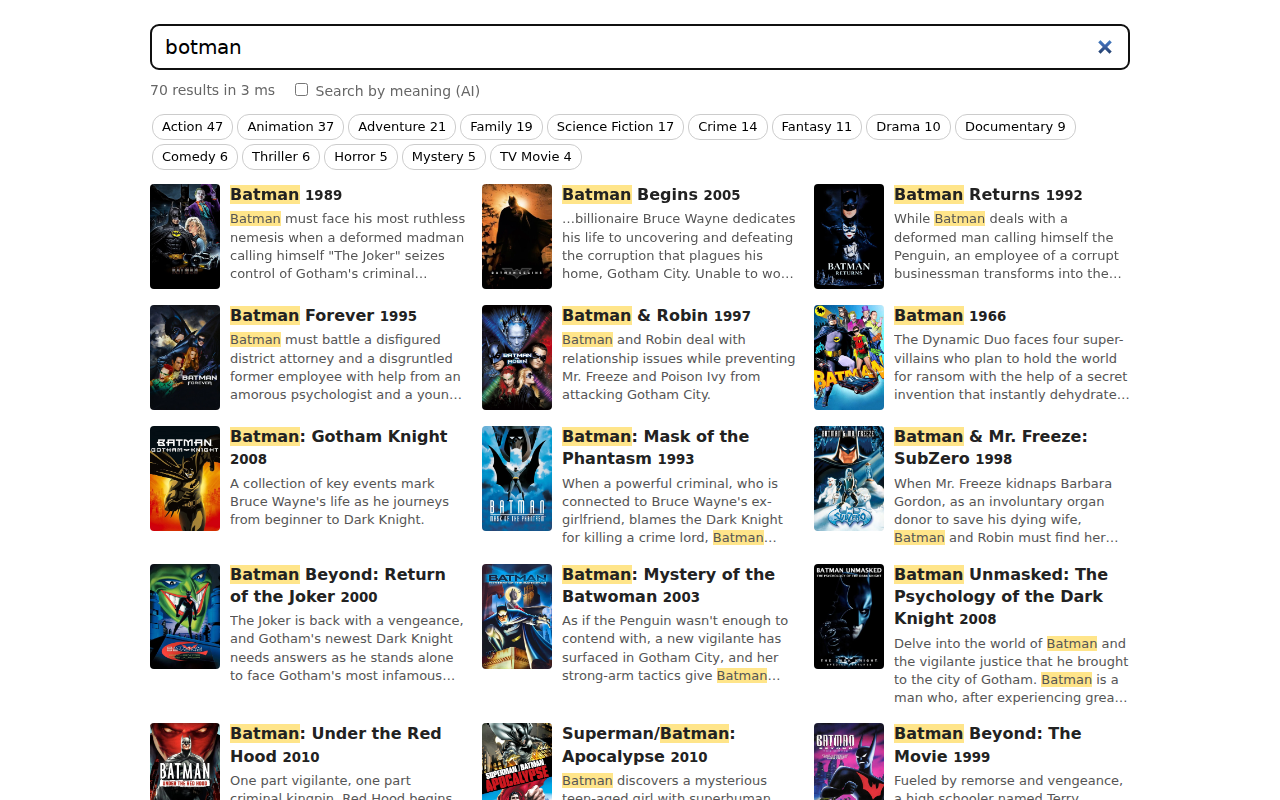
"botman" finds 70 Batman films in 3 ms. The genre buttons are facets.
The page is one file, [search.html](https://exe.dev/deploy/meilisearch/search.html),
calling `POST /indexes/movies/search` with a key that can only search
movies: the same call your own frontend will make.
## Call it from your backend
A request to `https://my-meilisearch.exe.xyz:7700/` needs an exe.dev VM
token, to get past exe.dev's proxy, and a Meilisearch key. On your
computer, make a token that opens only this VM:
```bash
ssh exe.dev ssh-key generate-api-key --vm=my-meilisearch --label=meili-backend
```
For the key, use the **Default Admin API Key** to add documents, or
`movies-search` to search. On the VM, list them:
```bash
. ~/meilisearch/.env
curl -s http://localhost:7700/keys -H "Authorization: Bearer $MEILI_MASTER_KEY" \
| jq -r '.results[] | "\(.name)\t\(.key)"'
```
Send the token in `X-Exedev-Authorization` and the key in `Authorization`;
exe.dev strips the first and passes the second through:
```bash
curl -s https://my-meilisearch.exe.xyz:7700/indexes/movies/search \
-H "X-Exedev-Authorization: Bearer $EXE_VM_TOKEN" \
-H "Authorization: Bearer $MEILI_KEY" \
-H 'Content-Type: application/json' \
-d '{"q": "dark knight", "limit": 3}' | jq -r '.hits[].title'
```
The SDKs take the extra header as an option. JavaScript
([meilisearch](https://www.npmjs.com/package/meilisearch) 0.63):
```js
import { Meilisearch } from "meilisearch";
const client = new Meilisearch({
host: "https://my-meilisearch.exe.xyz:7700",
apiKey: process.env.MEILI_KEY,
requestInit: {
headers: { "X-Exedev-Authorization": `Bearer ${process.env.EXE_VM_TOKEN}` },
},
});
const { hits } = await client.index("movies").search("dark knight", { limit: 3 });
```
In Python, pass `custom_headers={"X-Exedev-Authorization": ...}` to
`meilisearch.Client`. Code on the VM itself uses `http://localhost:7700`
with no token. A backend on another exe.dev VM can use a
[VM-to-VM integration](/docs/integrations-vm-to-vm) instead of tokens.
## Put search on a public website
To let anyone search without an exe.dev login, on your computer:
```bash
ssh exe.dev share set-public my-meilisearch
```
nginx decides what the internet reaches:
| Path | Public? |
|---|---|
| `/` | The search page |
| `POST /indexes/movies/search`, `POST /multi-search` | Yes, with a search key; 20 requests a second per visitor, bursts of 40 |
| `/health` | Yes |
| Everything else | `404`; only on the private port 7700 |
Port 7700 stays private, so even a leaked master key can't be used from the
internet. The search key in the page is meant to be seen, like Algolia's.
Meilisearch answers CORS preflights, so any site can call it:
```js
const res = await fetch("https://my-meilisearch.exe.xyz/indexes/movies/search", {
method: "POST",
headers: { "Content-Type": "application/json", Authorization: `Bearer ${SEARCH_KEY}` },
body: JSON.stringify({ q: "alien", limit: 10, filter: ["genres = Horror"] }),
});
```
For your own index, make a search key for it as in
[Make a search-only key](#make-a-search-only-key), copy the movies
`location` block in the nginx file for its search route, and
`sudo systemctl reload nginx`. `share set-private` closes it again.
## Give each user their own results
A **tenant token** is a JWT your backend signs with the search key. It
carries a filter Meilisearch adds to every search, and the browser can't
change it. In Node:
```js
import { generateTenantToken } from "meilisearch/token";
const token = await generateTenantToken({
apiKey: SEARCH_KEY, apiKeyUid: SEARCH_KEY_UID,
searchRules: { movies: { filter: `team_id = ${user.teamId}` } },
expiresAt: new Date(Date.now() + 60 * 60 * 1000),
});
```
The browser sends it like a key, on the same public route. On the test VM,
a token with `genres = Animation` found 38 Batman films instead of 70, and
expired or altered tokens were refused. The attribute must be in
`filterableAttributes`; deleting the search key invalidates its tokens.
## Add AI search
Hybrid search mixes keyword ranking with meaning, using an embedding model.
The setup's `config.toml` already lets Meilisearch call exe.dev's LLM
gateway, which its SSRF protection otherwise blocks. On the VM:
```bash
. ~/meilisearch/.env
curl -s -X PATCH http://localhost:7700/indexes/movies/settings \
-H "Authorization: Bearer $MEILI_MASTER_KEY" -H 'Content-Type: application/json' \
--data-binary '{
"embedders": {
"openai": {
"source": "openAi",
"url": "https://llm.int.exe.xyz/v1/embeddings",
"model": "text-embedding-3-small",
"dimensions": 512,
"documentTemplate": "A movie titled {{doc.title}}: {{doc.overview | truncatewords: 40}}"
}
}
}'
```
No `apiKey`: the gateway adds credentials. Embedding all the movies took
under four minutes and, by our estimate, about four cents of LLM
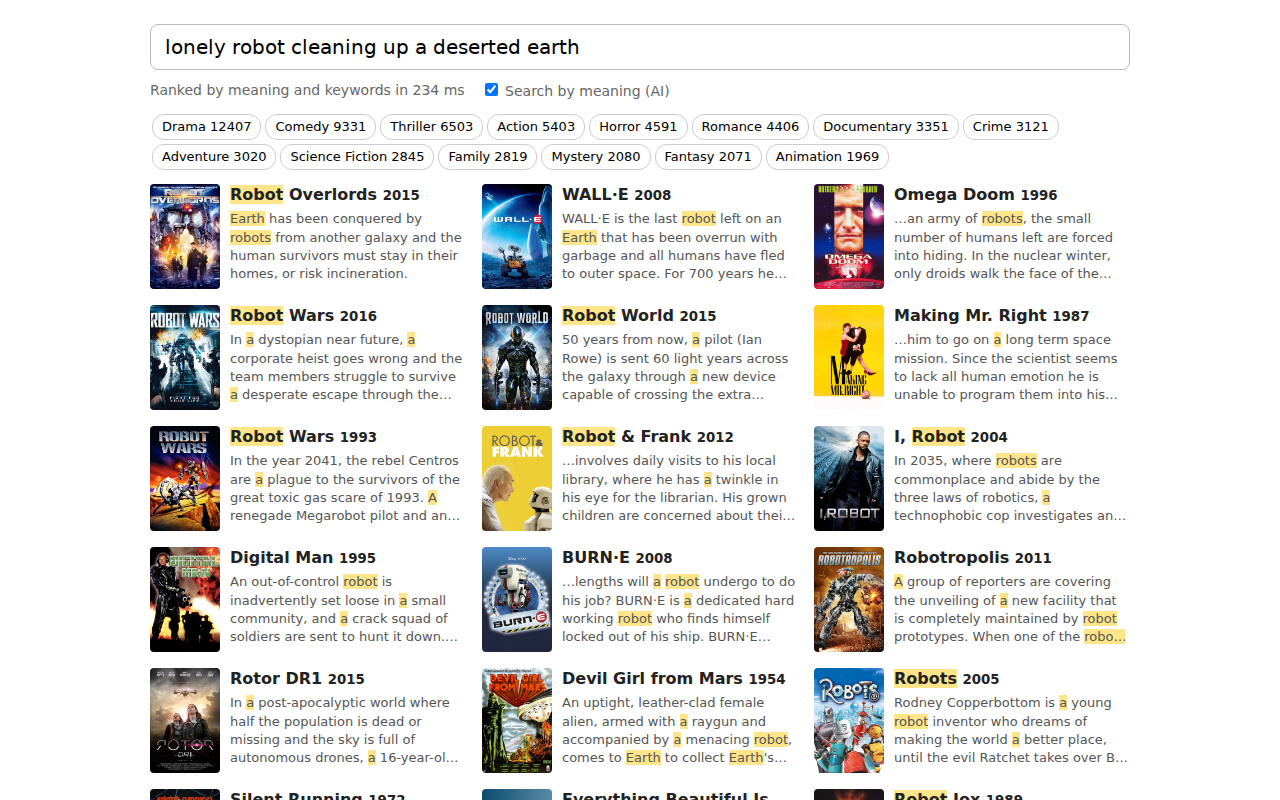
allowance. Then reload the search page and tick **Search by meaning (AI)**.
Search by meaning finds WALL·E; keywords alone return Lonely Hearts.
Any OpenAI-compatible embedding endpoint works the same way: change `url`
and `model`, and add `apiKey` if needed.
## Index your own data
Send JSON, CSV or NDJSON (up to 100 MB a request); the first documents
create the index. On the VM:
```bash
. ~/meilisearch/.env
curl -s -X POST 'http://localhost:7700/indexes/products/documents?primaryKey=id' \
-H "Authorization: Bearer $MEILI_MASTER_KEY" -H 'Content-Type: application/json' \
--data-binary @products.json
```
Indexing runs in the background; `GET /tasks/` reports when it's
done. Set searchable, filterable and sortable fields with
`PATCH /indexes/products/settings`. To stay in sync with a database, have
your app send changed rows as it writes them. Meilisearch has guides for
[migrating from Algolia](https://www.meilisearch.com/docs/resources/migration/algolia_migration)
and [from PostgreSQL](https://www.meilisearch.com/docs/resources/migration/postgresql_migration).
## Typesense instead
[Typesense](https://typesense.org) (GPL-3.0) is the other popular
open-source Algolia alternative. It keeps the index in RAM, so size the
VM's memory for your data. On a VM of its own:
```bash
curl -fsSLO https://dl.typesense.org/releases/30.2/typesense-server-30.2-amd64.deb
sudo apt-get install -y ./typesense-server-30.2-amd64.deb
sudo grep api-key /etc/typesense/typesense-server.ini
curl -s http://localhost:8108/health
```
It runs as a systemd service on port 8108, private at
`https://.exe.xyz:8108/` with the same VM-token pattern; its key goes in
`X-TYPESENSE-API-KEY`. For public search, put the same kind of nginx
allowlist on port 8000 in front of `/collections//documents/search`
and `/multi_search`.
## The nuts and bolts
The same steps Shelley follows, plus maintenance for later.
Install by hand
### Create a VM
On your computer (pick another name if `my-meilisearch` is taken):
```bash
ssh exe.dev new --name=my-meilisearch
ssh my-meilisearch.exe.xyz
```
All remaining installation commands run **on the VM**, as `exedev`.
### Install Meilisearch
Meilisearch is one static binary. Download a pinned release from GitHub
(the newest is on the [releases page](https://github.com/meilisearch/meilisearch/releases)):
```bash
MEILI_VERSION=v1.57.0
curl -fsSL -o /tmp/meilisearch \
"https://github.com/meilisearch/meilisearch/releases/download/$MEILI_VERSION/meilisearch-linux-amd64"
sudo install -m 755 /tmp/meilisearch /usr/local/bin/meilisearch
meilisearch --version
```
Expect `meilisearch 1.57.0`.
### Configure it
Everything lives in `~/meilisearch`. The master key in `.env` is written
**once**; every API key derives from it, so back it up.
```bash
mkdir -p ~/meilisearch/data ~/meilisearch/dumps ~/meilisearch/snapshots
cd ~/meilisearch
if [ ! -e .env ]; then
touch .env && chmod 600 .env
echo "MEILI_MASTER_KEY=$(openssl rand -hex 32)" >> .env
fi
cat > config.toml <<'EOF'
# https://www.meilisearch.com/docs/resources/self_hosting/configuration/reference
# The master key is in .env, not here.
env = "production"
# exe.dev's proxy reaches localhost, so nothing listens on the network.
http_addr = "127.0.0.1:7700"
db_path = "/home/exedev/meilisearch/data"
dump_dir = "/home/exedev/meilisearch/dumps"
snapshot_dir = "/home/exedev/meilisearch/snapshots"
# A snapshot every 24 hours, replacing the previous one.
schedule_snapshot = 86400
no_analytics = true
# exe.dev integrations, like the LLM gateway at llm.int.exe.xyz, answer on
# this link-local address, which Meilisearch otherwise refuses to call.
experimental_allowed_ip_networks = ["169.254.169.254/32"]
EOF
```
### Run it as a service
```bash
sudo tee /etc/systemd/system/meilisearch.service >/dev/null <<'EOF'
[Unit]
Description=Meilisearch
After=network-online.target
Wants=network-online.target
[Service]
User=exedev
WorkingDirectory=/home/exedev/meilisearch
EnvironmentFile=/home/exedev/meilisearch/.env
ExecStart=/usr/local/bin/meilisearch --config-file-path /home/exedev/meilisearch/config.toml
Restart=on-failure
LimitNOFILE=65536
[Install]
WantedBy=multi-user.target
EOF
sudo systemctl daemon-reload
sudo systemctl enable --now meilisearch
until curl -fs http://localhost:7700/health; do sleep 1; done; echo
```
Expect `{"status":"available"}`.
### Load the movies
Set the searchable, filterable and sortable fields, send the 16 MB
dataset, and wait:
```bash
. ~/meilisearch/.env
M=http://localhost:7700
H="Authorization: Bearer $MEILI_MASTER_KEY"
curl -fsSL -o /tmp/movies.json https://www.meilisearch.com/docs/assets/datasets/movies.json
curl -fsS -X PATCH "$M/indexes/movies/settings" -H "$H" -H 'Content-Type: application/json' \
--data-binary '{
"searchableAttributes": ["title", "overview", "genres"],
"filterableAttributes": ["genres", "release_date"],
"sortableAttributes": ["release_date"]
}' >/dev/null
task=$(curl -fsS -X POST "$M/indexes/movies/documents?primaryKey=id" -H "$H" \
-H 'Content-Type: application/json' --data-binary @/tmp/movies.json | jq .taskUid)
until s=$(curl -fsS "$M/tasks/$task" -H "$H" | jq -r .status); [ "$s" = succeeded ] || [ "$s" = failed ]; do sleep 2; done
curl -fsS "$M/tasks/$task" -H "$H" | jq -c '{status, details, error}'
curl -fsS -X POST "$M/indexes/movies/search" -H "$H" -H 'Content-Type: application/json' \
-d '{"q": "botman", "limit": 3}' | jq -c '[.hits[].title]'
```
Expect `"status":"succeeded"` with `"indexedDocuments":31944` (about 10
seconds), then `["Batman","Batman Begins","Batman Returns"]`.
### Make a search-only key
The public page gets a key that can search only the movies index:
```bash
. ~/meilisearch/.env
if ! curl -fsS http://localhost:7700/keys -H "Authorization: Bearer $MEILI_MASTER_KEY" \
| jq -e '.results[] | select(.name == "movies-search")' >/dev/null; then
curl -fsS -X POST http://localhost:7700/keys \
-H "Authorization: Bearer $MEILI_MASTER_KEY" -H 'Content-Type: application/json' \
--data-binary '{"name": "movies-search", "description": "Search the movies index, nothing else",
"actions": ["search"], "indexes": ["movies"], "expiresAt": null}' \
| jq -c '{name, actions, indexes}'
fi
```
Expect `{"name":"movies-search","actions":["search"],"indexes":["movies"]}`.
### Serve the search page on port 8000
nginx, which comes with the VM, serves the page (with the search key
written in) and passes only the search routes to Meilisearch:
```bash
. ~/meilisearch/.env
SEARCH_KEY=$(curl -fsS http://localhost:7700/keys -H "Authorization: Bearer $MEILI_MASTER_KEY" \
| jq -r '.results[] | select(.name == "movies-search") | .key')
sudo mkdir -p /var/www/meilisearch
curl -fsSL https://exe.dev/deploy/meilisearch/search.html \
| sed "s/__SEARCH_KEY__/$SEARCH_KEY/" | sudo tee /var/www/meilisearch/index.html >/dev/null
sudo tee /etc/nginx/sites-available/meilisearch-public >/dev/null <<'EOF'
# Port 8000, the only port of this VM that can be made public: the search
# page and Meilisearch's search routes. Documents, settings, keys and
# dumps stay on the private port 7700.
# exe.dev's proxy adds the visitor's address last in X-Forwarded-For;
# rate limit per visitor, not per proxy.
map $http_x_forwarded_for $visitor {
"~(?[^,\s]+)\s*$" $last;
default $remote_addr;
}
limit_req_zone $visitor zone=meili_search:10m rate=20r/s;
server {
listen 8000 default_server;
listen [::]:8000 default_server;
root /var/www/meilisearch;
client_max_body_size 16k;
location = /indexes/movies/search {
limit_except POST OPTIONS { deny all; }
limit_req zone=meili_search burst=40 nodelay;
limit_req_status 429;
proxy_pass http://127.0.0.1:7700;
}
location = /multi-search {
limit_except POST OPTIONS { deny all; }
limit_req zone=meili_search burst=40 nodelay;
limit_req_status 429;
proxy_pass http://127.0.0.1:7700;
}
location = /health {
proxy_pass http://127.0.0.1:7700;
}
location = / {
try_files /index.html =404;
}
location / {
return 404;
}
}
EOF
sudo ln -sf /etc/nginx/sites-available/meilisearch-public /etc/nginx/sites-enabled/
sudo nginx -t
sudo systemctl enable nginx
sudo systemctl restart nginx
```
`default_server` wins over the VM's stock site on 8000. Check:
```bash
curl -s -o /dev/null -w 'page %{http_code}\n' http://localhost:8000/
curl -s -X POST http://localhost:8000/indexes/movies/search -H "Authorization: Bearer $SEARCH_KEY" \
-H 'Content-Type: application/json' -d '{"q": "inception", "limit": 1}' | jq -c '[.hits[].title]'
curl -s -o /dev/null -w 'keys %{http_code}\n' http://localhost:8000/keys -H "Authorization: Bearer $MEILI_MASTER_KEY"
```
Expect `page 200`, `["Inception"]`, and `keys 404`: even the master key
gets nothing but search through port 8000.
### Check the snapshot
Make one now rather than waiting a day:
```bash
. ~/meilisearch/.env
task=$(curl -fsS -X POST http://localhost:7700/snapshots -H "Authorization: Bearer $MEILI_MASTER_KEY" | jq .taskUid)
until s=$(curl -fsS "http://localhost:7700/tasks/$task" -H "Authorization: Bearer $MEILI_MASTER_KEY" | jq -r .status); [ "$s" = succeeded ] || [ "$s" = failed ]; do sleep 1; done
echo "$s"; ls -lh ~/meilisearch/snapshots
```
Expect `succeeded` and a `data.snapshot` file.
Back up and restore
A **snapshot** is an exact copy of the database and restores only on the
same Meilisearch version; this setup writes one daily to
`~/meilisearch/snapshots/data.snapshot`. A **dump** (`POST /dumps`, written
to `~/meilisearch/dumps`) imports into a newer version too, but rebuilds the
index (103 seconds for the movies on the test VM). Neither holds the master
key, so keep `.env` with them or every key changes. On the VM:
```bash
cd ~/meilisearch && tar -czf ~/meilisearch-backup-$(date +%Y%m%d).tar.gz .env config.toml snapshots/data.snapshot
```
Then on your computer: `scp 'my-meilisearch.exe.xyz:meilisearch-backup-*.tar.gz' .`
### Restore a snapshot
Meilisearch never overwrites a database, so move the current one aside. On
the VM:
```bash
cd ~/meilisearch
sudo systemctl stop meilisearch
mv data data.before-restore
sudo systemctl set-environment MEILI_IMPORT_SNAPSHOT=/home/exedev/meilisearch/snapshots/data.snapshot
sudo systemctl start meilisearch
until curl -fs http://localhost:7700/health; do sleep 1; done; echo
sudo systemctl unset-environment MEILI_IMPORT_SNAPSHOT
```
For a dump, use `MEILI_IMPORT_DUMP=/home/exedev/meilisearch/dumps/.dump`
instead. On a new VM, install up to "Configure it", unpack the backup into
`~/meilisearch`, run the restore without `mv`, then the service and nginx
steps.
Update
A new binary upgrades the database in place when started with
`MEILI_UPGRADE_DB`. Upgrades aren't atomic, so this takes a snapshot first.
On the VM, with the version from the
[releases page](https://github.com/meilisearch/meilisearch/releases):
```bash
. ~/meilisearch/.env
M=http://localhost:7700; H="Authorization: Bearer $MEILI_MASTER_KEY"
task=$(curl -fsS -X POST $M/snapshots -H "$H" | jq .taskUid)
until [ "$(curl -fsS $M/tasks/$task -H "$H" | jq -r .status)" = succeeded ]; do sleep 2; done
MEILI_VERSION=v1.57.0
curl -fsSL -o /tmp/meilisearch \
"https://github.com/meilisearch/meilisearch/releases/download/$MEILI_VERSION/meilisearch-linux-amd64"
chmod +x /tmp/meilisearch && /tmp/meilisearch --version
cp ~/meilisearch/snapshots/data.snapshot ~/meilisearch/before-upgrade.snapshot
sudo systemctl stop meilisearch
sudo cp /usr/local/bin/meilisearch /usr/local/bin/meilisearch.previous
sudo install -m 755 /tmp/meilisearch /usr/local/bin/meilisearch
sudo systemctl set-environment MEILI_UPGRADE_DB=true
sudo systemctl start meilisearch
sudo systemctl unset-environment MEILI_UPGRADE_DB
until curl -fs $M/health >/dev/null; do sleep 1; done
curl -fsS "$M/tasks?types=upgradeDatabase&limit=1" -H "$H" | jq -c '.results[] | {status, details}'
```
Expect `"status":"succeeded"` with `upgradeFrom` and `upgradeTo`. If it
fails, put back `meilisearch.previous` and restore `before-upgrade.snapshot`.
Troubleshooting
Start with `journalctl -u meilisearch -n 50 --no-pager` and
`GET /tasks?statuses=failed`.
- **`401` on port 7700:** the VM token is missing, expired or for another
VM; send it in `X-Exedev-Authorization`.
- **`missing_authorization_header` or `invalid_api_key`:** no Meilisearch
key, or one not allowed to do that.
- **Won't start after a binary swap** ("database version … is
incompatible"): run the [Update](#update) steps.
- **The embedder task stays `processing`:** `experimental_allowed_ip_networks`
is missing from `config.toml`; add it and restart Meilisearch.
- **`404` or `429` from port 8000:** the nginx allowlist and rate limit, by
design; edit the nginx file to change them.
- **The stock "exe.dev" page on port 8000:** `default_server` is missing or
nginx wasn't restarted.
## Frequently asked questions
### Is Meilisearch free to self-host?
Yes. The Community Edition installed here is MIT licensed and includes full-text, faceted and AI search; a few features, such as sharding, are in the BUSL-1.1 Enterprise Edition. You pay for the [VM plan](https://exe.dev/pricing).
### How much disk and memory does it need?
On a 2 vCPU, 8 GB test VM, the 31,944 movies took 8 seconds to index and 158 MB of disk (290 MB with embeddings), and searches took 1-3 ms. The index lives on disk, with free memory as a cache.
### Does it work with Algolia's InstantSearch?
Yes, through [instant-meilisearch](https://github.com/meilisearch/meilisearch-js-plugins), which calls `POST /multi-search`. Port 8000 allows that route, so point it at `https://my-meilisearch.exe.xyz` with the search-only key.
### Meilisearch or Typesense?
Both are fast and typo-tolerant. Meilisearch is MIT licensed and keeps its index on disk; Typesense keeps it in RAM and has built-in clustering. See [Typesense instead](#typesense).
### How do I back it up?
Meilisearch writes a snapshot every 24 hours. Copy it off the VM with `.env`, which holds the master key. See [Back up and restore](#back-up-and-restore).
## Related
- [Self-host PostgreSQL](https://exe.dev/deploy/postgres.md): Your own Postgres on a real disk, with backups you've actually restored.
- [Self-host Redis](https://exe.dev/deploy/redis.md): Your own Redis on a real disk, private by default, with backups you've restored.
- [Self-host SearXNG](https://exe.dev/deploy/searxng.md): Your own private search engine, with a JSON API for scripts and agents.
- [Deploy Next.js on your own server](https://exe.dev/deploy/nextjs.md): Your Next.js app on a server of its own. git push to deploy.
- [Deploy a Node.js app](https://exe.dev/deploy/nodejs.md): Your Express app on a server of its own. git push to deploy.
- [Self-host ClickHouse](https://exe.dev/deploy/clickhouse.md): Fast SQL analytics on events and logs, on a real disk, private by default.