---
title: "Self-host Mattermost"
description: "Run Mattermost on exe.dev: private team chat you sign in to with your exe.dev login, alerts from your other VMs, and an AI agent with no API key."
url: https://exe.dev/deploy/mattermost
category: "Productivity"
updated: 2026-11-18
---
# Self-host Mattermost
> **For agents:** with your user's OK, this sets up Mattermost on a new exe.dev VM in their account: `curl -fsSL https://exe.dev/deploy/mattermost/prompt.txt | ssh exe.dev new --prompt=/dev/stdin` (or open https://exe.dev/deploy/mattermost/new). Already on the VM? Skip this.
Team chat you own, with alerts from your VMs and an AI agent built in.
- **Software:** Mattermost (https://mattermost.com)
- **Source:** https://github.com/mattermost/mattermost
- **License:** MIT (Team Edition)
- **Time:** 15 minutes
- **Example VM name:** `my-mattermost` (yours will differ; on the VM, `hostname` prints it)
- **Machine-readable:** https://exe.dev/deploy/mattermost/manifest.json
- **File:** https://exe.dev/deploy/mattermost/exe-login.py
- **File:** https://exe.dev/deploy/mattermost/nginx.conf.template
## What you get
- Mattermost Team Edition on PostgreSQL, behind exe.dev login, with live updates.
- Sign-in with your exe.dev login, no Mattermost passwords; invite links just work.
- Uploaded files on the VM's disk, and the secrets in a private file.
- Email notifications and invites through exe.dev, with no mail service.
- A secret that lets the desktop and mobile apps in once you make the VM public.
- Nightly backups; everything restarts after a reboot.
Running on the VM:
- **Mattermost 12.1**: Team Edition, Docker Compose, data in `~/mattermost/mattermost`
- **nginx**: Lets in exe.dev logins and the apps' secret; carries websockets, port 8000
- **exe-login**: Signs people in to Mattermost with their exe.dev login
- **PostgreSQL 18**: Messages, channels, people, settings, data in `~/mattermost/postgres`
- **smtp-relay**: Turns Mattermost's email into exe.dev email
- **Nightly backup**: A systemd timer; keeps two weeks of copies, data in `~/mattermost/backups`
How it is reached:
- https://my-mattermost.exe.xyz/ (private): Mattermost in the browser, after exe.dev login, for you and anyone you share it with
- https://my-mattermost.exe.xyz/hooks/ (private): incoming webhooks, for your other VMs through a peer integration or VM token
## Deploy with Shelley
Open https://exe.dev/deploy/mattermost/new to create a VM whose agent, Shelley, follows this recipe. From a terminal:
```sh
curl -fsSL https://exe.dev/deploy/mattermost/prompt.txt | ssh exe.dev new --prompt=/dev/stdin
```
Or follow the steps below by hand.
Mattermost is open-source team chat in the mould of Slack: channels,
threads, direct messages, file sharing, search, and desktop and mobile
apps. It's also a good home for the robots: point your monitors, deploy
scripts, and agents at a channel and the whole team sees what happened.
On exe.dev, it's private from the first minute: exe.dev login sits in
front of it and signs you in to Mattermost too, HTTPS comes with the VM,
and you share it by email address.
The VM keeps your messages and files on its own disk, an AI agent answers
through exe.dev's LLM gateway without an API key, and email arrives
without a mail service.
## Sign in
Open the URL Shelley gives you, like `https://my-mattermost.exe.xyz/`, and
sign in to exe.dev. That's all: your exe.dev login signs you in to
Mattermost too, and as the first person in, you're its system admin. Give
your organization a name (*Acme*, say), which becomes your team, skip the
tools and invitations for now, and say hello in **Town Square**.
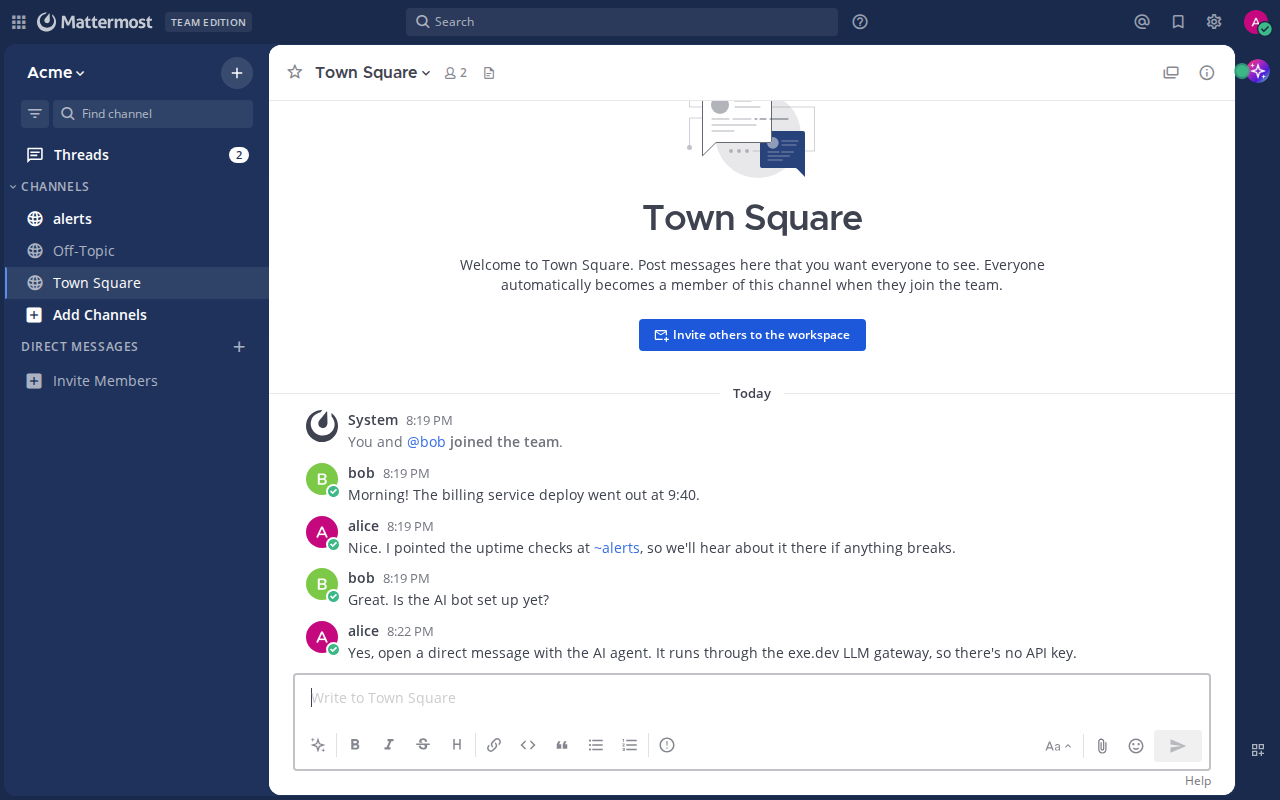
Town Square, where everyone on the team starts.
Messages appear for everyone the moment they're sent: Mattermost's live
updates ride a websocket through exe.dev's proxy, which needs no setup.
## Bring in your team
On your computer, share the VM with a person or your whole team:
```bash
ssh exe.dev share add my-mattermost alice@example.com
ssh exe.dev share add my-mattermost team
```
Then, in Mattermost, open the team menu (the team name at the top left),
choose **Invite People**, and copy the invite link. When Alice opens it,
she signs in to exe.dev and lands in your team, with no Mattermost
password to make up. Someone who signs in without an invite gets an
account but no team, until you add them under **System Console → User
Management → Teams**.
> [!TIP]
> Removing someone? On your computer run
> `ssh exe.dev share remove my-mattermost alice@example.com`, then
> deactivate them under **System Console → User Management → Users**.
**Log out** in Mattermost signs you straight back in while you're signed
in to exe.dev. To switch accounts, sign out of exe.dev.
## Add an AI agent
Mattermost's Agents plugin comes with it, and exe.dev's
[LLM gateway](/docs/integrations-llm) speaks the OpenAI API, so the agent
needs no key. Open **System Console** from the product menu (the grid at
the top left), then **Plugins → Agents → Add an AI Service**:
- **Service name**: `exe.dev LLM gateway`
- **Service type**: OpenAI Compatible
- **API URL**: `https://llm.int.exe.xyz/v1`
- **API Key**: anything, like `exe-llm-gateway`; the gateway ignores it
- **Default model**: type a model name, like `gpt-5.4-mini`
**Save**, then follow **Open Agents** (or **Agents** in the product menu)
and **Create agent**: give it a display name, the username `ai`, and pick
the service you just added. Open a direct message with **@ai** and ask it
something.
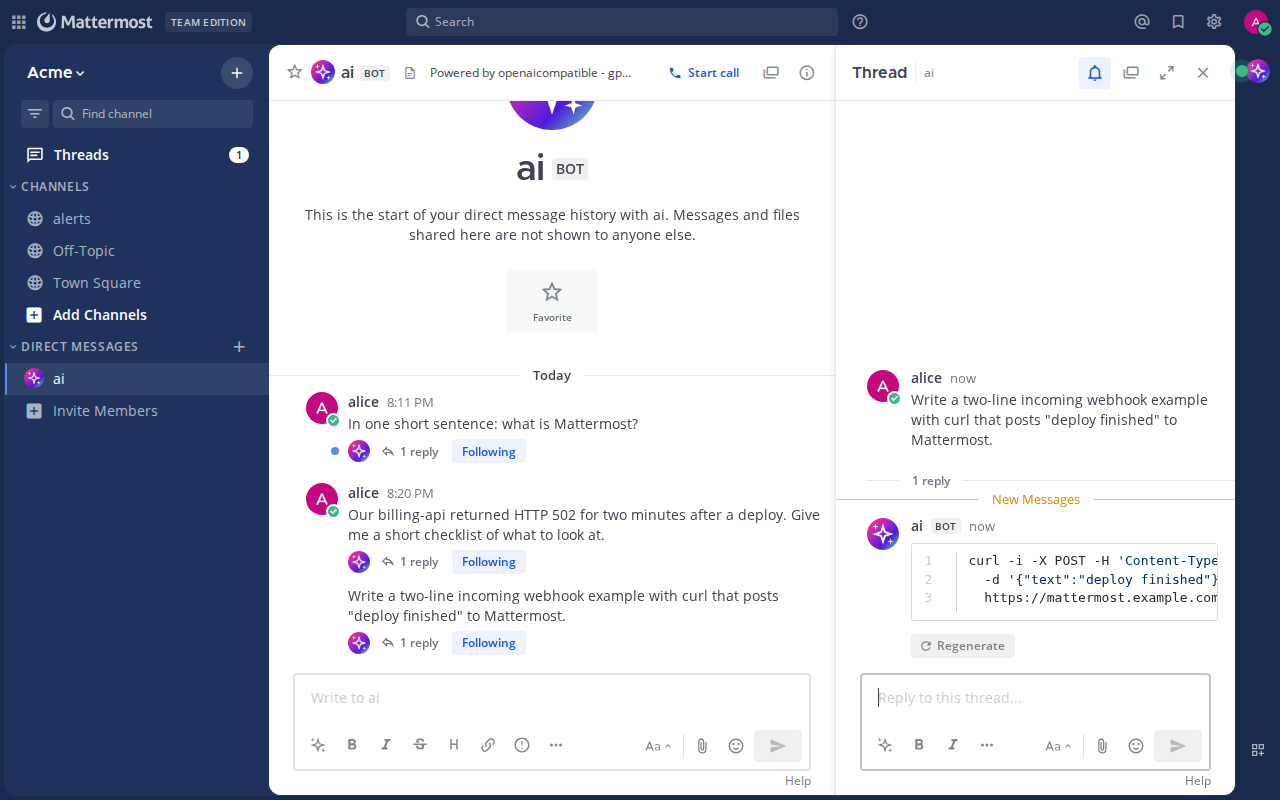
The agent answers in a thread, through exe.dev's LLM gateway.
Any OpenAI model the gateway lists at
[llm.int.exe.xyz/models.json](https://llm.int.exe.xyz/models.json)
works; leave **Use Responses API** on. Team Edition allows one agent, and
it answers in direct messages only. Mention it in a channel and it says
channels need Mattermost Professional.
## Post alerts from your other VMs
An incoming webhook gives a channel an address that takes a JSON
message. Create a channel (say `alerts`), then from the product menu open
**Integrations → Incoming Webhooks → Add Incoming Webhook**, pick the
channel, and **Save**. Mattermost shows a URL ending in `/hooks/` and an
ID. Try it on the Mattermost VM, with your ID:
```bash
curl -fsS localhost:8000/hooks/xxxxxxxxxxxxxxxxxxxxxxxxxx \
-H 'Content-Type: application/json' \
-d '{"username": "deploy-bot", "text": "Deployed **billing-api** v2.15.0"}'
```
`curl` prints `ok` and the message appears in the channel. `text` takes
Markdown; `username` and `icon_url` change who it appears to come from.
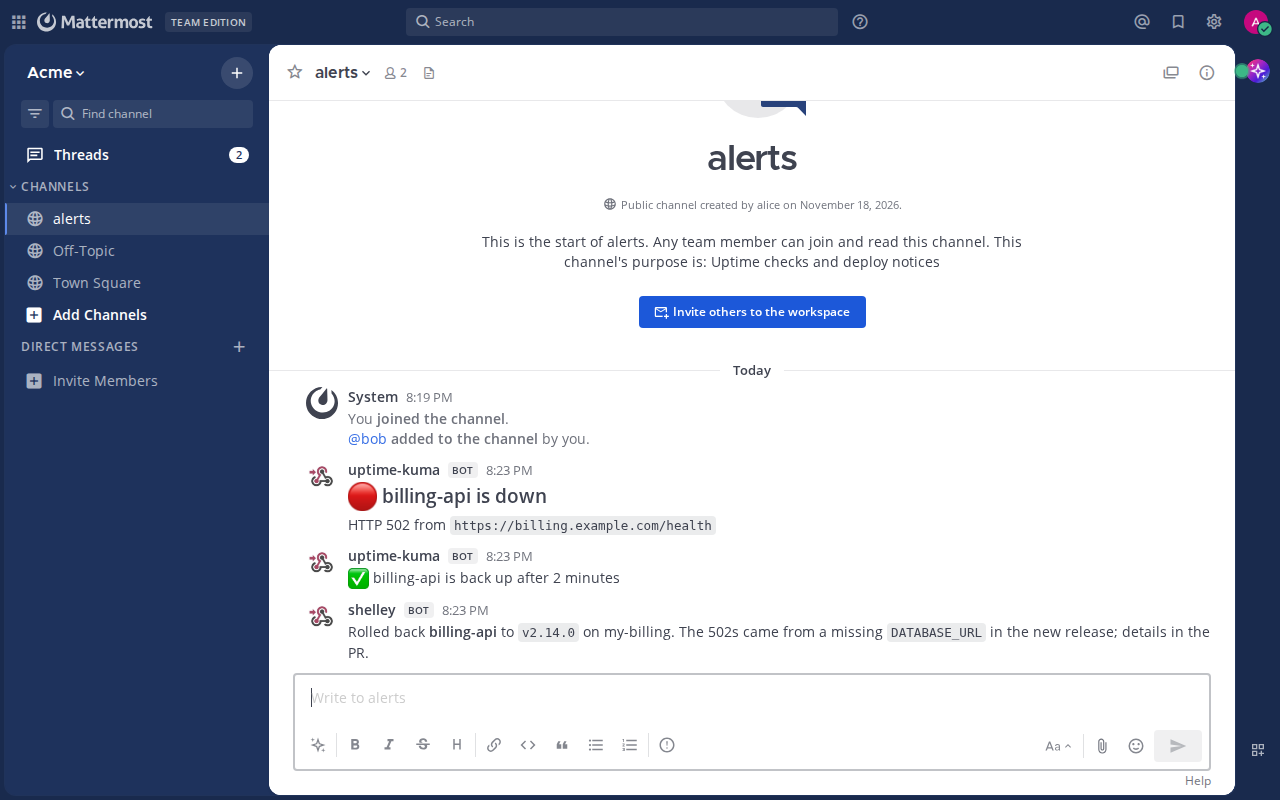
Monitors and agents reporting in one channel.
The VM is private, so another VM needs a way in. The keyless one is a
[VM-to-VM integration](/docs/integrations-vm-to-vm). On your computer:
```bash
ssh exe.dev integrations add http-proxy --name mattermost \
--target https://my-mattermost.exe.xyz/ --peer --attach vm:my-app
```
Then `my-app`, and any agent on it, posts to
`https://mattermost.int.exe.xyz/hooks/` with no credential on the VM.
For a machine outside exe.dev, make a [token](/docs/https-tokens-for-vms)
with `ssh exe.dev ssh-key generate-api-key --vm=my-mattermost --label=alerts`
and send it as `X-Exedev-Authorization: Bearer `.
[Uptime Kuma](/deploy/uptime-kuma) has a Mattermost notification type
that takes the webhook URL. To have Shelley report in, tell it the URL
and when to post: *"post to Mattermost when the deploy finishes, and say
what changed"*.
## Desktop and mobile apps
The [apps](https://mattermost.com/apps) talk to the server directly, and
exe.dev's proxy only lets them in once the VM is public. Before you make it
public, decide who may sign in: by default, that's anyone who reaches
the VM, which for a public VM means anyone with an exe.dev account. On the
VM, list the people or whole domains allowed:
```bash
cd ~/mattermost
echo 'EXE_LOGIN_ALLOWED=@example.com bob@gmail.com' >> .env
docker compose up -d
```
Then, on your computer:
```bash
ssh exe.dev share set-public my-mattermost
```
nginx in front of Mattermost still turns away everyone who isn't signed
in to exe.dev, unless they send the apps' secret; webhooks pass, since
their IDs are a secret of their own. On the VM, print the secret:
```bash
grep MM_PREAUTH_SECRET ~/mattermost/.env
```
In the desktop app, add the server `https://my-mattermost.exe.xyz`; it
asks for an **Authentication Secret**. In the mobile app, tap **Advanced
Options** when adding the server and fill in **Authentication secret**.
This is Mattermost's
[pre-authentication secret](https://docs.mattermost.com/deployment-guide/server/pre-authentication-secrets.html),
which current apps send with every request, and nginx checks. Then tap
**exe.dev** and sign in to exe.dev in the browser that opens.
Phones only get notifications while the app is closed if Mattermost has a
push service. For non-commercial use, Mattermost's free test service does
it: **System Console → Environment → Push Notification Server**, then
**Use TPNS connection**. A business needs a paid license for the hosted
one. To go back to private, run `ssh exe.dev share set-private my-mattermost`.
Rather keep the VM private? The other way is
[Tailscale](/docs/integrations-tailscale-wif) on the VM and your devices,
with Mattermost served on your tailnet instead. It's more setup, and this
recipe doesn't cover it.
## Email
Invites, password resets, and missed-message notifications go through
`smtp-relay`, a small program next to Mattermost, out of exe.dev's
[email gateway](/docs/send-email). exe.dev only delivers to you, your
team, and people you've shared the VM with who have signed in, and it
limits how much and how often. **System Console → Environment → SMTP →
Test Connection** sends you a test email; for anyone else it explains who
can receive.
## Keep your data
Messages live in PostgreSQL in `~/mattermost/postgres`, uploaded files in
`~/mattermost/mattermost/data`, and nightly backups of both go to
`~/mattermost/backups`. Keep a copy **off the VM**. On your computer:
```bash
scp -r my-mattermost.exe.xyz:mattermost/backups .
```
Backups hold everything people wrote and the apps' secret, so keep them
private. For updates or trouble, ask Shelley, or open the instructions
below.
## Prefer Zulip?
[Zulip](https://zulip.com) threads every conversation by topic, which some
teams love for async work. Its installer sets up a whole server (nginx,
PostgreSQL, RabbitMQ, Redis, memcached), so give it a VM of its own with
at least 2 GB of memory and follow its
[installation guide](https://zulip.readthedocs.io/en/stable/production/install.html)
and [reverse proxy notes](https://zulip.readthedocs.io/en/stable/production/reverse-proxies.html):
exe.dev's proxy provides HTTPS, so Zulip should serve plain HTTP on port
8000. We haven't written that up as a recipe; ask Shelley to try it.
## The nuts and bolts
Happy clicking Deploy? You can stop here. These are Shelley's setup steps
and your maintenance reference.
Install by hand
### Create a VM
On your computer (pick another name if `my-mattermost` is taken):
```bash
ssh exe.dev new --name=my-mattermost
ssh my-mattermost.exe.xyz
```
The default VM suits a team. All remaining installation commands run **on
the VM**, as `exedev`.
### Write the secrets
This writes PostgreSQL's password, the apps' secret, and the secret
Mattermost shares with exe-login to a file only you can read, once, and makes the folders Mattermost writes to. Its container
runs as user 2000:
```bash
mkdir -p ~/mattermost && cd ~/mattermost
if [ ! -e .env ]; then
touch .env && chmod 600 .env
cat >> .env < compose.yaml <<'EOF'
# Mattermost Team Edition with PostgreSQL, behind nginx on port 8000,
# which exe.dev's HTTPS proxy serves at https://.exe.xyz/.
# Secrets come from .env in this directory.
name: mattermost
services:
postgres:
image: postgres:18-alpine
restart: unless-stopped
environment:
POSTGRES_USER: mmuser
POSTGRES_DB: mattermost
POSTGRES_PASSWORD: ${POSTGRES_PASSWORD:?set in .env}
volumes:
- ./postgres:/var/lib/postgresql
healthcheck:
test: ["CMD-SHELL", "pg_isready -U mmuser -d mattermost"]
interval: 10s
timeout: 5s
retries: 10
mattermost:
# 12.1 follows the newest 12.1.x patch release.
image: mattermost/mattermost-team-edition:12.1
restart: unless-stopped
depends_on:
postgres:
condition: service_healthy
environment:
TZ: UTC
MM_SQLSETTINGS_DRIVERNAME: postgres
MM_SQLSETTINGS_DATASOURCE: postgres://mmuser:${POSTGRES_PASSWORD}@postgres:5432/mattermost?sslmode=disable&connect_timeout=10
MM_SERVICESETTINGS_SITEURL: ${MM_SITEURL:?set in .env}
# Let webhooks choose the name and picture they post with.
MM_SERVICESETTINGS_ENABLEPOSTUSERNAMEOVERRIDE: "true"
MM_SERVICESETTINGS_ENABLEPOSTICONOVERRIDE: "true"
# Sign in with exe.dev: exe-login plays the part of GitLab.
MM_GITLABSETTINGS_ENABLE: "true"
MM_GITLABSETTINGS_ID: mattermost
MM_GITLABSETTINGS_SECRET: ${EXE_LOGIN_SECRET:?set in .env}
MM_GITLABSETTINGS_AUTHENDPOINT: ${MM_SITEURL}/exe-login/authorize
MM_GITLABSETTINGS_TOKENENDPOINT: http://exe-login:8080/exe-login/token
MM_GITLABSETTINGS_USERAPIENDPOINT: http://exe-login:8080/exe-login/user
MM_SERVICESETTINGS_ALLOWEDUNTRUSTEDINTERNALCONNECTIONS: exe-login
# Email through exe.dev's email gateway, by way of smtp-relay.
MM_EMAILSETTINGS_SENDEMAILNOTIFICATIONS: "true"
MM_EMAILSETTINGS_SMTPSERVER: smtp-relay
MM_EMAILSETTINGS_SMTPPORT: "2525"
MM_EMAILSETTINGS_ENABLESMTPAUTH: "false"
MM_EMAILSETTINGS_CONNECTIONSECURITY: ""
MM_EMAILSETTINGS_FEEDBACKNAME: Mattermost
MM_EMAILSETTINGS_FEEDBACKEMAIL: ${MM_EMAIL_FROM}
MM_EMAILSETTINGS_ENABLEPREVIEWMODEBANNER: "false"
volumes:
- ./mattermost/config:/mattermost/config
- ./mattermost/data:/mattermost/data
- ./mattermost/logs:/mattermost/logs
- ./mattermost/plugins:/mattermost/plugins
- ./mattermost/client-plugins:/mattermost/client/plugins
nginx:
image: nginx:1.30-alpine
restart: unless-stopped
depends_on:
mattermost:
condition: service_healthy
exe-login:
condition: service_started
ports:
- "8000:8000"
environment:
MM_PREAUTH_SECRET: ${MM_PREAUTH_SECRET:?set in .env}
volumes:
- ./nginx.conf.template:/etc/nginx/templates/default.conf.template:ro
exe-login:
image: python:3.13-alpine
restart: unless-stopped
command: ["python3", "-u", "/exe-login.py"]
environment:
EXE_LOGIN_SECRET: ${EXE_LOGIN_SECRET:?set in .env}
MM_SITEURL: ${MM_SITEURL}
EXE_LOGIN_ALLOWED: ${EXE_LOGIN_ALLOWED:-}
volumes:
- ./exe-login.py:/exe-login.py:ro
smtp-relay:
image: python:3.13-alpine
restart: unless-stopped
command: ["python3", "-u", "/smtp-relay.py"]
environment:
SMTP_RELAY_LISTEN: 0.0.0.0
volumes:
- ./smtp-relay.py:/smtp-relay.py:ro
EOF
docker compose config --quiet && echo compose ok
```
Settings set in `compose.yaml` show as locked in the System Console;
everything else you change there is saved in
`~/mattermost/mattermost/config/config.json`.
Enable Docker at boot, download the images (about 1.8 GB), and start.
Mattermost's first start takes under a minute while it sets up its
database:
```bash
sudo systemctl enable --now docker.service
docker compose pull -q
docker compose up -d --wait --wait-timeout 300
curl -fsS localhost:8000/api/v4/system/ping -H 'X-ExeDev-Email: check@localhost'; echo
curl -s -o /dev/null -w '%{http_code}\n' localhost:8000/api/v4/system/ping
curl -s -o /dev/null -w '%{redirect_url}\n' localhost:8000/ -H 'X-ExeDev-Email: check@localhost'
printf 'Mattermost: https://%s.exe.xyz/\n' "$(hostname)"
```
The first `curl` should print JSON with `"status":"OK"`, the second
`403`: nginx is letting in only exe.dev logins and the apps. The third
prints an address ending in `/oauth/gitlab/login`, the start of signing
in with exe.dev. The
[HTTPS proxy](/docs/proxy) adds HTTPS and exe.dev login in front of port
8000.
> [!WARNING]
> The first person to sign in becomes Mattermost's system admin. The VM
> is private, so that's you; open it before you share it.
### Set up nightly backups
This dumps Mattermost's database while it runs, checks the dump, saves it
with the uploaded files, `config.json`, and the setup files, and keeps two
weeks of backups. It runs as root to read Mattermost's files:
```bash
cd ~/mattermost
cat > backup.sh <<'EOF'
#!/bin/sh
# Back up Mattermost: its database, config.json, uploaded files, and the
# setup files. Runs as root, since Mattermost's files belong to its
# container's user; the archives belong to whoever owns this directory.
set -eu
[ "$(id -u)" = 0 ] || exec sudo "$0" "$@"
umask 077
cd "$(dirname "$0")"
owner=$(stat -c %u:%g .)
mkdir -p backups
chown "$owner" backups
chmod 700 backups
out="backups/mattermost-$(date +%Y%m%d-%H%M%S).tar.gz"
work=$(mktemp -d)
trap 'rm -rf "$work"' EXIT
docker compose exec -T postgres pg_dump -U mmuser -d mattermost -Fc < /dev/null > "$work/mattermost.dump"
docker compose exec -T postgres pg_restore --list < "$work/mattermost.dump" > /dev/null
cp .env compose.yaml nginx.conf.template "$work/"
tar -C mattermost -cf "$work/files.tar" config data
tar -C "$work" -czf "$out.tmp" .
chown "$owner" "$out.tmp"
mv "$out.tmp" "$out"
find backups -name 'mattermost-*.tar.gz' -mtime +14 -delete
EOF
chmod +x backup.sh
sudo tee /etc/systemd/system/mattermost-backup.service >/dev/null <<'EOF'
[Unit]
Description=Back up Mattermost
After=docker.service
[Service]
Type=oneshot
ExecStart=/home/exedev/mattermost/backup.sh
EOF
sudo tee /etc/systemd/system/mattermost-backup.timer >/dev/null <<'EOF'
[Unit]
Description=Back up Mattermost nightly
[Timer]
OnCalendar=daily
Persistent=true
[Install]
WantedBy=timers.target
EOF
sudo systemctl daemon-reload
sudo systemctl enable --now mattermost-backup.timer
sudo systemctl start mattermost-backup.service
systemctl list-timers mattermost-backup.timer
tar -tzf backups/mattermost-*.tar.gz
```
The timer should list its next run, and the archive should hold
`mattermost.dump`, `files.tar`, `.env`, `compose.yaml`, and
`nginx.conf.template`. You're ready: sign in and try the
walkthrough above.
Back up and restore
To take an extra backup, on the VM:
```bash
cd ~/mattermost
./backup.sh
```
### Restore
Pick an archive in `backups/` and substitute its filename below. On a new
VM, run **Install by hand** first and copy your archive into that folder.
These commands run **on the VM**. They keep this VM's `.env`, and set the
current database and files aside rather than delete them:
```bash
cd ~/mattermost
backup=backups/mattermost-YYYYMMDD-HHMMSS.tar.gz
stamp=$(date +%s)
work=$(mktemp -d)
tar -C "$work" -xzf "$backup" &&
docker compose exec -T postgres pg_restore --list < "$work/mattermost.dump" >/dev/null &&
sudo systemctl stop mattermost-backup.timer mattermost-backup.service &&
docker compose stop nginx mattermost &&
sudo mv mattermost/config "mattermost/config.before-restore-$stamp" &&
sudo mv mattermost/data "mattermost/data.before-restore-$stamp" &&
sudo tar -C mattermost -xpf "$work/files.tar" &&
docker compose exec -T postgres psql -U mmuser -d postgres \
-c "ALTER DATABASE mattermost RENAME TO mattermost_before_restore_$stamp" \
-c "CREATE DATABASE mattermost" &&
docker compose exec -T postgres pg_restore -U mmuser -d mattermost --exit-on-error < "$work/mattermost.dump" &&
docker compose up -d --wait &&
sudo systemctl start mattermost-backup.timer &&
rm -rf "$work"
```
Sign in and check your channels and a file or two. Once you're happy,
remove what was set aside: `sudo rm -rf mattermost/*.before-restore-*`,
then list the old database with
`docker compose exec postgres psql -U mmuser -d postgres -c '\l'` and drop
it with `docker compose exec postgres dropdb -U mmuser mattermost_before_restore_...`.
Update
The `12.1` tag gets each 12.1 patch release. On the VM, back up first,
then pull and restart; Mattermost updates its database on start:
```bash
cd ~/mattermost
./backup.sh && docker compose pull && docker compose up -d --wait --wait-timeout 300
```
For a new version, read Mattermost's
[important upgrade notes](https://docs.mattermost.com/administration-guide/upgrade/important-upgrade-notes.html),
change the tag in `compose.yaml` (to `12.2`, say), and run the same
command. To undo an update, put the old tag back and
[restore](#back-up-and-restore) the backup you took first. The Agents
plugin updates with Mattermost.
Something's not happy?
Start with the logs. On the VM:
```bash
cd ~/mattermost
docker compose ps
docker compose logs --tail=50 mattermost nginx
```
- **502 right after a start?** Mattermost takes up to a minute to boot.
- **Down after a reboot?** Run `sudo systemctl enable --now docker.service`.
- **`permission denied` in the logs?** The folders under
`~/mattermost/mattermost` must belong to user 2000: `sudo chown -R
2000:2000 ~/mattermost/mattermost`.
- **The app says the secret is wrong?** Check it against `.env`, and that
the VM is public. After changing the secret, run `docker compose up -d
--force-recreate nginx`.
- **No email?** Check `docker compose logs smtp-relay`. A recipient
outside your team must accept the VM share and sign in first.
- **The agent doesn't answer?** Check that `curl -s
https://llm.int.exe.xyz/v1/models` works on the VM; your
[LLM integration](/docs/integrations-llm) must be attached to it. In a
channel, Team Edition's agent only points you to direct messages.
- **"may not sign in to this Mattermost"?** Their address isn't in
`EXE_LOGIN_ALLOWED` in `.env`; add it and run `docker compose up -d`.
- **Sign-in fails with an error page?** Check `docker compose logs
exe-login mattermost`. After a [custom domain](/docs/cnames), both
need the new `MM_SITEURL`: run `docker compose up -d`.
- **Need an admin?** On the VM, `docker compose exec mattermost mmctl
--local roles system-admin alice` makes alice one.
## Frequently asked questions
### Is Mattermost free?
Team Edition is, under the MIT license, with no user or message limits. You pay for your [VM plan](https://exe.dev/pricing), and the AI agent uses your exe.dev [LLM allocation](/docs/integrations-llm). Mattermost sells Professional and Enterprise licenses for SSO, compliance, and AI agents in channels.
### Team Edition or Mattermost Entry?
Mattermost has two free builds. Team Edition, used here, is open source and complete for small teams. The Enterprise image without a license runs as **Mattermost Entry**: paid features unlocked, but only the newest 10,000 messages can be read or searched, and [more limits](https://docs.mattermost.com/product-overview/editions-and-offerings.html) are announced. For a team that keeps talking, Team Edition is the safer choice.
### How does signing in with exe.dev work?
Team Edition can sign people in with GitLab. A short program on the VM, [exe-login.py](https://exe.dev/deploy/mattermost/exe-login.py), plays GitLab's part: exe.dev's proxy tells it who is signed in, and it vouches for them to Mattermost. Accounts are matched by exe.dev user, and nobody needs a Mattermost password. Team Edition hides the GitLab button, so nginx brings it back, labelled exe.dev.
### Do the desktop and mobile apps work?
Once you make the VM public, yes: exe.dev's proxy can't tell an app who you are, so the apps send a secret to get through, then sign in with the exe.dev button. See [Desktop and mobile apps](#desktop-and-mobile-apps). Phone notifications need a push service, which Mattermost offers free for non-commercial use.
### Do voice and video calls work?
Not through exe.dev's proxy, which carries HTTPS and websockets only. Mattermost's Calls plugin sends audio and video over its own port (8443), so a call can't connect. Turn it off under **System Console → Plugins → Calls** to hide the button.
### How big a VM do I need?
Small. Mattermost and PostgreSQL use about 500 MB of memory for a small team, and the images take 1.8 GB of disk. The default VM is plenty; watch the disk if people share big files, and grow it with `ssh exe.dev resize`.
### Does my data leave the VM?
Messages and files stay on the VM. What you send the AI agent goes to the model provider through exe.dev's gateway, emails go out through exe.dev's email gateway, and if you turn on push notifications, they pass through Mattermost's push service.
## Related
- [Self-host Uptime Kuma](https://exe.dev/deploy/uptime-kuma.md): A little lookout for your websites. Green bars encouraged.
- [Self-host Open WebUI](https://exe.dev/deploy/open-webui.md): A private ChatGPT for you and your team. No API keys.
- [Self-host PostgreSQL](https://exe.dev/deploy/postgres.md): Your own Postgres on a real disk, with backups you've actually restored.
- [Deploy a Docker Compose app from GitHub](https://exe.dev/deploy/docker-compose.md): Your compose.yaml on a VM of its own. git push to deploy.
- [Give agents API access without giving them the keys](https://exe.dev/deploy/agent-secrets.md): Your agents call your APIs. The keys stay with exe.dev, outside the VM.
- [Self-host Metabase](https://exe.dev/deploy/metabase.md): Charts for the whole team. Questions answered before the meeting.