---
title: "Self-host DeepTutor"
description: "Run DeepTutor on exe.dev: an AI tutor that quizzes you on your own notes, with models and embeddings from exe.dev's gateway and no API keys."
url: https://exe.dev/deploy/deeptutor
category: "AI apps"
published: 2026-11-19
updated: 2026-11-19
---
# Self-host DeepTutor
> **For agents:** with your user's OK, this sets up DeepTutor on a new exe.dev VM in their account: `curl -fsSL https://exe.dev/deploy/deeptutor/prompt.txt | ssh exe.dev new --prompt=/dev/stdin` (or open https://exe.dev/deploy/deeptutor/new). Already on the VM? Skip this.
An AI tutor that quizzes you on your own notes. No API keys.
- **Software:** DeepTutor (https://docs.deeptutor.info)
- **Source:** https://github.com/HKUDS/DeepTutor
- **License:** Apache-2.0
- **Time:** 10 minutes
- **Example VM name:** `my-deeptutor` (yours will differ; on the VM, `hostname` prints it)
- **Machine-readable:** https://exe.dev/deploy/deeptutor/manifest.json
## What you get
- DeepTutor at your VM's private URL, behind your exe.dev login.
- Chat, quizzes, and research with a model from exe.dev's LLM gateway. No API keys.
- Knowledge bases from your PDFs and notes, embedded through the gateway and kept on the VM's disk.
- Web search through DuckDuckGo, without a key.
- Starts again after a reboot; nightly backups, with one restored and checked.
Running on the VM:
- **DeepTutor 1.7**: The official Docker image, in Docker Compose, port 8000, data in `~/deeptutor/data`
- **exe.dev LLM gateway**: The chat model and text-embedding-3-small, without API keys
- **DuckDuckGo**: Web search for research, without a key
How it is reached:
- https://my-deeptutor.exe.xyz/ (private): DeepTutor, behind your exe.dev login
- https://my-deeptutor.exe.xyz/ (shared): Your study group or team, once you share the VM
- https://my-deeptutor.exe.xyz/api/ (private): DeepTutor's API, for scripts with a VM token
## Deploy with Shelley
Open https://exe.dev/deploy/deeptutor/new to create a VM whose agent, Shelley, follows this recipe. From a terminal:
```sh
curl -fsSL https://exe.dev/deploy/deeptutor/prompt.txt | ssh exe.dev new --prompt=/dev/stdin
```
Or follow the steps below by hand.
DeepTutor, from the University of Hong Kong's Data Intelligence Lab, is an
AI tutor built around your own material. Upload lecture notes, papers, or
a textbook into a knowledge base, then ask questions grounded in them,
turn them into quizzes that check your answers, or research a topic with
web search. Here it runs on your own exe.dev VM, with the chat model and
the embeddings for your notes coming from exe.dev's
[LLM gateway](/docs/integrations-llm). There are no API keys to find,
paste, or leak.
The VM is private behind your exe.dev login, so DeepTutor needs no
password of its own. Your notes stay on the VM's disk, backed up every
night. Share the VM with a study group or team when you want company.
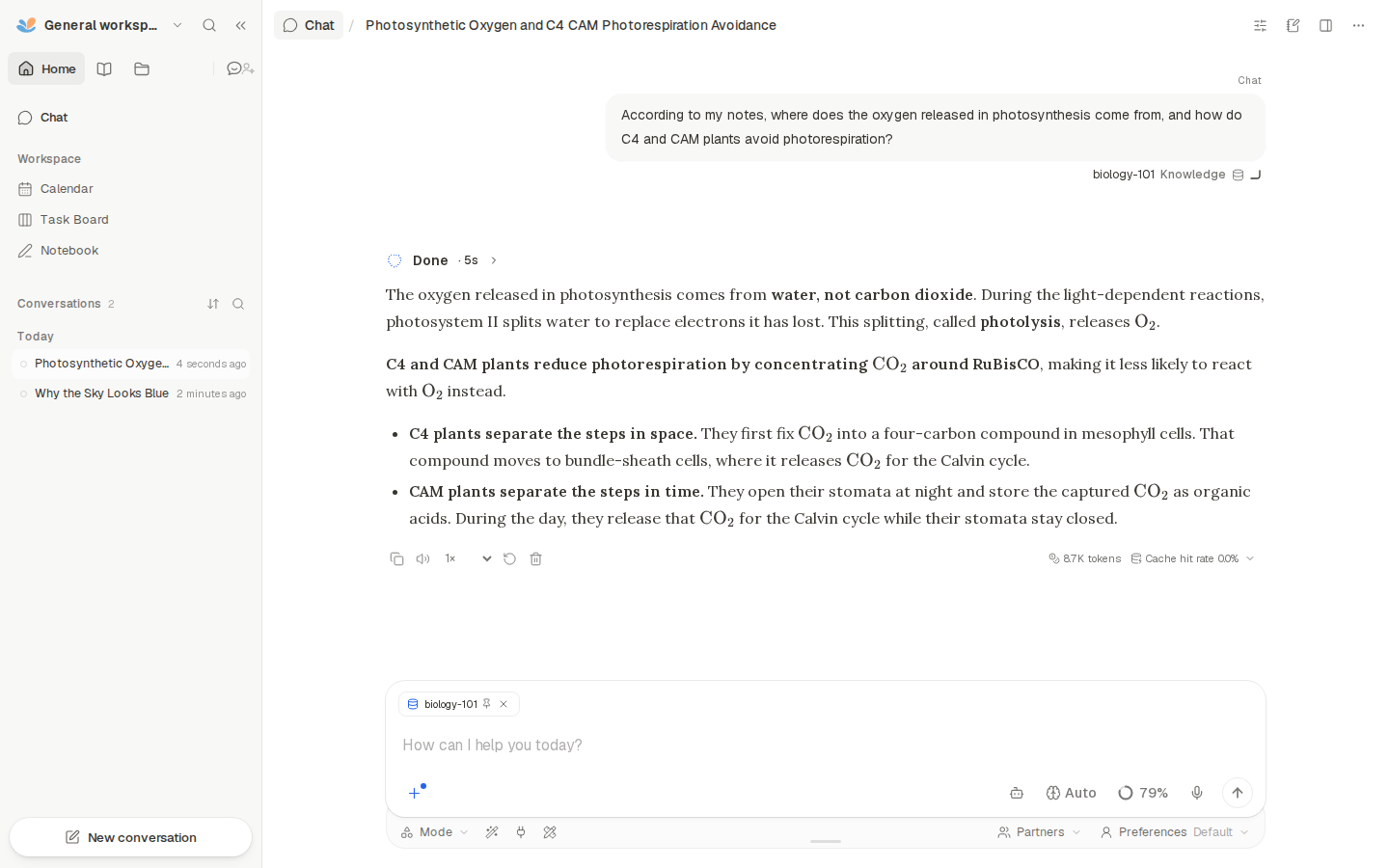
A question answered from uploaded lecture notes, with the biology-101 knowledge base attached.
## Start studying
Open the URL Shelley gives you. It'll look like
`https://my-deeptutor.exe.xyz/`. Sign in to exe.dev if you're asked, and
DeepTutor opens on its chat page. Ask it anything to say hello.
Then give it your notes:
1. Click the folder icon at the top left (**Resources**), then
**Knowledge Center → New knowledge base**.
2. Name it, say `biology-101`. Keep the **LlamaIndex** engine and the
`text-embedding-3-small · Agent Setup` embedding model.
3. Drop in PDFs, Word or PowerPoint files, Markdown, or plain text, and
click **Create**. A few dozen pages are ready in under a minute.
Back in **Chat**, click **+** in the message box, then **Knowledge**, and
pick `biology-101`. It shows as a chip in the message box and stays
attached to the conversation. Ask a question and DeepTutor answers from
your notes.
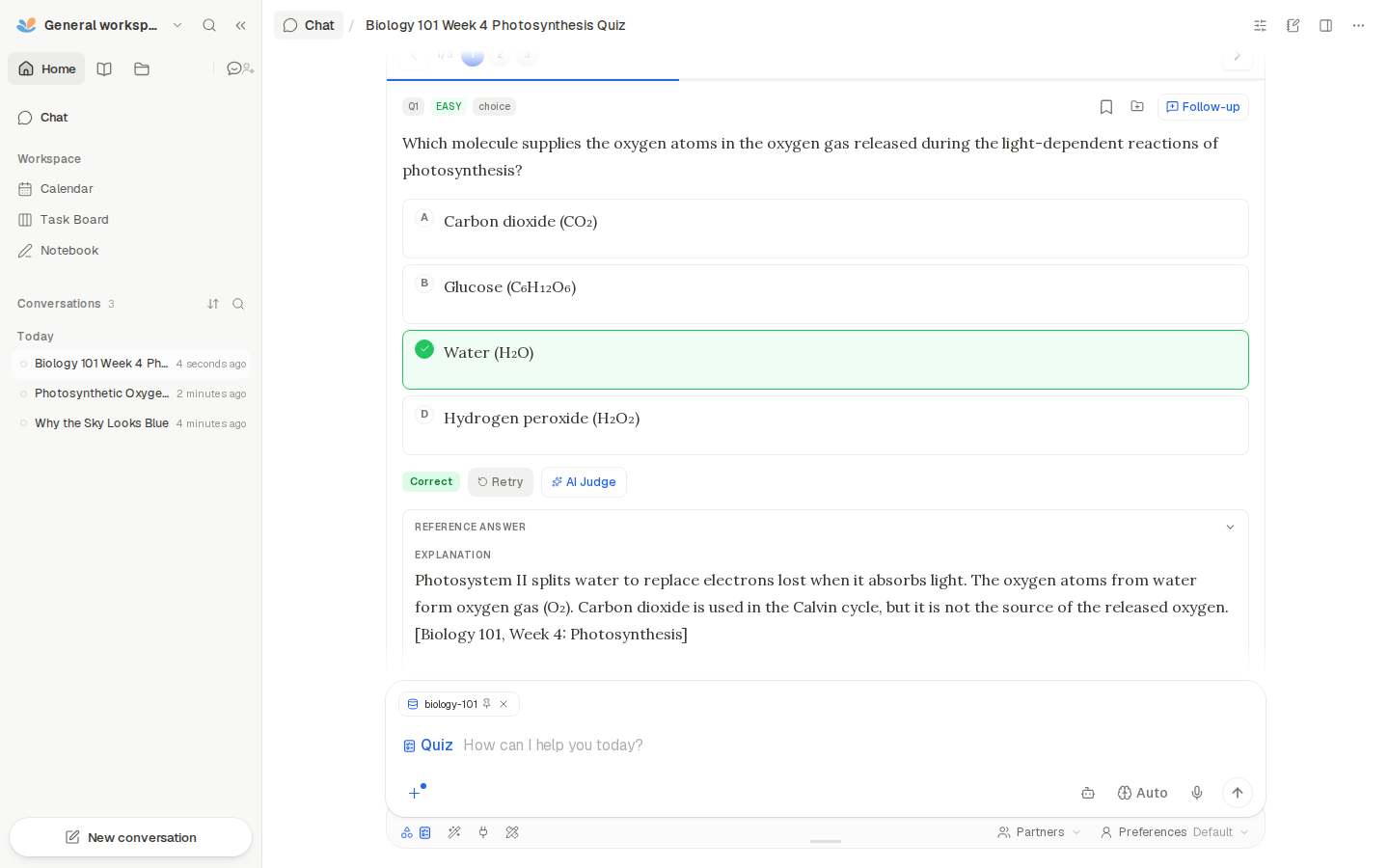
To test yourself, open **Mode** under the message box and choose **Quiz**.
Set how many questions and how hard, click **Confirm**, and type a topic,
such as "photosynthesis, from my week 4 notes". Pick an answer and click
**Check Answer** for an explanation that cites your notes.
A quiz generated from the same notes, with the explanation citing them.
The other modes are worth a look too: **Solve** works through a problem
step by step, **Research** searches the web with DuckDuckGo and writes a
report, and **Visualize** draws charts and diagrams. The shortcuts under
the message box (**Explain**, **Practice**, **Plan**) start common
requests. Models, search, and everything else are in **Settings**, in
the menu under the workspace name at the top left.
## Study with your group
On your computer, share the VM with a friend or teammate:
```bash
ssh exe.dev share add my-deeptutor friend@example.com
```
They get an email invitation, sign in to exe.dev, and open the same URL.
`ssh exe.dev share add my-deeptutor team` shares with your whole exe.dev
team, and `ssh exe.dev share remove my-deeptutor friend@example.com` locks
someone out again.
As set up here, everyone you share with uses the **same** DeepTutor: the
same knowledge bases, chats, and settings. That suits a study group
building one set of notes together. To give each person their own chats
and knowledge bases, with you deciding which of yours they can use,
[turn on accounts](#accounts).
> [!WARNING]
> Don't make the VM public with `share set-public`. Until accounts are on,
> anyone who reaches the URL uses DeepTutor as you, and everyone's
> questions count against your LLM allocation.
## Keep your notes
Backups run nightly into `~/deeptutor-backups`. Each one has your
knowledge bases with the original files, chats, settings, and accounts.
Keep a copy **off the VM**. On your computer:
```bash
scp -r my-deeptutor.exe.xyz:deeptutor-backups .
```
To restore one, update DeepTutor, or call its API from your own scripts,
see the sections below, or ask Shelley to help. Something stuck? On the
VM, try `cd ~/deeptutor && docker compose logs --tail=100`.
## The nuts and bolts
Happy clicking Deploy? You can stop here. These are the same setup steps
Shelley follows, plus optional extras and the maintenance commands for
later.
Install by hand
### Create a VM
On your computer (pick another name if `my-deeptutor` is taken):
```bash
ssh exe.dev new --name=my-deeptutor
ssh my-deeptutor.exe.xyz
```
All remaining installation commands run **on the VM**, as `exedev`.
Commands use `hostname`, so your VM can have any name.
### Get Docker ready
DeepTutor's Docker image bundles the backend, the web app, and the
document readers. Enable Docker at boot, or exe.dev's on-demand Docker
won't restart DeepTutor after a reboot. Install `jq` if needed:
```bash
sudo systemctl enable --now docker.service
systemctl is-enabled docker.service
command -v jq >/dev/null || sudo apt-get install -y jq
```
The check should print `enabled`.
### Start DeepTutor
The image runs DeepTutor's web app on port 3782, which passes requests on
to its backend inside the container. Compose publishes the web app on
port 8000, the port exe.dev's [HTTPS proxy](/docs/proxy) serves at
`https://.exe.xyz/`. Everything DeepTutor keeps goes in `data`. The
image tag pins the exact release; DeepTutor publishes no floating minor
tags.
```bash
mkdir -p ~/deeptutor/data
cat > ~/deeptutor/compose.yaml <<'EOF'
# DeepTutor behind exe.dev's HTTPS proxy. Settings, knowledge bases,
# chats, and accounts live in ./data.
name: deeptutor
services:
deeptutor:
image: ghcr.io/hkuds/deeptutor:1.7.3
restart: unless-stopped
ports:
# The web app. Only exe.dev's proxy reaches it from outside.
- "8000:3782"
environment:
TZ: UTC
volumes:
- ./data:/app/data
EOF
```
A small wrapper runs DeepTutor's command-line tool inside the container.
The gateway needs no key, but DeepTutor won't call an embedding endpoint
without one, so the wrapper hands it a placeholder:
```bash
cat > ~/deeptutor/dt <<'EOF'
#!/usr/bin/env bash
# Run DeepTutor's CLI inside its container: ./dt doctor, ./dt kb list, ...
cd "$(dirname "$(readlink -f "$0")")"
exec docker compose exec -T -u deeptutor -e GATEWAY_KEY=exe-llm-gateway \
deeptutor python -m deeptutor_cli "$@"
EOF
chmod +x ~/deeptutor/dt
```
Start it and wait for `{"status":"ready"}`. The first start downloads
about 1 GB (4 GB on disk), which takes a minute or two. If it takes more
than ten, stop the loop with Ctrl-C and
[check the logs](#troubleshooting).
```bash
cd ~/deeptutor
docker compose up -d
until docker compose exec -T deeptutor curl -fsS http://localhost:8001/health/ready 2>/dev/null; do sleep 5; done; echo
docker compose ps
curl -s -o /dev/null -w '%{http_code} %{redirect_url}\n' http://localhost:8000/
```
The container should be `Up` and, after half a minute, `healthy`; the
last line shows `307` and a redirect to `/chat`.
### Connect the models
DeepTutor reads its model setup from a JSON file. This one points chat at
the gateway's preferred GPT model, through OpenAI's Responses API, and
embeddings for your notes at `text-embedding-3-small`. Web search uses
DuckDuckGo. `api_key_env` names the placeholder from the wrapper;
DeepTutor refuses keys written into the file itself.
```bash
cd ~/deeptutor
model=$(curl -fsS https://llm.int.exe.xyz/models.json | jq -r '
.preferred_model as $p
| [.models[] | select(.id == $p and .provider == "openai"
and ((.apis // []) | index("openai_responses")))][0].id // "openai/gpt-5.5"
| sub("^openai/"; "")')
echo "$model"
cat > data/setup.json < /tmp/model_catalog.json
cat /tmp/model_catalog.json > model_catalog.json && rm /tmp/model_catalog.json
jq -c '.services.llm.profiles[].models[]' model_catalog.json
```
Now ask DeepTutor to check itself, including a small request to the model:
```bash
cd ~/deeptutor
./dt config show | jq -c '{llm: .llm.model, embedding: .embedding.model, search: .search.provider}'
./dt doctor --online --format json | jq -r '.checks[] | "\(.status)\t\(.label)"'
```
Expect the model, `text-embedding-3-small`, and `duckduckgo`, then `pass`
for the configuration, credentials (the placeholder), endpoint, storage,
and provider response. "RAG prerequisites" says `skip` until there's a
knowledge base.
### Check a knowledge base
Index a one-line note through the embedding model, search it, and delete
it again:
```bash
cd ~/deeptutor
echo 'Our study group meets in room BLUE PELICAN.' > data/smoke-test.md
./dt kb create smoke-test --doc /app/data/smoke-test.md | tail -n 1
./dt kb search smoke-test 'Where does the study group meet?' --format json | jq -r .answer
./dt kb delete smoke-test --force
rm data/smoke-test.md
./dt kb list --format json | jq length
```
Expect `Knowledge base created successfully.`, the sentence with
`BLUE PELICAN`, `Deleted 'smoke-test'.`, and `0`. A warning about
`similarity_top_k` is normal for a one-line knowledge base.
### Set up nightly backups
The backup stops DeepTutor for a few seconds, so the knowledge-base
indexes and chat history are copied in a consistent state. It runs as
root and skips `data/.cache`, a root-owned cache DeepTutor rebuilds.
```bash
cat > ~/deeptutor/backup.sh <<'EOF'
#!/usr/bin/env bash
# Back up DeepTutor: data (settings, knowledge bases, chats, accounts),
# the Compose file, and the CLI wrapper. Run with sudo.
set -euo pipefail
umask 077
cd "$(dirname "$(readlink -f "$0")")"
owner=$(stat -c %U:%G .)
dest="$(dirname "$PWD")/deeptutor-backups"
mkdir -p "$dest"
out="$dest/deeptutor-$(date -u +%Y%m%d-%H%M%S).tar.gz"
# A short stop keeps the indexes and the session store consistent.
docker compose stop deeptutor
trap 'docker compose start deeptutor' EXIT
tar -czf "$out.part" --exclude=data/.cache compose.yaml dt backup.sh data
docker compose start deeptutor
trap - EXIT
mv "$out.part" "$out"
chown -R "$owner" "$dest"
# Keep the 14 newest backups.
ls -1t "$dest"/deeptutor-*.tar.gz | tail -n +15 | xargs -r rm --
echo "$out"
EOF
chmod +x ~/deeptutor/backup.sh
```
Schedule it for 03:30 UTC (or so), then take a first backup:
```bash
sudo tee /etc/systemd/system/deeptutor-backup.service >/dev/null </dev/null <<'EOF'
[Unit]
Description=Back up DeepTutor every night
[Timer]
OnCalendar=*-*-* 03:30:00
RandomizedDelaySec=30m
Persistent=true
[Install]
WantedBy=timers.target
EOF
sudo systemctl daemon-reload
sudo systemctl enable --now deeptutor-backup.timer
sudo systemctl start deeptutor-backup.service
systemctl list-timers deeptutor-backup.timer
ls -lh ~/deeptutor-backups
cd ~/deeptutor
until docker compose exec -T deeptutor curl -fsS http://localhost:8001/health/ready 2>/dev/null; do sleep 5; done; echo
```
Check that the timer has a next run, the directory has a tarball, and
DeepTutor is `ready` again. For failures:
`journalctl -u deeptutor-backup.service`.
### Test a backup
Unpack the newest backup into a **scratch directory** and run
DeepTutor's CLI on that copy, without touching the running one:
```bash
latest=$(ls -1t ~/deeptutor-backups/deeptutor-*.tar.gz | head -n 1)
mkdir /tmp/deeptutor-restore-test
sudo tar -xzf "$latest" -C /tmp/deeptutor-restore-test
cd /tmp/deeptutor-restore-test
sudo ls -A . data
docker compose -p deeptutor-restore-test run --rm --no-deps -T -u deeptutor \
--entrypoint python deeptutor -m deeptutor_cli kb list --format json
```
Expect `compose.yaml`, `dt`, `backup.sh`, and `data` with `user` and
`knowledge_bases` among its folders, then a list of your knowledge bases
(`[]` on a new install). Remove only the scratch copy:
```bash
cd /tmp/deeptutor-restore-test && docker compose -p deeptutor-restore-test down
cd ~ && sudo rm -rf /tmp/deeptutor-restore-test
```
Installation done. Leave sharing to the owner; continue with
[Start studying](#start-studying).
Give everyone their own account
With accounts on, each person you share the VM with signs in to
DeepTutor too, and gets their own chats and knowledge bases. You, the
first account, are the admin: you add the others and choose which models
and which of your knowledge bases each one can use. DeepTutor can't read
exe.dev's login, so this is a second password, behind the first.
On the VM, turn accounts on, with secure cookies for the HTTPS URL, and
restart:
```bash
cd ~/deeptutor/data/user/settings
jq '.enabled = true | .cookie_secure = true' auth.json > /tmp/auth.json
cat /tmp/auth.json > auth.json && rm /tmp/auth.json
jq --arg o "https://$(hostname).exe.xyz" '.cors_origins = [$o]' system.json > /tmp/system.json
cat /tmp/system.json > system.json && rm /tmp/system.json
cd ~/deeptutor
docker compose restart
until docker compose exec -T deeptutor curl -fsS http://localhost:8001/health/ready 2>/dev/null; do sleep 5; done; echo
```
Open DeepTutor right away: it asks you to **Create your account**. The
first account becomes the admin, and after that DeepTutor closes
registration. Then, for each person:
1. Open **Admin** in the menu under the workspace name at the top left
(or go to `/admin/users`), click **Add user**, and set a username
and a starting password. They choose their own at first sign-in.
2. Click the sliders icon on their row (**Manage assignments**), tick the
model and any knowledge bases of yours they should use, and click
**Save assignments**. Without a model, they see "Feature locked".
3. Share the VM with them, as in [Study with your group](#study-with-your-group),
and send them their username and starting password.
If you skipped the reasoning-levels step in
[Connect the models](#connect-the-models), run it now; otherwise their
chat page doesn't load. Accounts and passwords are in the nightly
backup. To turn accounts off again, set `.enabled = false` the same way
and restart; everyone then shares your view again.
Call the API from scripts
DeepTutor's web app talks to its backend through `/api`, and scripts can
too, through exe.dev's proxy with a [VM token](/docs/https-tokens-for-vms).
The proxy checks the token and strips it before DeepTutor sees the
request.
On your computer, make a token for this VM and keep it in a mode-600
file:
```bash
(umask 077; ssh exe.dev ssh-key generate-api-key --vm=my-deeptutor --label=deeptutor-scripts > ~/.deeptutor-token)
```
List your knowledge bases, then add a file to one, say `biology-101`:
```bash
TOKEN=$(cat ~/.deeptutor-token)
curl -fsS -H "X-Exedev-Authorization: Bearer $TOKEN" \
https://my-deeptutor.exe.xyz/api/knowledge-bases
curl -fsS -H "X-Exedev-Authorization: Bearer $TOKEN" \
-F files=@week5-notes.md \
https://my-deeptutor.exe.xyz/api/knowledge-bases/biology-101/upload
```
The upload returns at once and DeepTutor indexes in the background; the
file shows up in the knowledge base a few seconds later. Tools that only
do Basic auth can send the token as the password, with any username. If
you [turned on accounts](#accounts), DeepTutor also wants its own login:
POST your username and password to `/api/auth/login` with a cookie jar
(`curl -c jar.txt -H 'Content-Type: application/json' -d '{"username":"...","password":"..."}'`)
and send the cookie (`-b jar.txt`) with later requests.
The API is undocumented and changes between releases; the web app's
network tab is the best reference.
Back up and restore
Backups run nightly at about 03:30 UTC into `~/deeptutor-backups`, the
14 newest kept. Take one by hand any time:
```bash
sudo ~/deeptutor/backup.sh
```
Copy them off the VM now and then, as in [Keep your notes](#keep-your-notes).
For whole-disk copies, see exe.dev's [VM backups](/docs/vm-backups).
To restore one in place, stop DeepTutor, move the current install aside,
unpack the backup, and start it. Pick the backup by name with
`ls ~/deeptutor-backups`:
```bash
backup=~/deeptutor-backups/deeptutor-YYYYMMDD-HHMMSS.tar.gz
cd ~/deeptutor && docker compose down
cd ~ && mv deeptutor deeptutor.before-restore
mkdir deeptutor && sudo tar -xzf "$backup" -C deeptutor
cd ~/deeptutor && docker compose up -d
until docker compose exec -T deeptutor curl -fsS http://localhost:8001/health/ready 2>/dev/null; do sleep 5; done; echo
./dt kb list
```
The knowledge bases come back with their indexes, so nothing is
re-embedded. Once DeepTutor looks right, delete
`~/deeptutor.before-restore` with `sudo rm -rf`.
Update DeepTutor
DeepTutor releases often. Read the
[release notes](https://github.com/HKUDS/DeepTutor/releases) for anything
about settings or storage, then take a backup, change the image tag, and
pull. For example, for 1.7.4:
```bash
cd ~/deeptutor
sudo ./backup.sh
sed -i 's|ghcr.io/hkuds/deeptutor:.*|ghcr.io/hkuds/deeptutor:1.7.4|' compose.yaml
docker compose pull && docker compose up -d
until docker compose exec -T deeptutor curl -fsS http://localhost:8001/health/ready 2>/dev/null; do sleep 5; done; echo
docker image inspect "$(docker compose images -q deeptutor)" \
--format '{{index .Config.Labels "org.opencontainers.image.version"}}'
./dt doctor --online --format json | jq -r '.checks[] | "\(.status)\t\(.label)"'
```
The version should be the new one, and the doctor checks `pass` as
before. If the update goes wrong, put the old tag back in `compose.yaml`
and [restore](#back-up-and-restore) the backup you just took. Old images
stay on disk; remove the old one with `docker image rm`, for example
`docker image rm ghcr.io/hkuds/deeptutor:1.7.3`.
Troubleshooting
Start with the status, the logs, and DeepTutor's own checks:
```bash
cd ~/deeptutor
docker compose ps
docker compose logs --tail=100
./dt doctor --online
```
**The page doesn't load, or shows a 502.** DeepTutor takes half a minute
to start; wait for `healthy` in `docker compose ps`. If the container
keeps restarting, the logs say why. Check that nothing else uses port
8000 (`sudo ss -ltnp 'sport = :8000'`).
**Chat replies with an error about `max_tokens` or a model.** Keep
`api_format` at `openai_responses` for GPT models; the older
`openai_chat` format fails with them. Gateway models from other
providers need their prefix, such as `fireworks/glm-5p3`.
**"Embedding API key not set" when creating a knowledge base.** The
setup file lost its `api_key_env`, or the CLI ran without the wrapper.
Rerun [Connect the models](#connect-the-models) with `./dt`.
**Someone else sees "This page couldn't load" in Chat.** With accounts
on, DeepTutor 1.7.3's chat page crashes for non-admins when a model has
no reasoning levels, for example one added later in **Settings**. Rerun
the reasoning-levels command from [Connect the models](#connect-the-models).
**Someone else sees "Feature locked".** Assign them a model in
**User Management → Manage assignments**.
**Research finds nothing on the web.** DuckDuckGo sometimes returns no
results to servers, and DeepTutor falls back to fetching pages
directly. Try again, or pick another provider in **Settings → Search**.
**The knowledge-base engine shows "Not installed".** The Docker image
includes LlamaIndex, the default, but not LightRAG or GraphRAG. Use
LlamaIndex.
## Frequently asked questions
### How much does it cost?
DeepTutor is free and open source. You pay for your [VM plan](https://exe.dev/pricing), and chats, quizzes, and embeddings use your exe.dev [LLM allocation](/docs/integrations-llm), including your study group's. Embedding a few hundred pages of notes costs very little; long Research runs cost the most.
### Which models can I use? Is Claude there?
Any gateway model that speaks OpenAI's Responses API, which includes the GPT models. Claude works too, through Anthropic's API: in `~/deeptutor/data/setup.json`, set the `llm` block's `model` to, say, `claude-sonnet-5-5`, `api_format` to `anthropic`, and rerun the [apply step](#connect-the-models). The gateway's list is at `https://llm.int.exe.xyz/models.json`.
### Will it run on the default VM? How much memory does it need?
Yes. On a 2-vCPU, 8 GB VM, DeepTutor used about 200 MB idle and under 400 MB with a knowledge base and a few chats; the models run on the gateway, not the VM. The Node.js heap limit in DeepTutor's release notes is for its development server; the Docker image runs the production build. The image takes about 4 GB of disk.
### Who can see my notes and chats?
Only people you share the VM with. Out of the box, everyone you share it with uses the same DeepTutor: the same notes, chats, and settings. [Turn on accounts](#accounts) to give each person their own. Prompts and note excerpts go to the model provider through exe.dev's gateway.
### Which web search providers work without a key?
DuckDuckGo, which this setup uses. DeepTutor also supports a SearXNG instance you run yourself; Brave, Tavily, Jina, Serper, Perplexity, and others need their own API keys. Change it in **Settings → Search**.
### Can DeepTutor run code on my VM?
Its agent can run commands for some tasks, such as charts and math animations, but inside DeepTutor's container, not on the VM itself. The container can still reach your notes and the gateway, so only share DeepTutor with people you trust with your notes.
### Can I use it for a class or a company?
Yes. DeepTutor is Apache-2.0, which allows commercial use. For more than a small group, turn on [accounts](#accounts) so each learner has their own history, and keep an eye on your LLM allocation.
## Related
- [Self-host Open WebUI](https://exe.dev/deploy/open-webui.md): A private ChatGPT for you and your team. No API keys.
- [Self-host LibreChat](https://exe.dev/deploy/librechat.md): GPT, Claude, Grok, and open models in one private team chat. No API keys.
- [Self-host Dify](https://exe.dev/deploy/dify.md): Build and publish AI apps and workflows. Models without API keys.
- [Run JupyterLab on your own VM](https://exe.dev/deploy/jupyter.md): Private notebooks on a VM that keeps your data. No tokens.
- [Self-host daily_stock_analysis](https://exe.dev/deploy/daily-stock-analysis.md): AI stock reports every trading day, without forking to GitHub Actions.
- [Run a private LLM router for your team](https://exe.dev/deploy/llm-router.md): One private endpoint for every model. Share the VM, and each person gets a budget.