---
title: "Self-host daily_stock_analysis"
description: "Run daily_stock_analysis on an always-on exe.dev VM instead of GitHub Actions: AI stock reports by email, a private dashboard, no LLM API keys."
url: https://exe.dev/deploy/daily-stock-analysis
category: "AI apps"
published: 2026-11-19
updated: 2026-11-19
---
# Self-host daily_stock_analysis
> **For agents:** with your user's OK, this sets up daily_stock_analysis on a new exe.dev VM in their account: `curl -fsSL https://exe.dev/deploy/daily-stock-analysis/prompt.txt | ssh exe.dev new --prompt=/dev/stdin` (or open https://exe.dev/deploy/daily-stock-analysis/new). Already on the VM? Skip this.
AI stock reports every trading day, without forking to GitHub Actions.
- **Software:** daily_stock_analysis (https://github.com/ZhuLinsen/daily_stock_analysis)
- **Source:** https://github.com/ZhuLinsen/daily_stock_analysis
- **License:** MIT
- **Time:** 10 minutes
- **Example VM name:** `my-daily-stock-analysis` (yours will differ; on the VM, `hostname` prints it)
- **Machine-readable:** https://exe.dev/deploy/daily-stock-analysis/manifest.json
## What you get
- daily_stock_analysis 3.35 from its official Docker image, with config, history and reports in `~/dsa`
- Models from exe.dev's LLM gateway, with no API key on the VM
- A first report on AAPL and NVDA, readable at the VM's private URL
- A scheduled run at 17:00 New York time on trading days, with the report emailed to you
- The container back after a reboot
Running on the VM:
- **daily_stock_analysis 3.35**: the official Docker image, web UI, API and scheduler in one container, port 8000, data in `~/dsa/data`
- **exe.dev LLM gateway**: GPT-6 Luna writes the reports; no API key
- **exe.dev email**: the daily report, sent to you through a webhook, data in `~/dsa/reports`
How it is reached:
- https://my-daily-stock-analysis.exe.xyz/ (private): the dashboard, history, settings and API, signed in with exe.dev
- https://my-daily-stock-analysis.exe.xyz/ (shared): people you share the VM with, with the same full access
## Deploy with Shelley
Open https://exe.dev/deploy/daily-stock-analysis/new to create a VM whose agent, Shelley, follows this recipe. From a terminal:
```sh
curl -fsSL https://exe.dev/deploy/daily-stock-analysis/prompt.txt | ssh exe.dev new --prompt=/dev/stdin
```
Or follow the steps below by hand.
[daily_stock_analysis](https://github.com/ZhuLinsen/daily_stock_analysis)
(DSA) checks a list of stocks every trading day: it pulls prices, technical
indicators and fundamentals from free data sources, asks a language model
for a verdict on each one, and sends you a "decision dashboard": a score, a
trend call, buy and stop levels, and the risks. It covers A-shares, Hong
Kong, US, Japanese, Korean and Taiwanese stocks, and has a web UI with the
history of every report, chat about a stock, and backtests.
Most people run it by forking the repository and letting GitHub Actions
run it each evening. On an exe.dev VM it stays up instead: the scheduler
runs inside the app, the dashboard and its history live on the VM's disk at
a private URL behind your exe.dev login, and models come from exe.dev's
[LLM gateway](/docs/integrations-llm), so there are no API keys to manage.
The report arrives by [email](/docs/send-email), with nothing to sign up
for.
> [!WARNING]
> daily_stock_analysis is a research tool. Its reports are not investment
> advice, and it never places trades. A language model writes them from
> free data that can be late or wrong, and it can be confidently wrong.
> Decisions and losses are yours.
## Your first report
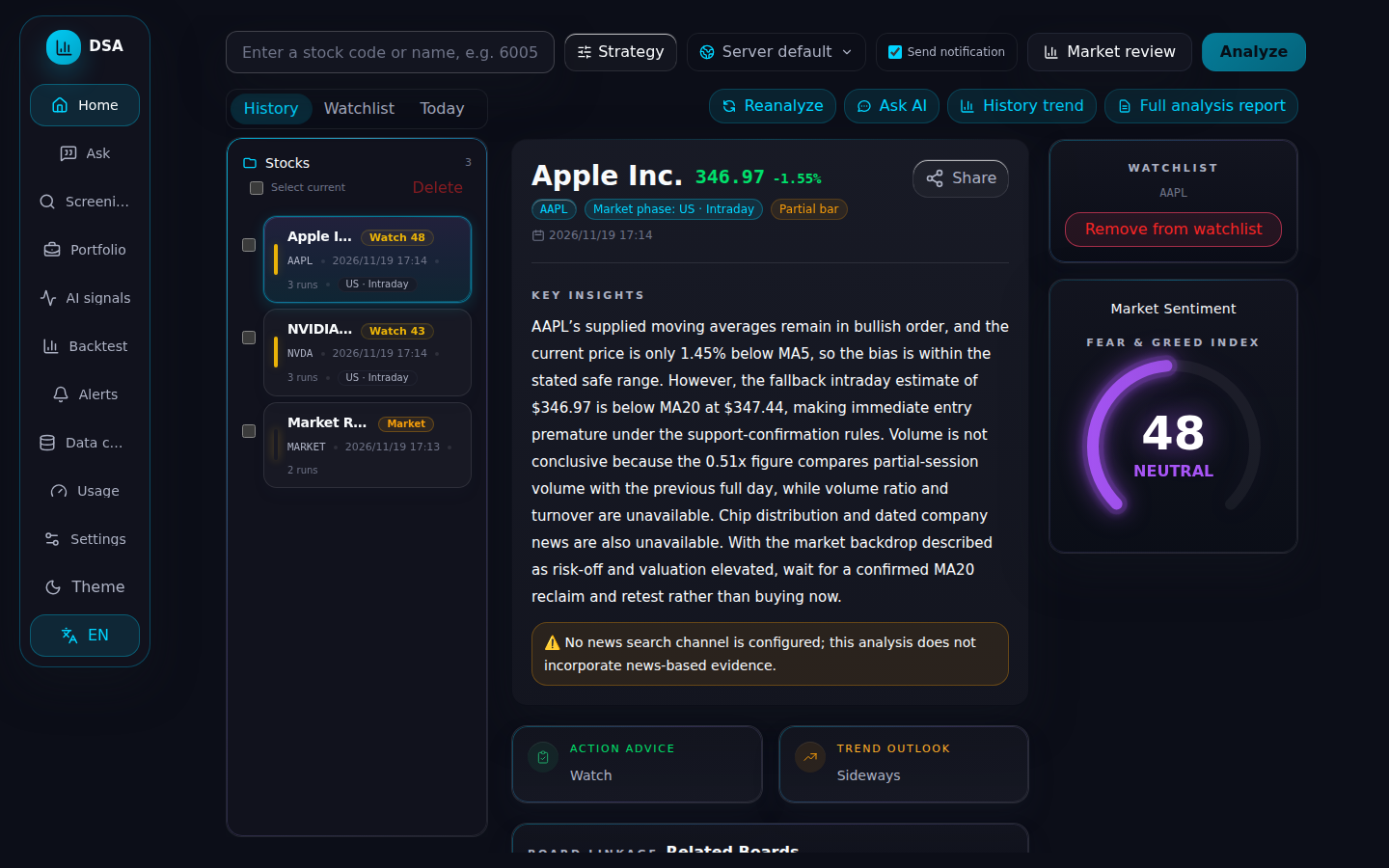
Open `https://my-daily-stock-analysis.exe.xyz/`. Setup already analyzed
Apple and NVIDIA, so **History** lists both, with the market review. Click
one for its dashboard: the verdict and score, the key points, buy, stop and
target levels, and the news it found.
The dashboard after the first run. The banner notes that no news search is configured yet.
To analyze another stock, type its code in the box at the top (`MSFT`,
`600519`, `hk00700`) and click **Analyze**. A report takes under a minute, and is emailed to
you too while **Send notification** is ticked.
**Full analysis report** opens the long version, and **Ask AI** starts a
chat about the stock with the report as context.
The interface is in English (switch with **EN** in the sidebar), and so are
the reports, because setup sets `REPORT_LANGUAGE=en`. The upstream docs are
mostly in Chinese; the [English README](https://github.com/ZhuLinsen/daily_stock_analysis/blob/main/docs/README_EN.md)
and [full guide](https://github.com/ZhuLinsen/daily_stock_analysis/blob/main/docs/full-guide_EN.md)
cover the settings.
## The daily run
At 17:00 New York time on every trading day, DSA analyzes your stock list,
writes a US market review, saves both to the history, and emails you the
report. Weekends and market holidays are skipped.
Everything is in **Settings**, which saves to `~/dsa/data/.env` and applies
without a restart (if you edit `.env` by hand instead, run
`docker compose restart` in `~/dsa`):
- **Base settings → Stock List**: the stocks to analyze, such as
`AAPL,NVDA,MSFT,600519,hk00700`.
- **System → Scheduled task**: the run times (add more than one), and
**Run once now** to run the whole list right away.
- **Notifications**: the email webhook setup made, and other channels.
The times are in the container's time zone, `America/New_York`. Following
the Chinese market instead? Change `TZ` in `~/dsa/compose.yaml` to
`Asia/Shanghai`, set the run time to after its close (the upstream default
is `18:00`), set **Market review region** to `cn`, and run
`docker compose up -d` in `~/dsa`.
## Settings worth knowing
The ones you'll change most, with their names in `.env`:
| Setting | What it does |
| --- | --- |
| `STOCK_LIST` | The stocks to analyze, comma-separated |
| `REPORT_LANGUAGE` | `en`, `zh` (the default) or `ko` |
| `REPORT_TYPE` | `simple` (the default), `full`, or `brief` |
| `SINGLE_STOCK_NOTIFY` | `true` sends one message per stock instead of one report |
| `MARKET_REVIEW_REGION` | `us`, `cn`, `hk`, `jp`, `kr`, `tw`, or `both` (China and US) |
| `SCHEDULE_TIME`, `SCHEDULE_TIMES` | One run time, or several, comma-separated |
| `LITELLM_MODEL` | The model that writes the reports |
## Models and cost
DSA reaches the gateway as an OpenAI-compatible channel named `exe`, with
the placeholder key the gateway ignores. Reports come from GPT-6 Luna, which
took under 40 seconds per stock in our test, at roughly $0.002 a report.
To use another model the gateway serves through OpenAI's API, add it to
**AI models → LLM_EXE_MODELS** and make it the main model, with the
`openai/` prefix: for example `openai/gpt-6.1-terra`. Claude isn't
available this way: the gateway offers it only through Anthropic's
Messages API.
## News and data sources
Prices and fundamentals come from free sources that need no keys. They can
be slow or rate-limited, and some data (chip distribution, for one) exists
only for A-shares; the report says what was missing.
News makes the reports noticeably better, and needs a search API key. DSA
supports [Tavily](https://tavily.com), [SerpAPI](https://serpapi.com),
[Brave Search](https://brave.com/search/api/) and others, under **Settings →
Data sources**; Tavily and Brave have free tiers. DSA calls those APIs
directly, so the key goes in `~/dsa/data/.env` on the VM rather than an
exe.dev integration. For A-shares, a [Tushare](https://tushare.pro) token
adds better data.
## Share it, or script it
The dashboard is private to you. To let someone in, on your computer:
```bash
ssh exe.dev share add my-daily-stock-analysis friend@example.com
```
They sign in with exe.dev and get everything you have, including
**Settings** and any API keys in it, so share it with people you'd hand
those to. DSA also has its own admin password (**Settings → System**); it
puts a second sign-in in front of the whole app and its API, which the
exe.dev login already covers.
Scripts can use DSA's API through exe.dev with a
[VM token](/docs/https-tokens-for-vms). On your computer:
```bash
ssh exe.dev ssh-key generate-api-key --vm=my-daily-stock-analysis --label=dsa-scripts
```
It prints a token starting with `exe1.`. Save it in a file only you can
read, such as `~/.dsa-token` with `chmod 600`, then start a run:
```bash
curl -X POST -H "X-Exedev-Authorization: Bearer $(cat ~/.dsa-token)" \
https://my-daily-stock-analysis.exe.xyz/api/v1/system/scheduler/run-now
```
It answers `{"accepted":true,"running":true}`, or 409 if a run is
already going. `GET /api/v1/system/scheduler/status` shows the last and
next runs, and the full API is listed at `/docs` on the VM.
## The nuts and bolts
Happy with Deploy? You can stop here. These are the steps Shelley follows,
and the upkeep for later.
Install by hand
### Create the VM
On your computer (pick another name if `my-daily-stock-analysis` is taken):
```bash
ssh exe.dev new --name=my-daily-stock-analysis
ssh my-daily-stock-analysis.exe.xyz
```
Everything else runs **on the VM** as `exedev`.
### Get Docker ready
Enable Docker at boot, or exe.dev's on-demand Docker won't bring DSA back
after a reboot, and pull the 3.35.0 image (about 600 MB):
```bash
sudo systemctl enable --now docker.service
docker pull zhulinsen/daily_stock_analysis:v3.35.0
```
### Write the settings
All of DSA's settings live in one file, which the web UI edits too. This
points it at the gateway, writes reports in English, and emails them to
the VM's owner through exe.dev's email gateway, using DSA's custom webhook
channel:
```bash
mkdir -p ~/dsa/data ~/dsa/logs ~/dsa/reports
cd ~/dsa
test -e data/.env || (umask 077; cat > data/.env <<'EOF'
STOCK_LIST=AAPL,NVDA
REPORT_LANGUAGE=en
MARKET_REVIEW_REGION=us
LLM_CHANNELS=exe
LLM_EXE_PROTOCOL=openai
LLM_EXE_BASE_URL=https://llm.int.exe.xyz/v1
LLM_EXE_API_KEY=exe-llm-integration
LLM_EXE_MODELS=gpt-6-luna,gpt-6.1-terra
LITELLM_MODEL=openai/gpt-6-luna
SCHEDULE_ENABLED=true
SCHEDULE_TIME=17:00
CUSTOM_WEBHOOK_URLS=http://169.254.169.254/gateway/email/send
CUSTOM_WEBHOOK_BODY_TEMPLATE={"to":"OWNER_EMAIL","subject":"Daily stock analysis","body":$content_json}
EOF
)
OWNER=$(curl -s https://reflection.int.exe.xyz/email | jq -r .email)
sed -i "s/OWNER_EMAIL/$OWNER/" data/.env
grep -E '^(STOCK_LIST|LITELLM_MODEL|CUSTOM_WEBHOOK_BODY)' data/.env
```
The last line shows your stock list, the model, and your email in the
webhook body. If the email is missing, put the VM owner's exe.dev address
in its place with `nano data/.env`.
### Start DSA
The container runs the web UI and API on port 8000, which the
[HTTPS proxy](/docs/proxy) serves at the VM's private URL, and the
scheduler with them. `TZ` sets the time zone of the run times:
```bash
cat > compose.yaml <<'EOF'
name: dsa
services:
dsa:
image: zhulinsen/daily_stock_analysis:v3.35.0
container_name: dsa
restart: unless-stopped
command: [python, main.py, --serve-only, --host, 0.0.0.0, --port, "8000"]
environment:
ENV_FILE: /app/data/.env
TZ: America/New_York
ports:
- "8000:8000"
volumes:
- ./data:/app/data
- ./logs:/app/logs
- ./reports:/app/reports
EOF
docker compose up -d
sleep 15
curl -s localhost:8000/api/health; echo
curl -s localhost:8000/api/v1/system/scheduler/status; echo
```
Health says `"status":"ok"`, and the scheduler says `"enabled":true` with
the next run at 17:00. The log warns that the web UI listens on all
addresses without a password; that's expected, because exe.dev's proxy
lets only you in.
### Run the first analysis
This runs the whole stock list and the market review once, the same as
the scheduled run, email included. It takes a minute or two:
```bash
curl -s -X POST localhost:8000/api/v1/system/scheduler/run-now; echo
until curl -s localhost:8000/api/v1/system/scheduler/status | grep -q '"running":false'; do sleep 10; done
ls reports
```
The first request answers `{"accepted":true,"running":true}`, and
`reports` then holds `report_.md` and `market_review_.md`.
Two emails titled "Daily stock analysis" arrive, the report and the
market review, as Markdown text, and the dashboard lists both stocks.
Back up and restore
### Back up
`~/dsa` holds everything: settings in `data/.env`, the history database
`data/stock_analysis.db`, and the Markdown reports. Stop DSA briefly for a
consistent copy, on the VM:
```bash
cd ~/dsa && docker compose stop
(umask 077; tar czf ~/dsa-backup-$(date +%F).tgz -C ~ dsa/compose.yaml dsa/data dsa/reports)
docker compose start
```
Then fetch it on your computer, and keep it private, since `.env` holds
any API keys you added:
```bash
scp 'my-daily-stock-analysis.exe.xyz:dsa-backup-*.tgz' .
```
### Restore
Copy a backup to the VM's home directory (`scp` the other way), then on
the VM:
```bash
cd ~/dsa && docker compose down
cd ~ && tar xzf dsa-backup-YYYY-MM-DD.tgz
cd ~/dsa && docker compose up -d
```
The history is back on the dashboard.
Update
DSA releases often; see its [releases](https://github.com/ZhuLinsen/daily_stock_analysis/releases).
Back up first, then set the new tag in `compose.yaml` and restart, on the
VM:
```bash
cd ~/dsa
sed -i 's/:v3.35.0/:v3.36.0/' compose.yaml
docker compose pull && docker compose up -d
docker image prune -f
```
The database migrates itself on start.
Troubleshooting
**No email.** In **Settings → Notifications**, pick **Custom Webhook**
under **Notification test** and click **Send test**: it shows the HTTP
status from exe.dev's email gateway. Check the address in
`CUSTOM_WEBHOOK_BODY_TEMPLATE`; the gateway sends only to the VM's owner
and the people it's shared with.
**A run is skipped.** Scheduled runs, and **Run once now**, leave out
stocks whose market is closed that day, and do nothing on a day every
market in the list is closed. **Analyze** works any day. To turn the check
off, set `TRADING_DAY_CHECK_ENABLED=false` in `.env`.
**Missing prices or data.** The free sources sometimes fail or rate-limit;
the log names each source it tried. Run again later, or add a keyed
source under **Data sources**.
**Settings shows "worker did not exit" after a run.** In our tests this
appeared after runs that had finished and sent their report. If the
report is in the history, it's harmless.
**Two analyses at once.** Don't run `python main.py` with other flags
inside the container to analyze a stock: with the schedule on, it starts a
second scheduler. Use **Analyze**, **Run once now**, or the API, and
`docker compose restart` if you already did.
**Forgot the admin password.** On the VM:
`cd ~/dsa && docker compose exec -u dsa dsa python -m src.auth reset_password`.
**Anything else.** `docker compose logs -f dsa` in `~/dsa`, or the daily
logs in `~/dsa/logs`. They're mostly in Chinese; scheduled runs log little
there, so the history and the report files are the surer record.
## Frequently asked questions
### Is this investment advice? Does it trade for me?
No and no. The project says its reports are for information and learning only, and it never places orders. A language model writes each report from free market data that can be late or incomplete, and two runs on the same day can disagree. Treat a "Buy" as a prompt to do your own research.
### Why not fork it and run it on GitHub Actions, as the README says?
That works, and it's free for public forks. On a VM you also get the web dashboard, the history of every report, chat about a stock, and backtests, which an Actions run throws away; you edit settings in a browser instead of repository secrets; and there are no model API keys to manage, because the gateway is built in.
### How much does it cost?
The software is free (MIT). You pay for your [VM plan](https://exe.dev/pricing), and the reports use your exe.dev [LLM allocation](/docs/integrations-llm): each stock is one model call, and a call the size of a report cost about $0.002 with GPT-6 Luna in our test. Bigger models cost more.
### Which markets does it cover?
Chinese A-shares, Hong Kong, the US, Japan, Korea and Taiwan, plus ETFs, from free sources (AkShare, Baostock, Yahoo Finance) by default. Use codes like `600519`, `hk00700`, `AAPL`, `7203.T`, `005930.KS` and `2330.TW`.
### Can it push to Telegram?
Yes: daily_stock_analysis has its own Telegram, Discord, Slack, ntfy and other channels under **Settings → Notifications**. Its Telegram sender talks to Telegram directly with a bot token, so the token is stored in `~/dsa/data/.env` on the VM; exe.dev's [Telegram integration](/deploy/telegram-bot) can't stand in for it.
### How is it different from TradingAgents?
daily_stock_analysis gives one model one stock at a time and builds a dashboard, history and notifications around the results. [TradingAgents](/deploy/tradingagents) has a team of agents debate each ticker, which is slower and costs more per stock. Both run well on an always-on VM.
## Related
- [Self-host TradingAgents](https://exe.dev/deploy/tradingagents.md): Multi-agent stock research every evening, by email. No API keys.
- [Self-host Open WebUI](https://exe.dev/deploy/open-webui.md): A private ChatGPT for you and your team. No API keys.
- [Host a Telegram bot](https://exe.dev/deploy/telegram-bot.md): An AI Telegram bot that runs all the time. The bot token stays with exe.dev.
- [Deploy a Docker Compose app from GitHub](https://exe.dev/deploy/docker-compose.md): Your compose.yaml on a VM of its own. git push to deploy.
- [Give agents API access without giving them the keys](https://exe.dev/deploy/agent-secrets.md): Your agents call your APIs. The keys stay with exe.dev, outside the VM.
- [Self-host DeepTutor](https://exe.dev/deploy/deeptutor.md): An AI tutor that quizzes you on your own notes. No API keys.